Have you ever worked tirelessly toward a goal—only to find that just when you are about to achieve it, someone tries to pull you down?
A colleague questions your credibility.
A competitor spreads subtle negativity.
A friend grows distant when you begin to shine.
Or worse—you feel restless when someone else succeeds.
Why does success sometimes attract jealousy?
Why does ego rise even in spiritual spaces?
And how should a truly wise person respond when rivalry threatens to destroy peace?
In the sacred dialogue between Viduraji and Rishi Maitreya, this very dilemma unfolds through the powerful story of King Prithu and the stolen sacrificial horse.
King Prithu was righteous, devoted, and divinely empowered. Yet even he faced jealousy from Indra—the King of Heaven himself. What followed was not merely a historical event, but a profound psychological and spiritual revelation about ego, false righteousness, forgiveness, and the path of true devotion.
This story from the Shree Bhagavata Purana is more relevant today than ever.
Because today, our “sacrificial horse” may be:
- A career milestone
- A social media achievement
- A leadership role
- A spiritual identity
- Or even the desire to prove we are right
Through King Prithu’s journey—from rivalry to realization, from anger to surrender—we discover how to respond to jealousy, how to protect Dharma in our own lives, and how true success lies not in winning against others, but in conquering the ego within.
If you have ever struggled with comparison, validation, competition, or inner unrest—this story holds answers.
And not just answers.
Transformation.
King Prithu and the Stolen Horse: From Rivalry to Realization
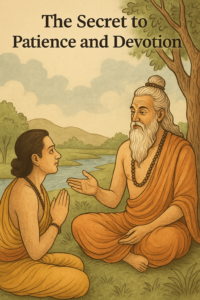
In the sacred dialogue between Vidura and Maitreya, a profound question arose—one that pierces through the layers of power, jealousy, ego, and ultimate surrender.
Vidur Ji asked with deep curiosity:
“If King Prithu was righteous, divinely empowered, and devoted to the Lord—why did Devraj Indra steal his sacrificial horse? Why would the King of Heaven obstruct such a sacred act?”
The answer that followed was not merely history—it was a mirror to the human heart.
The Sacred Yajna at Brahmavarta
In the holy land of Brahmavarta, where the river Saraswati flowed eastward with serene dignity, King Prithu performed a grand Ashvamedha Yajna. This was no ordinary ritual—it was a cosmic alignment of Dharma, devotion, and divine grace.
The Supreme Lord Himself appeared in the form of Yagyeshwar—the Lord of Sacrifice. Alongside Him came Brahma, Rudra, the Lokpals, Gandharvas, sages, Siddhas, Apsaras, and exalted Yogeshwars like Kapil, Narada, Dattatreya, and the Sanat Kumars.
The Earth, once oppressed during King Vena’s tyrannical reign, now appeared as Kamdhenu—the wish-fulfilling cow—offering all ingredients required for the sacrifice.
King Prithu saw only one Master—Shri Hari.
His heart was not intoxicated by power. It was surrendered in devotion.
And because of that devotion, the glory of his sacrifice grew so luminous that even the heavens trembled.
But not all hearts celebrate another’s rise.
Indra’s Jealousy: When Ego Dresses as Religion
While King Prithu stood immersed in the sacred intensity of his final ritual, offering oblations to the Lord of Sacrifice with unwavering devotion, a storm of jealousy was rising in the heavens. Indra, unable to bear the growing glory of the righteous king, descended silently and stole the consecrated sacrificial horse.
But Indra did not appear as a warrior.
He cloaked himself in deception.
Wearing matted locks upon his head, smearing sacred ash across his body, and donning the garb of a renunciate, he disguised himself in what later came to be known as Pakhand Vesh—the armor of hypocrisy. Carrying the stolen horse, he fled swiftly across the sky.
From afar, the watchful eyes of Rishi Atri perceived the theft. The sage immediately commanded King Prithu’s valiant son to pursue the offender.
With righteous fury blazing in his heart, the prince rushed forward, his bow drawn, his voice thundering through the heavens:
“Stop where you are!”
Yet as he took aim, he paused.
Before him stood a figure that resembled the very embodiment of Dharma—an ascetic with matted hair and ash-covered limbs. Confusion clouded the prince’s mind. How could he release an arrow upon one who appeared to be holy? Doubt restrained his hand, and he returned without striking.
Seeing this hesitation, Sage Atri spoke again with firm clarity:
“Though he wears the garb of renunciation, he is none other than Indra. Do not be deceived by appearances. He has obstructed your father’s sacred vow. Act!”
Thus urged, the prince soared once more into pursuit, his resolve hardened. He chased Indra through the sky just as Jatayu once chased Ravana in desperate defense of righteousness. Seeing the prince close behind, Indra abandoned both the disguise and the horse and vanished from sight. The prince returned triumphantly to the sacrificial arena, and the sages, witnessing his courage, named him Vijitashva—the conqueror of the horse.
But jealousy does not surrender easily.
Indra, powerful and cunning, once again enveloped the skies in thick darkness. Hidden within that veil, he stole the horse a second time—this time along with its golden chains. Once more Sage Atri discerned the deception and directed the prince to pursue.
Now Indra appeared in yet another false form—holding a skull in his hand, wearing a tiger skin, presenting himself as a fearsome ascetic. Again the prince faltered at the sight of what seemed sacred. Again the sage reminded him: “Do not mistake disguise for truth.”
Filled with blazing determination, Vijitashva drew his arrow. And once more, before the strike could fall, Indra discarded the false garb and disappeared, leaving the horse behind. The prince brought it back to his father’s hall, victorious yet thoughtful.
The many deceptive forms that Indra assumed became known as Pakhand—hypocritical paths born from fragments of sin and insecurity. They mimicked the outer symbols of spirituality but lacked its inner purity. Over time, people began to cling to these counterfeit practices, mistaking appearance for essence, ritual for realization, costume for consciousness.
And thus, through jealousy, illusion gave birth to falsehood—reminding humanity for all ages that true Dharma is not in the robe, the ash, or the symbol… but in the purity of intention and the surrender of the heart.
Prithu’s Anger: When Even the Righteous Can Burn
When news of Indra’s repeated deception reached King Prithu, a fierce fire blazed within him. The mighty monarch, whose arms had subdued the Earth herself for the sake of Dharma, could no longer tolerate such obstruction. His eyes reddened with righteous anger. Lifting his celestial bow, he fixed an arrow upon the string, determined to end the rivalry with a single strike.
At that critical moment, the learned priests surrounding the sacrificial arena intervened.
“O King,” they pleaded with folded hands, “you are wisdom embodied. Once a ruler accepts Diksha for a sacred sacrifice, he is bound by its discipline. During such consecration, no life may be taken except that which is ritually ordained. To slay Indra now would violate the very sanctity you seek to protect. Moreover, your enemy is already weakened—consumed by jealousy of your growing glory. Leave this to us. Through the power of sacred mantras, we shall summon him here and, by Vedic authority, offer him into the sacrificial fire.”
Their words were sharp with indignation. Consulting the King, the priests began chanting potent incantations, invoking Indra with the intention of dragging him into the flames of the yajna itself.
But just as the atmosphere thickened with fiery resolve, a divine radiance descended upon the arena.
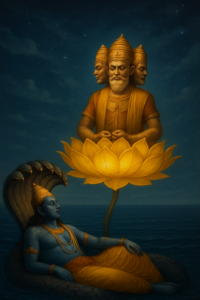
It was Brahma, the grandsire of the worlds.
With serene authority, Brahmaji halted the ritual.
“Stop,” he commanded, his voice steady yet compassionate. “You must not kill Indra. He who has performed a hundred sacrifices is not separate from the divine order. The very deities you worship in this yajna are expansions of his cosmic function. Would you destroy, through sacrifice, the one in whose name sacrifice is sanctified?”
The assembly fell silent.
Brahma continued, revealing a deeper concern:
“The deceptive paths Indra has assumed—these Pakhand forms—are seeds of future confusion. If you escalate this rivalry, he will create even more such misleading practices. Let this contest end here. O King, be satisfied with ninety-nine sacrifices.”
Then turning directly toward King Prithu, Brahmaji’s gaze softened.
“O noble ruler, you are a knower of the path of Moksha. You do not need the validation of ritual completion. Both you and Indra arise from the same Supreme Source, manifestations of Lord Hari’s divine body. To harbor anger toward him is to war against your own higher self.
When a man attempts to force destiny to bend according to his personal will, anger clouds his intellect. Delusion follows. And Dharma quietly erodes.”
Brahmaji’s words cut through the King’s fury like cooling rain upon burning earth.
“You took birth from the body of King Vena for a sacred purpose—to restore Dharma when it was collapsing. Remember that vow. The great sages, like Bhrigu, entrusted you with the protection of righteousness, not with the pursuit of rivalry. These hypocritical paths born of jealousy are already misleading common people, who are drawn toward what merely appears spiritual. End this conflict, and you will uproot the very mother of irreligion.”
The battlefield of arrows became a battlefield of conscience.
In that moment, King Prithu faced a greater test than defeating Indra.
He had to conquer himself.
Slowly, deliberately, the great king lowered his bow. The fire of anger subsided into the light of discernment. Choosing Dharma over pride, purpose over prestige, he relinquished his insistence on completing the hundredth sacrifice.
Through the counsel of Brahmaji, the Guru of the worlds, King Prithu made peace with Indra—not out of weakness, but out of awakened wisdom.
And in that surrender, he achieved a victory far greater than any ritual could bestow.
The Appearance of Lord Vishnu: The Turning Point
After renouncing his claim to the hundredth sacrifice, King Prithu completed the sacred rites with dignity and restraint. Having concluded the yajna, he performed the ceremonial bath that marks the fulfillment of a great vow. The sacred waters washed not only his body, but also the last traces of rivalry from his heart.
The assembled deities, satisfied with the offerings and the spirit in which they had been made, bestowed their blessings upon him. The atmosphere was no longer charged with tension—it shimmered with harmony.
True to his noble character, King Prithu distributed generous gifts to the Brahmins—gold, cows, garments, ornaments—offered not with pride, but with gratitude. The Brahmins, moved by his humility and reverence, blessed him with words that carried the power of truth. Their blessings were not merely formal—they were luminous seeds of destiny.
And then, in a moment that sanctified the entire arena, the Supreme Lord Himself appeared.
Accompanied by Indra, the radiant form of Vishnu illuminated the sacrificial grounds. All present bowed in awe.
The Lord spoke with compassion:
“O King, Indra—who hindered your vow to complete the hundredth sacrifice—stands before you seeking forgiveness. I ask that you forgive him.
Those who possess true wisdom do not harbor hatred toward any being, for they understand that the body is not the Self. If even one as elevated as you become momentarily touched by My Maya, it shows how subtle illusion can be. Merely serving the wise externally is not enough—real knowledge must awaken within.”
His words were both gentle and profound.
“A wise person sees this body as a temporary instrument—shaped by past actions, driven by desires, subject to ignorance. Why then should he become attached to it? And if one is not attached to the body, how can he cling to notions of ‘mine’ and ‘yours’ regarding home, wealth, or family?”
Then the Lord revealed the eternal truth of the Self:
The soul is pure and self-luminous—it shines by its own light.
It is nirguna—beyond the three qualities of material nature.
It is all-pervading—the silent witness within all beings.
It is utterly distinct from the physical body.
“One who realizes this truth,” the Lord continued, “remains untouched by worldly fluctuations, even while living amidst them. Because his consciousness rests in Me—the Supreme Soul—he is not shaken by success or disturbed by loss.
Rule this Earth according to the sacred traditions of your ancestors. Heed the counsel of the Brahmins. Govern without attachment, and you shall be loved by all. In due time, you will attain the highest spiritual perfection—even while living at home.
Your forgiveness has won My heart. Know this well: I am not easily attained by austerity or Yoga if forgiveness is absent. I dwell only in the hearts of those who maintain equanimity—Samta—toward all beings.
Now ask of Me any boon you desire.”
Sage Maitreya then said to Viduraji:
“O Vidur, hearing these divine words from the Universal Guru, Shri Hari, King Prithu bowed his head in complete surrender. His heart was no longer touched by pride or rivalry—it was softened by realization.”
Indra, overwhelmed with remorse, stepped forward. His crown seemed heavy with shame. He moved to fall at Prithu’s feet in repentance.
But before he could bow, King Prithu embraced him.
In that embrace, jealousy dissolved. In that embrace, forgiveness triumphed over ego.
Having released every trace of resentment, the King turned again toward the Lord.
Overcome by devotion, he approached the Supreme Master of the universe—the eternal friend of His devotees. Falling at His lotus feet, Prithu clasped them tightly, as though anchoring his very soul to divine grace.
Tears welled in his eyes—not of sorrow, but of awakening.
Wiping them gently, he gazed steadily upon the Lord’s radiant form. His voice trembled—not from weakness, but from love.
And then, with a heart overflowing, King Prithu began to speak…
The Prayer of King Prithu: The Height of Devotion
Overwhelmed with devotion, King Prithu folded his hands, his voice trembling with love rather than desire. Looking upon the radiant form of Vishnu, he spoke words that revealed the true height of Bhakti.
“O Lord,” he began softly, “what wise person would ask You for fleeting pleasures—pleasures that are available even to those suffering in lower realms? How insignificant are such desires before Your divine presence. I do not seek wealth, power, or even heavenly delights.
Nor do I crave that liberation which separates one from the nectar of hearing Your glories. What value is Moksha if it deprives the soul of the sweet honey that flows from Your lotus feet through the lips of realized saints? Of what use is a state where Your divine name is not sung, where Your stories are not heard, where the heart does not melt in remembrance?”
His eyes shone with tears of surrender.
“My only prayer is this: grant me countless ears—ten thousand, if You will—so that I may endlessly drink the nectar of Your virtues. For once a person has tasted even a single drop of Your auspicious glories in the company of saints, how could he ever turn away? Only one whose intellect is dulled by ignorance could abandon such divine joy.
Even Lakshmiji, the supreme goddess whom all beings seek for prosperity and fortune, longs to hear Your praises. Following her example, I too desire nothing but loving service to You, O Supreme Purushottam, the eternal abode of all virtues.”
The assembly fell silent.
There was no request for kingdoms.
No plea for immortality.
No hunger for recognition.
Only love.
Sage Maitreya then said to Viduraji:
“O Vidur, hearing such pure devotion, the Lord was deeply pleased. For devotion free from personal ambition is rare even among the gods.”
Then the Lord Himself spoke, His voice gentle yet filled with eternal authority:
“O King, blessed indeed are you. Your heart is firmly anchored in Me, and such devotion is the greatest fortune. One whose mind is absorbed in My remembrance easily crosses the ocean of My Maya—an illusion otherwise nearly impossible to overcome.
Continue to follow My guidance with sincerity and diligence. He who aligns his will with Mine finds auspiciousness in every circumstance—whether in gain or loss, praise or blame.”
The Lord’s words were not merely blessings; they were affirmation. Prithu had passed the final test—not of ritual, but of realization.
In that sacred moment, the Lord honored the King’s prayer—not by granting material boons, but by strengthening his devotion.
After completing his final worship with profound reverence, King Prithu stood silently as divine grace filled the atmosphere. The Lord, having showered His compassion upon His devotee, prepared to depart.
With folded hands and bowed head, Prithu offered his final obeisance to the unseen Lord of Lords—the One beyond form yet present in every heart.
And then, transformed by devotion, illumined by wisdom, and softened by surrender, King Prithu returned to his capital—not merely as a sovereign ruler, but as a realized soul whose greatest wealth was love for the Divine.
Closing Reflection
In a world obsessed with competition, metrics, titles, and external validation, we are constantly chasing our own version of the “hundredth sacrifice.”
We compare.
We compete.
We measure our worth through numbers.
And when someone obstructs us, jealousy—either ours or theirs—ignites conflict.
But the story of King Prithu reveals something revolutionary:
The real battle is not outside.
It is within.
When Prithu lowered his bow, he did not lose prestige—he gained peace. When he embraced Indra instead of destroying him, he did not become weak—he became wise. When he prayed not for wealth or liberation but for devotion, he stepped into spiritual immortality.
In today’s world—where anxiety, burnout, resentment, and comparison silently consume millions—this ancient story offers psychological clarity and spiritual grounding.
It teaches us:
- We do not need to complete every “hundredth sacrifice” to be worthy.
- We do not need to prove yourself to be powerful.
- We do not need to defeat others to succeed.
We need only to align with your purpose, release ego, and anchor your heart in higher truth.
Stories like this are not escapes from reality. They are blueprints for living wisely in reality.
They answer modern problems—comparison culture, identity crisis, toxic competition, spiritual confusion—by reminding us of eternal principles:
Forgiveness heals.
Detachment liberates.
Devotion stabilizes.
Self-awareness empowers.
If this story stirred something within you, it means you already carry the wisdom of Prithu in your heart.
May we conquer your inner Indra.
May we lower your bow when anger rises.
May we choose surrender over superiority.
And may we discover that the greatest success in life is not being celebrated by the world—
But being at peace within yourself.
“True victory is not defeating our rival—it is dissolving our ego.”