Have you ever wondered why, despite having more technology, more resources, and more knowledge than any generation before us, we still feel a constant sense of lack—lack of peace, lack of fulfillment, lack of stability?
Why does abundance exist all around us, yet scarcity dominates our minds, relationships, and even our planet?
In today’s world, we extract relentlessly— from nature, from people, from ourselves—yet remain dissatisfied. Burnout replaces contentment. Exploitation replaces gratitude. And slowly, the Earth itself seems to withdraw, responding with imbalance, climate crises, and exhaustion.
Thousands of years ago, the Bhagavat Purana narrated a story that answers this very dilemma—the story of King Prithu, where the Earth herself transforms into a cow and teaches humanity the sacred art of receiving.
This is not merely a mythological tale; it is a psychological, ecological, and spiritual manual for modern life.
This story asks a piercing question:
Do we deserve abundance simply because we demand it—or because we know how to receive it with responsibility, humility, and dharma?
Once you enter this story, you may realize—it is not about the Earth alone.
It is about us.
In an age when sages conversed not merely to exchange knowledge but to awaken souls, Vidura, the ever-seeking pilgrim of truth, sat before Rishi Maitreya with a question that still echoes in the conscience of humanity.
Vidura asked, not out of idle curiosity, but from a place of deep spiritual wonder:
“The Earth can take many forms—why did she specifically assume the form of a cow? The Earth was once naturally uneven; how did King Prithu make her level and habitable? And it is said that the Supreme Lord Himself descended as King Prithu. O revered sage, please narrate all the sacred events of this divine Prithu incarnation of Lord Hari.”
Maitreya Rishi smiled gently. He knew this was not merely a historical question—it was a doorway to timeless wisdom, a lesson for kings and commoners alike, for ancient times and modern ages.
A Kingdom Starving, A King Awakened
Rishi Maitreya began:
After the Brahmins consecrated King Prithu, son of Vena, as the rightful ruler and protector of the people, an unimaginable calamity struck the land. The Earth became barren. Grain vanished. Medicinal herbs disappeared. Hunger gnawed at the very bones of humanity.
Men and women, once strong and hopeful, were reduced to walking skeletons. Their bodies burned from within, as if a hidden fire raged endlessly in their stomachs.
They approached King Prithu, their eyes hollow but their faith still alive.
“O King,” they cried,
“Just as a tree is consumed by a fire hidden within its hollow, we are being destroyed by hunger. You are our guardian, our provider, the very master of our livelihood. We have come seeking your refuge. Please arrange food for us immediately—otherwise, we shall perish before even seeing a grain of nourishment.”
Prithu listened in silence.
A true king does not react impulsively. He contemplates. He carries the suffering of his people within his own heart.
Through deep reflection, Prithu realized the cause of this devastation—the Earth herself had concealed the seeds and medicinal herbs within her womb.
The Wrath of Dharma
Realizing this, King Prithu lifted his mighty bow.
His form blazed with righteous fury. He looked like Lord Shiva during the destruction of Tripura—unyielding, unstoppable, terrifying in divine purpose.
Seeing this, the Earth trembled.
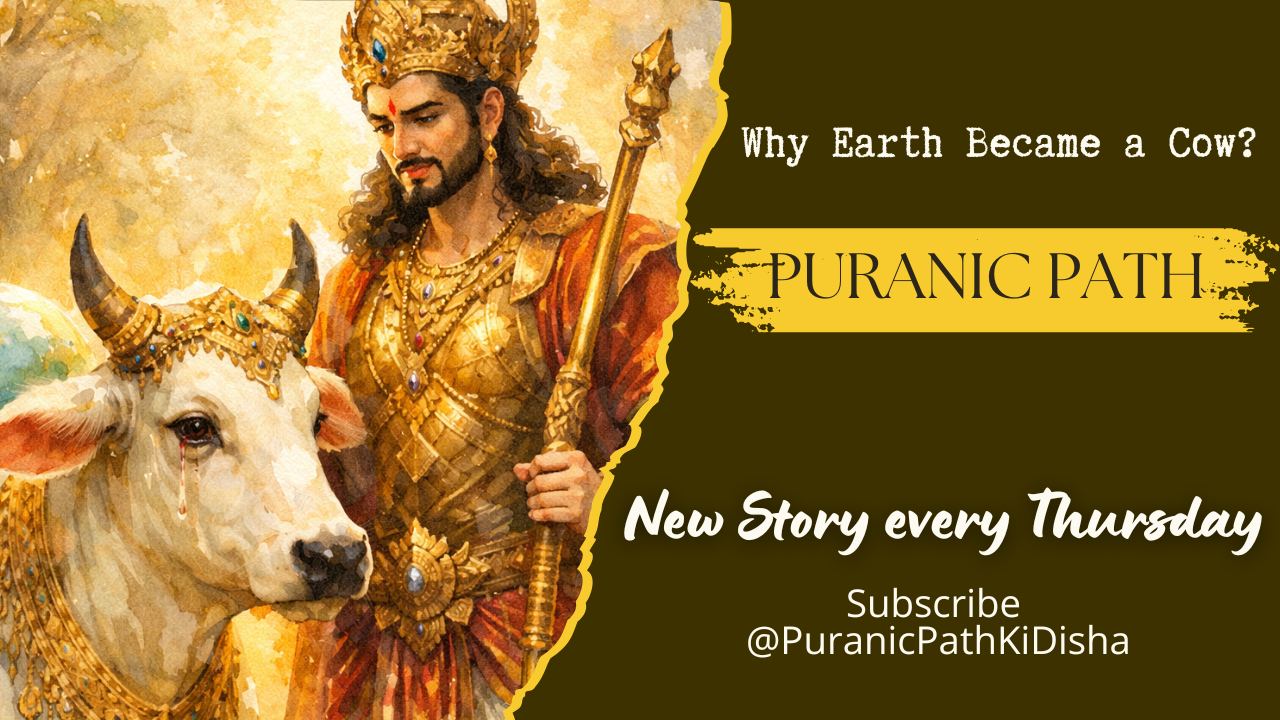
She assumed the form of a cow and fled, just as a frightened doe runs from a relentless hunter. Across the heavens, across the earth, through the intermediate realms—wherever she ran, King Prithu followed, arrow fixed, eyes blazing.
There was no refuge.
Just as no one can escape Time, the Earth found no savior from the determined son of Vena.
Finally, exhausted and overwhelmed, she turned back. With tears flowing and fear trembling through her form, she spoke.
The Earth Speaks: A Cry of Dharma
“O King,” she pleaded,
“You are righteous and compassionate toward those who seek refuge. You are the protector of all living beings—then please protect me as well.
I am innocent and distressed. Why do you wish to kill me? How can you commit the sin of harming a woman? Even ordinary men do not raise a hand against a woman, even when she errs. How then can you, who are known for mercy toward the afflicted, do this?
I am the boat upon which the entire world rests. If you destroy me, how will you and your subjects remain afloat in existence?”
Prithu’s Terrible Truth
Upon hearing her plea, King Prithu spoke with a voice heavy with the weight of Dharma:
“O Earth, you have defied my command. You willingly accept your portion of sacrificial offerings as a divine being, yet you deny the people their rightful sustenance. Such conduct cannot be excused. To punish wrongdoing is not cruelty for a king—it is his sacred duty.
You have acted without wisdom or compassion. Long ago, the seeds created by Lord Brahma were entrusted to you, yet you have concealed them within your womb and now refuse to release them, disregarding both your responsibility and my authority.
Know this well: whether one is a man, a woman, or of any other form—if a being lives only for their own nourishment, turns cold to the suffering of others, and becomes hostile to life itself, then to punish such a being is not violence; it is the preservation of righteousness.
By illusion, you have assumed the form of a cow today. But if necessary, I shall pierce you with my arrows and, through my own yogic power, sustain my starving subjects.”
As these words thundered forth, King Prithu stood blazing with uncompromising resolve—no longer merely a ruler of men, but the very embodiment of Time itself, inexorable and fearsome, before whom none could stand untouched.
Surrender of the Earth: The Turning Point
Hearing these thunderous words, the Earth began to tremble violently. Overwhelmed with fear and reverence, she folded her hands and spoke with profound humility:
“O Lord,” she said, her voice quivering, “you are the Supreme Reality itself, manifesting in countless forms through your divine Māyā. In your true nature, you are ever established in self-realization—untouched by the ego of body and senses, free from attachment and aversion. I bow to you again and again.
When you yourself stand before me, weapons raised, where else can I seek refuge? Who in all the worlds can protect me if you choose to strike? And yet, how can you wish to destroy me, who am the very foundation upon which Dharma itself stands?”
Having spoken these words of surrender, the Earth gathered her mind inward with deep contemplation. Then, still fearful yet earnest, she continued:
“O Lord, please restrain your anger and listen to my prayer. O King, I witnessed how unrighteous men—those who had abandoned their vows and discipline—began to consume the herbs without restraint. Kings ceased to protect me and no longer honored their sacred duty. As a result, people turned into thieves, taking without reverence or responsibility.
To preserve the sanctity of Yagya and the cosmic order, I concealed the medicinal herbs and grains within myself. Much time has now passed, and those seeds may have decayed within my womb. Yet they can still be drawn forth by the methods taught by the ancient sages.
If you desire nourishment to fulfill the needs and strengthen the bodies of all living beings, then please arrange for a suitable calf, a milker, and a proper vessel. Out of affection for that calf, I shall yield everything to you in the form of milk. And I humbly request one more boon—please ensure that the waters poured by Indra upon me during the rains are retained even after the monsoon, so that my inner vitality does not dry up. This, O King, will surely bring great auspiciousness to your reign.”
Thus spoke the Earth—no longer in defiance, but in surrender—revealing that abundance does not flow through force alone, but through harmony between power, responsibility, and reverence.
The Sacred Milking of the Earth
King Prithu accepted her words.
He made Swayambhuva Manu the calf and milked all grains into his own hands.
Inspired by this divine act, all beings followed, each according to their nature:
- The sages made Brihaspati the calf and milked the sacred Vedas into the vessel of the senses.
- The devas made Indra the calf and drew nectar, strength, and vitality into golden vessels.
- The asuras made Prahlad the calf and milked intoxicants into iron pots.
- Gandharvas and Apsaras made Vishvavasu the calf and drew music and beauty.
- The Pitṛs made Aryama the calf and milked offerings for ancestors.
- The Siddhas made Kapila Muni the calf and milked mystical powers.
- Yakshas and Rakshasas made Bhutnath the calf and drew blood and intoxicants.
Thus, the Earth gave to all—exactly according to their consciousness.
From Fear to Fatherhood: Birth of Prithvi
Rishi Maitreya said Vidur Ji, when all beings had thus drawn their respective essences from the Earth according to their nature and need, King Prithu’s heart overflowed with gratitude and joy. Beholding the Earth—now revealed as the true granter of all desires—his earlier wrath dissolved completely. In its place arose a deep, tender, fatherly affection. Accepting her as his own daughter, King Prithu bestowed upon her the name Prithvi, and from that moment she came to be known as the daughter of Prithu, cherished and protected, not feared or conquered.
Thereafter, with the gentle authority of a caring father, King Prithu turned his attention to the well-being of his subjects. Using only the tip of his bow, he broke down the rugged mountains, evened out the uneven lands, and transformed the face of the Earth. What was once wild and unstructured became balanced and habitable. His actions were not acts of domination, but expressions of responsibility—shaping the land so that life upon it could flourish in harmony.
Upon this leveled Earth, King Prithu established the foundations of civilization. He organized villages, towns, and cities; built fortresses and military camps; created settlements for cowherds (Ahirpalis), pens for cattle, agricultural villages, mines, and dwellings at the foothills of mountains. Each settlement had purpose, order, and balance, reflecting a vision where human life moved in rhythm with nature rather than against it.
Before the reign of King Prithu, no such system existed. People lived wherever they wished, without structure or collective harmony. It was Prithu who first transformed scattered existence into organized society, guided by Dharma and care for all beings.
Rishi Maitreya then concluded, “Vidur Ji, this is the sacred reason the Earth assumed the form of Mother Cow—to teach that when ruled with righteousness, humility, and responsibility, she yields abundance; and when honored as a living mother rather than exploited as an object, she becomes the nourisher of all worlds.”
The Closing Thought
The story of Prithu Avatar quietly dismantles one of the biggest illusions of modern life—the belief that force, entitlement, and unchecked desire can create prosperity.
King Prithu teaches us something radically relevant today:
When leadership becomes self-centered, nature retreats.
When consumption loses conscience, abundance hides.
And when power forgets responsibility, suffering multiplies.
The Earth became a cow not because she was weak, but because only a nurturing mother can teach humanity how to receive without destroying.
In our times, we are all Prithu in some way—parents, leaders, professionals, consumers, citizens. The question is not whether we will take from life, but how. Will we extract endlessly, or will we learn to receive with gratitude and restraint? Will we dominate, or will we protect?
This ancient story answers today’s deepest anxieties—about climate change, burnout, broken systems, and inner emptiness—by reminding us of a timeless truth:
Life gives abundantly when approached with humility, responsibility, and surrender—not entitlement.
When we stop treating the world as a resource and start honoring it as a living presence,
the Earth responds.
The mind calms.
And life, once again, begins to nourish us.
That is the silent promise of this story—change the way you receive, and life itself will change.
“Abundance does not disappear when resources end—it disappears when reverence ends.”