Episode 2 of 3: When the City of the Body Begins to Fall
Have you ever felt it?
That subtle shift.
The energy isn’t the same.
The body doesn’t respond the way it used to.
Relationships begin to change.
Children grow distant.
Respect feels conditional.
Success feels fragile.
You build a life for decades — career, family, name, achievements — and then slowly, quietly… something begins to slip.
Days turn into years.
Nights steal your strength.
Anxiety replaces confidence.
Fear enters silently.
In today’s world, we talk about anti-aging, biohacking, career reinvention, mental health, identity crisis, retirement anxiety, midlife transitions.
But thousands of years ago, an ancient allegory already mapped this entire psychological journey.
The story of Raja Puranjan is not mythology — it is a profound spiritual blueprint of:
- The human body as a “Nine-Gated City”
- The assault of Time (days and nights)
- The arrival of Old Age (Jara)
- The alliance of Fear and Disease
- The collapse of ego and identity
- The karmic consequences of unconscious living
- Rebirth shaped by final thoughts
- And finally — the awakening to the Eternal Friend within
This is Episode 2 of 3.
If Episode 1 was about attachment, Episode 2 is about confrontation.
This is the moment when Time besieges the body.
When illusions begin to crack.
When identity trembles.
When death becomes real.
When the forgotten Self calls us back.
And the most powerful question arises:
Are we prepared for the siege of Time?
Because whether we acknowledge it or not —
Chandavega (days and nights) is already marching.
And somewhere within us, Avigyata — the Unknown Friend — is waiting to be remembered.
🌿 A Reminder Before We Continue
This is Episode 2 of the three-part series on Raja Puranjan’s allegory.
If you have journeyed with us through Episode 1, you already know:
This is not merely the story of a king.
It is the journey of an agyani jeev (ignorant soul) — searching, attaching, forgetting, suffering.
In the final episode, every symbol will be fully decoded.
But even now, the veil is slowly lifting.
Remember:
- The Nine-Gated City
- The Five-Hooded Serpent
- The Ten Servants
- The Blind Companions
- The Mysterious Friend — Avigyata
They will all return.
And this time, the story will no longer be pleasant.
Because Time has arrived.
The Assault of Chandavega – When Days and Nights Begin to Plunder
Continuing the sacred narrative, Narada Muni revealed what unfolded when King Puranjan entered the final stage of his life.
He said:
“O King, there exists a powerful Gandharva king named Chandavega. Under his command serve 360 mighty Gandharvas, and alongside them are an equal number of Gandharvis — radiant and dark in complexion. Moving in relentless rotation, they ceaselessly attack and plunder the city — a city overflowing with the riches of worldly pleasure and comfort.”
Day after day.
Night after night.
Without pause.
Without mercy.
When the formidable followers of Chandavega began their assault upon King Puranjan’s city, they were met by the vigilant guardian — the five-hooded serpent, Prajagara.
This powerful serpent, ever alert and fiercely protective, stood alone against the invading 720 Gandharvas and Gandharvis. For a hundred years he struggled, defending the city with all his remaining strength.
But the assault was unending.
As this silent war raged on, King Puranjan watched in growing distress. Anxiety gripped his heart. His relatives, his citizens, his entire kingdom trembled with unease. For the first time, the once-confident ruler sensed that something irreversible was unfolding — something beyond his control.
The city he had loved, expanded, and identified with was slowly being worn down — not by swords or armies, but by the invisible march of time.
The Arrival of Jara – The Daughter of Time
During this same period, there wandered through the three worlds a forsaken maiden — the daughter of Kala (Time). She moved from realm to realm seeking a husband, yet none were willing to accept her. Wherever she went, doors quietly closed before her.
Her name was Jara — Old Age.
No one desired her company.
No one welcomed her presence.
All feared her approach.
At last, she came before Yavanaraj Bhaya (Fear) and, with folded hands, spoke earnestly:
“O mighty king among the Yavanas, you are the most powerful of rulers. I have chosen you in my heart and wish to accept you as my husband. I have come to serve you with devotion. Please accept me and grant me your protection. For what greater virtue does a man possess than to show compassion toward one who stands helpless before him?”
Bhaya listened — and a subtle smile crossed his face.
He perceived in her arrival the unfolding of a deeper, unseen design — a hidden decree of Providence.
With a knowing tone, he replied:
“Through my yogic vision, I have already selected a fitting husband for you. You are not welcomed by anyone because you bring decline and misfortune; therefore, people avoid you and refuse your hand. But be assured — your destiny shall be fulfilled.
This Prajwara (Fever) is my brother; from today, let him be yours as well. Together, you two — accompanied by my formidable and unseen army — shall wander through the world invisibly.”
Thus was forged a silent alliance:
Old Age,
Fear,
and Fever.
And together, unseen yet unstoppable, they began their march toward every living being.
The Collapse of the Illusion
With Old Age, Fear, and Fever united in purpose, they began to roam the earth unseen, entering cities silently, touching lives without announcement.
And then — with terrifying swiftness — they surrounded the city of Puranjan.
That once-glorious city, overflowing with luxury and pleasure, stood protected only by the now-weakened five-hooded serpent. The guardian who had once fought fiercely was aging; his strength was no longer what it had been.
The assault began.
Gradually, the citizens of the city started to suffer. Vitality faded. Joy diminished. Stability trembled.
As the city came under siege, King Puranjan himself — still bound by ego and deeply attached to his vast family — began to experience afflictions of body and mind. His limbs weakened. His confidence faltered. His thoughts grew restless.
When the daughter of Time — Jara, Old Age — finally embraced him, all his former glory withered instantly.
The radiance of youth disappeared.
The pride of strength dissolved.
The certainty of authority collapsed.
Because he had long been addicted to sensory pleasures, his inner resilience was fragile. Deprived of enjoyment, he became miserable and confused. His power of discrimination — Vivek — deserted him.
He watched helplessly as his magnificent city declined.
The harmony he once enjoyed fractured.
His sons and grandsons, once obedient, became indifferent — even hostile.
Respect faded into impatience.
Affection turned into distance.
His beloved wife, who had once ruled his heart, grew cold and detached.
In that painful realization, he understood: the daughter of Kala had enslaved him.
The land of Panchala — the realm of his cherished senses — had been invaded and ravaged. The pleasures that once sustained him now betrayed him.
Surrounded by decay, weakened in body, and shaken in spirit, King Puranjan sank into a state of endless anxiety.
For the first time, the sovereign of the city felt utterly powerless.
There was no strategy left.
No army to command.
No escape in sight.
Only the slow, relentless tightening of Time’s grip.
The Burning of the City
Overpowered and helpless, King Puranjan could no longer resist. The relentless forces of the Gandharvas and the Yavanas crushed him from all sides. His defenses failed, his authority shattered.
Then Prajwara — the elder brother of Yavanaraj — unleashed his fury. To satisfy his brother, he set the entire city ablaze.
Flames rose high.
The once-glorious city of pleasure and pride was engulfed in fire.
As the city burned and gradually fell into the grip of the daughter of Kala, the aging guardian serpent writhed in agony. The five-hooded protector, who had defended the city for so long, trembled violently in unbearable pain. His strength had been drained by years of assault from the Gandharvas. His limbs were weak. His vigor exhausted.
He longed to escape the burning city — but he could not.
Bound by weakness, scorched by suffering, he remained trapped.
Seeing the destruction around him, Puranjan broke down in anguish.
He began to weep — not for lost wisdom, not for forgotten truth — but for his household.
Those deeply attached to family life know how tightly the heart clings in such moments.
Through tears he lamented:
“When I leave this world, how will my helpless wife survive? The anxiety for our children will surely consume her. She never ate without me. If I showed even the slightest anger, she trembled in fear. Her love for me is so intense that if I were merely away for a short time, she would waste away in separation.
Though she is the mother of brave sons, how will she manage this vast household without me?
And my sons… my grandsons… who depend entirely upon me — how will they endure my absence? They will cry out in despair, like passengers stranded upon a ship wrecked in the middle of the ocean.”
Thus, even as the flames rose higher and the city collapsed around him, his thoughts remained bound — not to the Self, not to the Eternal — but to the fragile web of worldly attachment.
The conqueror of cities now trembled like a frightened child, clinging to what was already slipping from his grasp.
The Consequence of Cruelty
While King Puranjan was still drowning in grief over his wife, sons, and grandchildren, the Yavanas suddenly arrived.
Like ruthless hunters capturing a helpless animal, they seized him without mercy. Bound tightly, stripped of dignity, and powerless to resist, he was dragged away toward their dark abode.
His loyal followers trailed behind him, wailing in despair. The palace that once echoed with celebration now resounded with lamentation.
And the moment he was taken away—
The city collapsed.
Its towers crumbled.
Its gates shattered.
Its grandeur dissolved.
The magnificent structure he had built, loved, and identified with returned quietly to its elemental origins — earth to earth, fire to fire, air to air.
Nothing remained.
Yet even as he was being forcibly dragged by the mighty Yavanaraj, King Puranjan did not remember his eternal friend — Avigyata, the ever-present witness, the Supreme Soul who had silently accompanied him throughout his life.
In his final helplessness, he remembered everything else—
But not the One who truly mattered.
And then karma unfolded.
The very animals he had once slaughtered mercilessly in sacrificial rituals now remembered the agony he had inflicted upon them. As embodiments of his past deeds, they confronted him in terrifying form, striking him fiercely with axes, their rage echoing with the pain he had once ignored.
For years he wandered in a realm of dense darkness — a state devoid of wisdom, stripped of pride, bereft of identity.
There, in that suffocating void, he endured relentless suffering.
Bound by ignorance, haunted by the consequences of his own actions, he tasted the bitter fruits of the seeds he had sown.
The king who once ruled a splendid city now had nothing—
No kingdom.
No family.
No power.
No protection.
Only the echo of forgotten truth…
And the silent absence of the Friend he never remembered.
Rebirth as the Princess of Vidarbha
Even at the final moment of his life, when the body was failing and breath was fading, King Puranjan’s mind did not turn toward the Eternal.
It remained bound — absorbed completely in thoughts of his beloved wife.
And as the scriptures declare, whatever one remembers at the time of death shapes the doorway of the next birth.
Thus, because his consciousness clung to her form, he was reborn — not as a king — but as a beautiful princess, the daughter of the noble ruler of Vidarbha.
Such is the mysterious law of attachment.
When the princess of Vidarbha blossomed into youth and reached marriageable age, her father proclaimed that only the most valiant and victorious hero would be worthy of her hand. Many kings came with ambition in their hearts, but only one prevailed.
King Pandya, the mighty conqueror who had defeated all rival monarchs in battle, won her in marriage.
Through him, she gave birth to a radiant daughter named Malayanayani (Shyama-lochana) — dark-eyed and graceful — and seven powerful sons, who would later rule as the seven kings of the Dravida region.
Time moved forward.
Having fulfilled his duties as king and father, King Malayadhvaja eventually divided his kingdom among his sons. Renouncing worldly authority, he withdrew to the sacred Malaya Mountains, his heart now yearning not for conquest, but for communion — to worship Lord Krishna in solitude and devotion.
And just as moonlight naturally follows the moon wherever it travels, the lotus-eyed princess of Vidarbha abandoned her palace, her children, her comforts, and every royal luxury to follow her husband into the forest.
There, amidst serene mountains and holy rivers, they embraced a life of austerity.
Daily they bathed in sacred waters, purifying not only their bodies but their minds. The King gradually renounced all indulgence, sustaining himself only on water. Through intense penance, his once-royal frame grew thin and emaciated.
Yet as his body weakened, his inner awareness strengthened.
By restraining his senses, calming his life-force, and mastering his restless mind, he turned inward — meditating deeply upon the Supreme Brahman dwelling within his own heart.
The king who once sought fulfillment through conquest and pleasure now sought the Eternal within.
What he had forgotten in one lifetime, he was slowly rediscovering in another.
The Turning Within – The Path of Tapasya
Seated upon his sacred asana, King Malayadhvaja remained utterly still — motionless like a mountain, unmoving like a stone.
The turbulence of his earlier life had long subsided. The senses that once rushed outward were now withdrawn. The mind that once wandered in desire was now anchored in stillness.
Through unwavering devotion to Lord Vasudeva, and through faithful absorption in the teachings of the Guru — who is none other than the manifestation of Lord Hari — a radiant lamp of pure wisdom was kindled within his heart.
That inner flame dispelled lifetimes of darkness.
In deep meditation, he realized a profound truth:
The Soul is the silent illuminator of the mind’s changing states — waking, dreaming, and deep sleep. Just as a dream appears to pervade the dreamer’s entire experience, yet remains separate from the dreamer’s true self, so too the Soul pervades all bodily attributes without ever being bound by them.
He perceived clearly that the Self is untouched by birth and decay, pleasure and pain, action and reaction.
Then a higher realization dawned.
He saw no distinction between his own innermost Self and the Supreme Brahman. And beyond even that perception — beyond the subtle sense of “I” realizing the Absolute — he transcended duality altogether.
In that state where knower, knowing, and known dissolve into unity, he attained perfect peace.
The king who once conquered kingdoms had now conquered himself.
During this sacred period, the princess of Vidarbha remained by his side — no longer as a queen adorned with jewels, but as a devoted ascetic.
Having renounced all comforts and luxuries, she considered serving her husband her highest dharma. Through fasting, vows, and austere living, her once-radiant body grew thin. Her hair became matted. Her royal grace transformed into quiet spiritual strength.
Unbeknownst to her, however, her husband had already completed his earthly journey.
Though seated upright upon his asana, his body motionless as before, his soul had departed — ascending to higher realms.
But she did not know.
With loving attention, she continued her service as always. Gently massaging his feet, she suddenly paused.
There was no warmth.
No pulse.
No response.
A chill of realization pierced her heart.
Like a doe separated from its herd — trembling, bewildered, and helpless — she cried out in anguish:
“O King! Arise! Please arise! This earth, encircled by vast oceans and threatened by unrighteous rulers, trembles in fear. Rise and protect her as you always have!”
Her voice echoed through the silent forest.
But the one she called to had already gone beyond sound, beyond body, beyond return.
The Widow’s Lament
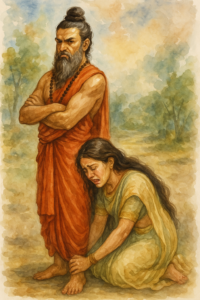
Crying out in anguish, the princess collapsed at her husband’s feet in the lonely forest. Her tears fell uncontrollably, soaking the earth beneath her. The stillness around her only intensified her grief.
Unable to bear the pain of separation, she resolved to follow him even in death.
With trembling hands, she gathered wood and constructed a funeral pyre. Gently, reverently, she placed her husband’s lifeless body upon it. As the flames began to rise, she prepared herself to enter the fire — determined to become Sati, to end her sorrow in the blaze of devotion.
Her cries echoed through the mountains. Her heart was shattered. Her world had dissolved.
But at that precise and sacred moment — just as destiny seemed sealed — an elderly Brahmana appeared there.
He was no ordinary ascetic. His face radiated serenity. His eyes shone with the quiet brilliance of self-realization. There was an ageless familiarity about him, as though he had always been near, though unnoticed.
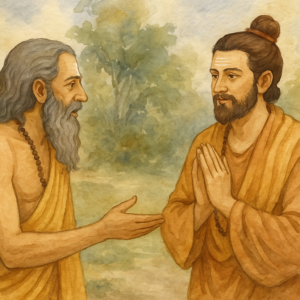
Approaching the grieving princess, he spoke in a voice gentle yet penetrating — words that carried both compassion and awakening:
“Who are you, O noble lady? And who is this man whom you call your husband? Why do you weep for one who merely appears to be sleeping?
Do you not recognize me?
I am that very friend with whom you once roamed freely in the past — your eternal companion, forgotten but never absent.”
His words fell like cool rain upon the fire of her grief.
And with that question — “Who are you?” — the entire illusion of identity began to tremble.
The Return of the Forgotten Friend
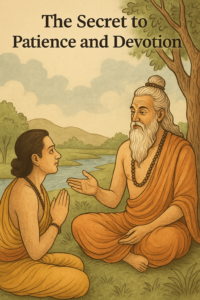
The Brahmana continued, his voice calm yet piercing the very core of her grief:
“In ancient times, I was your eternal companion. My name is Avigyata — the One who knows, the Witness, the Unknown Friend.
You abandoned Me when you desired to seek a dwelling in which to enjoy the pleasures of the world.
Long before this birth, you and I lived together as intimate friends upon the serene shores of the Manasa Lake. For thousands of years, we wandered freely — without attachment, without fixed residence, untouched by worldly identity.
But then you desired experience.
You sought a city.
That ‘city’ you entered was constructed from the five great elements. Its ruler appeared to be a woman — the subtle governing intelligence.
The five objects of the senses became its gardens — sights, sounds, smells, tastes, and touches blooming like alluring flowers. The nine gates were its entrances. Earth, water, fire, air, and ether formed its protective walls.
The mind and the five knowledge-acquiring senses were its inner forces. The organs of action were its marketplaces of activity. And Buddhi — the intellectual faculty — was its queen, presiding over the entire domain.
Such was that city — that once a soul entered it, intoxicated by its beauty and pleasures, wisdom gradually faded.
Entranced by the mistress of that city, indulging in her delights, you forgot your original nature.
Through attachment, you became bound. Through identification, you became confused. Through indulgence, you descended into sorrow.
You are not truly the daughter of the King of Vidarbha.
Nor was Malayadhvaja your ultimate husband.
Nor were you truly the husband of Puranjani in your previous birth.
In one life you thought, ‘I am a man.’
In another, ‘I am a woman.’
But all of this is merely Maya — the divine illusion operating through My power.
In truth, you are neither male nor female.
We are both Hamsas — pure swan-like souls, free, luminous, eternal.
I am the Supreme Self.
You are the individual soul (Jeeva).
Yet there is no real separation between us.
If you look deeply — beyond body, beyond mind, beyond memory — you will see that I am not different from you.
Just as a person sees one reflection in a mirror and another in the eyes of others — though the Self remains one — so too the One Supreme Soul appears as both Lord and individual being due to the conditioning of Vidya (knowledge) and Avidya (ignorance).
The division is apparent, not real.
When the Hamsa — the Supreme — awakened the Hamsa of the Manasa Lake — the individual soul — remembrance dawned.
In that awakening, the forgotten self-knowledge blossomed once again.
Through the gentle counsel of the Eternal Friend, the soul returned to its original awareness — radiant, free, and whole.
And thus,” Narada Muni concluded, “O King Prachinabrahi, through this allegory I have granted you divine vision — the understanding of the true nature of the Self and the Supreme.”
Spiritual Reflection – Awakening Through Suffering
In our modern world, we are terrified of three things:
Aging.
Irrelevance.
Loss of control.
We fear:
- Losing our physical strength
- Losing our social value
- Losing our relationships
- Losing our identity
- Losing our body
But Raja Puranjan’s story reveals something radical:
You were never the city.
You were never the roles.
You were never the gender.
You were never the possessions.
You were always the Witness.
Today, we suffer from:
- Midlife crisis
- Identity confusion
- Emotional dependency
- Attachment-driven anxiety
- Fear of death
- Karma of unconscious living
This allegory answers them all.
It teaches:
- The body will age — but the Self does not.
- Relationships change — but consciousness remains.
- Wealth collapses — but awareness survives.
- Death is not destruction — it is transition shaped by remembrance.
- Attachment binds — but self-knowledge liberates.
Modern psychology tells us to “find ourselves.”
Ancient wisdom tells us:
You were never lost.
You simply forgot.
The real tragedy of Puranjan was not death.
It was forgetfulness.
He remembered his wife.
He remembered his children.
He remembered his kingdom.
But he forgot Avigyata.
And that is exactly what modern life does to us. It keeps us busy enough to forget who we are.
Yet the most powerful moment in this story is not the burning city.
It is the return of the Eternal Friend.
The gentle question:
“Who are you?”
That question alone can dissolve anxiety.
Because when you realize you are not the collapsing city —
You stop fearing the fire.
This is why such ancient spiritual stories remain eternally relevant in solving modern existential crises.
They do not offer escape.
They offer clarity.
And clarity brings peace.
If you read this episode carefully, you will not just see Puranjan aging —
You will see your own fears, attachments, and identity patterns unfolding.
But you will also see something else:
No matter how far you wander,
No matter how many births you pass through,
No matter how many identities you wear —
The Eternal Friend never leaves.
And remembering Him is the beginning of freedom.
🌺 To Be Continued – The Final Revelation
In Episode 3, we will:
- Decode every symbol completely.
- Understand the nine gates, serpent, servants, Gandharvas, Yavanas.
- Reveal how this is the complete psychological and spiritual map of the human condition.
- Learn how to move from self-centeredness to surrender.
And finally answer:
How can an agyani jeev awaken before Time burns the city?
Until then—
Ask yourself:
Are the Gandharvas already plundering your city?
Is the serpent weakening?
Have you remembered Avigyata?
Because the eternal Friend….is still waiting.