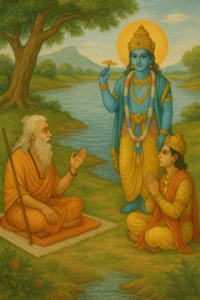
Episode 1 of 3: The Beginning of the Soul’s Forgetfulness
🌿 Important Note to Our Readers
This sacred and symbolic story of Raja Puranjan will unfold in three episodes.
- In this first episode, we will witness the beginning — the search, the meeting, and the descent into attachment.
- In the second episode, we will see the deepening of delusion and the consequences of forgetfulness.
- And in the third and final episode, every name, every gate, every character, every region will be decoded. There you will understand how this is not merely a king’s story — but the metaphorical journey of an agyani jeev (ignorant soul) trapped in samsara.
🔔 So remember the names carefully.
Remember the nine gates.
Remember the serpent.
Remember the ten servants.
Remember Avigyat.
Because in the final episode, you will realize — this story was always about you.
Have you ever felt that despite achieving success, building relationships, earning wealth, and fulfilling responsibilities — something still feels incomplete?
Have you ever wondered:
- Why does satisfaction fade so quickly?
- Why does attachment slowly turn into anxiety?
- Why do we lose ourselves while trying to “build” a life?
- Why, despite being constantly connected, do we feel spiritually disconnected?
In today’s world of endless scrolling, career pressure, relationship expectations, social validation, and performance-driven living, we are constantly moving outward — chasing experiences, achievements, pleasure, recognition. Yet rarely do we pause to ask: Who is the one chasing?
The ancient Raja Puranjan story from the Shree Bhagavata tradition is not merely mythology. It is a profound psychological and spiritual blueprint of human life. It is a mirror.
The “Nine-Gated City” is not just a city.
The mysterious maiden is not just a woman.
The blind companions are not just characters.
And the forgotten friend Avigyat is not a stranger.
This story of Raja Puranjan is a timeless allegory of the human body, the restless mind, sensory indulgence, attachment, ego, karma, aging, and spiritual forgetfulness.
It addresses modern struggles like:
- Identity crisis
- Emotional dependency
- Material success without inner peace
- Attachment-driven anxiety
- Ritualistic religion without transformation
- Loss of purpose despite abundance
In a world obsessed with external growth, this story gently asks:
Are you building a kingdom — or losing your soul?
As you begin Episode 1, remember the names. Remember the gates. Remember the serpent. Remember Avigyat.
Because by the end of this journey, you may realize something startling:
This is not the story of a king.
This is the story of us.
The Question of True Welfare
In the lineage of the great and noble King Prithu, there was a king named Prachin-Brahi.
His story was narrated by the sage Maitreya to the wise Vidura.
At that time, King Prachin-Brahi was deeply absorbed in karmkand — elaborate ritualistic sacrifices. Day and night, sacred fires burned. Animals were offered. Priests chanted mantras. The kingdom believed that through rituals alone, heaven could be secured.
But rituals without wisdom are like lamps without oil.
Seeing this, the compassionate sage Narada Muni approached the King.
Naradaji asked gently:
“O King, what welfare do you seek through these rituals?
True welfare is not temporary heaven.
True welfare is the complete destruction of sorrow and the attainment of supreme bliss.
That cannot be achieved by rituals alone.”
The King bowed his head and confessed:
“My intellect has been clouded by ritualism.
I do not know the path of supreme good.
A man who thinks his sons, wife, and wealth are the ultimate goal wanders endlessly in ignorance.
Please free me from this bondage of action.”
Naradaji smiled — not with judgment, but compassion.
And then he began a story.
The Allegory Begins – The Story of Raja Puranjan
Narada Muni said gently, “O King, listen with full attention to the story of Raja Puranjan. Long ago, there lived a renowned monarch named Puranjan, celebrated for his ambition and restless spirit. Yet beyond his royal identity, there was something more subtle about him — he was never alone. He had a mysterious companion named Avigyat, meaning ‘The Unknown.’ This friend was extremely dear to him, always present, yet never fully recognized. No one could comprehend Avigyat’s true nature, intentions, or movements. Though unseen and beyond ordinary understanding, he remained the silent witness of Puranjan’s every action.”
(Remember this name: Avigyat.)
The Search for the Perfect City
King Puranjan wandered across the entire earth in search of a dwelling that would perfectly fulfill his desires. He visited countless kingdoms, examined magnificent cities, and explored lands rich with beauty and prosperity — yet nowhere did his heart find rest. Each place seemed impressive at first glance, but none truly satisfied him. Gradually, a subtle dejection crept into his heart. Though surrounded by abundance, he felt incomplete — as if something essential was still missing.
Then one day, upon the southern slopes of the majestic Himalayas, in the sacred land of Bharat-Khand, his eyes fell upon a wondrous city unlike any he had seen before. It was a splendid city with nine grand gates, adorned with every auspicious sign and symbol of prosperity.
The city was encircled by flourishing gardens and fragrant orchards. Elegant balconies overlooked wide avenues. Beautiful windows and towering royal gateways shimmered in the sunlight. Massive palaces rose high into the sky, their domes fashioned from gold, silver, and iron — symbolizing strength, wealth, and endurance. Within its boundaries were assembly halls filled with conversation, bustling crossroads alive with movement, well-laid roads, pleasure houses, and tranquil resting places for weary travelers.
At the heart of this magnificent city lay a serene lake, its waters clear and calm, reflecting the sky like a mirror. The atmosphere was so harmonious that even wild animals dwelt there in peace. They behaved like sages, practicing non-violence, harming none and fearing none. It was as though the entire city was designed to offer comfort, enjoyment, and security — a perfect abode for one seeking fulfillment.
And as King Puranjan gazed upon it, his restless heart stirred with a sense of wonder — perhaps, at last, he had found what he had been searching for.
(Remember: a city with nine gates.)
The Mysterious Maiden
As King Puranjan wandered through that enchanting forest near the nine-gated city, his eyes suddenly fell upon a vision of extraordinary beauty. Before him stood a radiant young maiden, graceful and luminous like a celestial goddess who had descended upon the earth.
She was not alone.
Around her stood ten powerful attendants, each commanding a hundred followers of their own — disciplined, alert, and ready to serve her will. Walking just ahead of her was a formidable five-hooded serpent, vigilant and protective, guarding her from every direction. Though she appeared youthful and innocent, there was a quiet authority about her presence — as though the entire city subtly revolved around her.
She seemed to be searching — waiting, perhaps, for a worthy companion.
The Meeting
Captivated by her charm, King Puranjan approached the maiden and spoke in a gentle, persuasive voice:
“Who are you, O beautiful one? Whose daughter are you? From where have you come, and what purpose brings you near this splendid city? Who are these ten servants who follow you, guided by eleven mighty leaders? And who are these maidens attending you? Tell me also — who is this five-hooded serpent that walks before you as your guardian?
Do you wander here in solitude, seeking a noble husband? Just as Goddess Lakshmi adorns and enhances the glory of Lord Vishnu, come and grace this city with me. I am a valiant and capable hero — worthy of your companionship.”
His words were sweet, confident, and filled with youthful pride.
Narada Muni narrates that the maiden, too, was inwardly charmed by the King. A gentle smile arose upon her face as she replied:
“We do not truly know who created us. We do not know our names, our lineage, or even the origin of this city in which we dwell. We only know that we are here — serving its purposes. I do not know who constructed this magnificent city for us to inhabit.
These men are my companions and friends. These maidens are my attendants. And while I sleep, this five-hooded serpent remains ever awake, guarding and sustaining the city from all sides.”
There was innocence in her voice — yet also mystery.
She continued softly:
“It is indeed my good fortune that you have arrived here. May you be blessed. If it is worldly enjoyment that you seek, I, along with all my companions, can offer you every pleasure imaginable. Remain in this nine-gated city for hundreds of years and delight in the experiences it provides.
In this world, it is through the life of a householder — the Grihastha Ashram — that one attains Dharma (righteousness), Artha (wealth), Kama (desire), the joy of children, even Moksha (liberation), along with fame and heavenly rewards. The wise declare that the householder’s path sustains ancestors, gods, sages, humanity, all living beings — and oneself as well.
And tell me — what woman would refuse a noble, renowned, and handsome hero who has approached her of his own accord?”
Her words were persuasive, layered with promise — of fulfillment, pleasure, legacy, and purpose.
And thus, in that sacred forest, beside the mysterious nine-gated city, began a union that would shape the destiny of King Puranjan — though neither of them yet understood the deeper forces at play.
The Nine Gates Revealed
Narada Muni continued his narration:
Thus, having agreed with one another and bound by mutual attraction, King Puranjan and the enchanting maiden began to dwell together in that splendid city. Days turned into months, months into years, and in the flow of time, they lived there for a hundred years — absorbed in countless pleasures, experiences, and pursuits.
That extraordinary city was designed with nine gates — seven situated in the upper portion and two in the lower. Through these gates, the King would travel outward, exploring different regions and enjoying various engagements. Each gate opened to a distinct field of experience, and each journey shaped his life in subtle ways.
There were five gates facing the East, one to the South, one to the North, and two to the West. Narada Muni then began to describe them in detail, for none of them were without meaning.
The Eastern Gates
• Khadyota and Avirmukhi – These two gates were built side by side in the same place. Through them, King Puranjan would journey to the region known as Vibhrajit, accompanied by his companion Dyuman. There, he delighted in radiant and dazzling experiences.
• Nalini and Naalini – Another pair of gates standing together. Through these, he would travel to the fragrant region of Saurabh, guided by his friend Avadhuta. In that realm, subtle pleasures captivated him deeply.
• Mukhya – The fifth gate of the East. Through this entrance, the King would go to the regions called Bahudan and Apana, accompanied by Rasagya and Vipan. There he indulged in varied forms of enjoyment and expression, finding delight in taste, speech, and exchange.
The Southern, Northern, and Western Gates
• The Southern Gate – Pitruhu
Through this gateway, the King would travel to the region of Dakshin Panchal, accompanied by Shrutdhar. In that direction, he engaged in activities connected with ancestral paths and traditions.
• The Northern Gate – Devhu
Through this entrance, he journeyed toward Uttar Panchal, again with Shrutdhar. This path led him toward regions associated with divine pursuits and elevated aspirations.
• The Western Gate – Asuri
By this gate, the King would enter the region of Gramaka, accompanied by Durmad. There, he became absorbed in intense and passionate engagements.
• The Second Western Gate – Nirriti
Through this final gate, he traveled to the region named Vaishasa, along with Lubdhak. This was a place where darker consequences quietly awaited.
Thus, through these nine gateways, King Puranjan continuously moved outward — exploring, experiencing, indulging, and identifying with the city and its offerings.
Unaware of the deeper design behind it all, he believed himself to be the sovereign enjoyer — not realizing that every journey through a gate was weaving subtle threads of attachment around his own heart.
(But that revelation will come later. Remember the gates.)
The Gradual Fall into Delusion
Among the many inhabitants of that splendid city were two peculiar citizens named Nirvak and Peshaskrit. Both of them were blind. Though King Puranjan ruled over countless capable and perceptive residents, he strangely chose to rely upon these two sightless guides in all his undertakings. Wherever he traveled, whatever tasks he performed, he did so under their direction.
And thus, though he believed himself to be sovereign, his vision was quietly governed by blindness.
Whenever the King entered the inner chambers of the palace — the antahpur — accompanied by his chief attendant Vishuchin, he became entirely absorbed in the intimate world of his queen and children. There he tasted waves of emotion: delight, anxiety, pride, jealousy, affection, fear. His mind became entangled in countless actions and reactions, constantly stirred by desires that never rested.
Slowly, imperceptibly, he ceased to live from his own center.
He became a reflection — a mere shadow — of his Queen.
When she ate, he ate. When she sang, he sang. When she wept, tears flowed from his own eyes. When she laughed, he laughed without restraint. If she spoke, he echoed her voice. If sorrow touched her heart, he felt crushed and helpless. If joy blossomed in her, he rejoiced as though it were his own.
His identity dissolved into imitation.
Completely captivated by her charm, King Puranjan lost his inner independence. His discernment weakened. His ministers and attendants, perceiving his attachment, began to manipulate him subtly for their own purposes.
Like a pet monkey trained for entertainment — dancing at the slightest gesture of its master — the once-mighty King found himself copying her every movement, every mood, every impulse. Even when his inner voice resisted, he lacked the strength to act independently.
Thus the ruler of the city became ruled by attachment.
What began as companionship had now transformed into bondage.
And without realizing it, King Puranjan drifted further away from his true self — the silent witness who had once walked beside him as his forgotten friend.
The Hunt – Violence of Desire
Narada Muni continued:
“O King, one day King Puranjan, adorned in radiant golden armor and carrying an inexhaustible quiver upon his back, mounted a swift chariot drawn by five powerful horses. Accompanied by his eleventh commander, he rode toward the forest known as Panchaprastha.
Though it was never easy for him to leave the side of his beloved queen, on that particular day he was overtaken by an intense passion for hunting. Desire surged within him so strongly that he ignored even her presence. Inflamed with pride and excitement, he entered the forest with bow in hand, eager to conquer.
What began as sport soon turned into cruelty.
Blinded by arrogance and intoxicated by the thrill of domination, he mercilessly shot down countless innocent animals. His sharp arrows pierced living beings who had done him no harm. Compassion vanished from his heart.
The scriptures declare that even a king inclined toward hunting must do so only within strict bounds — for ritual necessity or regulated purpose — never out of reckless indulgence. Sacred laws exist to discipline human impulses, not to suppress them but to purify them. A wise person who acts within scriptural guidance remains untouched by sin, for knowledge governs his action. But one who acts impulsively, enslaved by ego and whim, becomes bound by the consequences of those actions.
Thus, through unrestrained violence and self-centered desire, one tightens the knots of karma. Falling deeper into samsara, one’s discrimination (vivek) fades, and the soul risks descending into lower births.
As the forest echoed with the cries of dying creatures, Puranjan’s energy slowly drained. The thrill of the hunt gave way to exhaustion. His throat burned with thirst, and his body longed for relief. Weary and overheated, he finally returned to his palace.
After bathing and eating according to tradition, he rested briefly to ease his fatigue. But soon his thoughts turned toward his queen.
“Where is she?” he asked the attendants anxiously. “What has happened to your mistress today?”
When he entered her chamber, he found her lying on the bare floor — without bed, without ornament, withdrawn and silent.
The sight struck him like an arrow.
His heart trembled. Anxiety flooded his mind. The conqueror of forests now stood helpless before a single woman’s silence.
In a soft and pleading voice, he tried to console her:
“If I have offended you, tell me. If someone else has wronged you and is not of noble lineage, I shall punish him at once. And if I myself am the offender, forgive me — for I am yours alone. What wife would reject her beloved husband when he sincerely seeks to make amends?”
He who had been fierce and merciless in the forest now spoke with submission and desperation.
Through gentle glances, subtle gestures, and the irresistible charm of affection mixed with reproach, the beautiful queen once again drew Puranjan completely under her sway. Her silence became command; her smile became reward.
Thus he surrendered himself entirely to her influence.
And in that surrender — not of wisdom, but of attachment — he gradually lost awareness of his true nature.
The knowledge of the Self (Atma) faded.
The remembrance of the Supreme Soul (Paramatma) disappeared.
The sovereign of the city became a captive of his own desires.
Expansion of Attachment
From his union with Queen Puranjani, King Puranjan was blessed with 1,100 sons and 110 daughters. Each child was endowed with admirable qualities — modesty, generosity, strength, and grace — and together they expanded the fame and prestige of their royal lineage. All of them proudly carried the name of Puranjan, further extending his identity through generations.
Years passed swiftly.
Without even realizing it, half of the King’s long life had already slipped away.
He carefully arranged marriages for his sons with worthy brides and gave his daughters in marriage to noble and capable husbands. In time, each of his sons begot hundreds of children of their own. The royal household expanded like a flourishing tree, its branches spreading wide across the land.
The palace resounded with laughter, ceremonies, responsibilities, and endless activity.
Outwardly, it appeared as complete success — prosperity, legacy, continuity.
But inwardly, another process was unfolding.
Deeply attached to his children, grandchildren, ministers, and servants, King Puranjan became increasingly entangled in the web of worldly relationships. His sense of identity fused with his family’s growth and achievements. Their honor became his honor; their sorrow became his sorrow. Gradually, his heart grew heavy with ownership and possessiveness.
Driven by an insatiable desire to secure prosperity, fame, and heavenly rewards, he turned intensely toward elaborate Yagyas (sacrificial rituals). In the name of religion and duty, he performed grand ceremonies involving the sacrifice of animals, believing that such acts would bring divine favor and ensure future well-being.
He worshipped various deities, honored ancestors, and even propitiated subtle forces and lords of spirits — all with meticulous attention to ritual detail.
Yet in all this activity, something essential was neglected.
While he was diligent in external worship, he forgot the inner purpose of life. While he upheld tradition, he overlooked transformation. While he protected his kingdom and nourished his lineage, he remained indifferent to the welfare of his own soul.
Thus, absorbed in the maintenance of family and ritualistic duty, his entire life passed in outward accomplishment but inward forgetfulness.
And then—
Silently, inevitably—
Old Age arrived.
That stage of life which even the strongest men dread.
That phase which strips away pride, vigor, and certainty.
That uninvited guest who waits for no one’s permission.
The city he had built and expanded so carefully was about to face its greatest test.
Spiritual Reflection – The Timeless Truth
In today’s fast-paced world, we build careers like Puranjan built his city.
We expand families, networks, social presence, investments.
We perform rituals of productivity.
We measure life in milestones and metrics.
But silently, Blind guides influence our choices. Attachment shapes our identity.
And the “Unknown Friend” — our inner consciousness — remains forgotten.
The story of Raja Puranjan answers one of the deepest modern questions:
Why, despite having everything, do we feel incomplete?
Because like Puranjan, we mistake the body for the self, the roles for identity, the attachments for purpose.
This allegory gives clarity where modern confusion prevails.
It teaches that:
- Outer success without inner awareness leads to bondage.
- Attachment without discernment leads to suffering.
- Ritual without realization leads to emptiness.
- Desire without discipline leads to exhaustion.
But awareness brings freedom.
Remembrance brings peace.
Devotion brings direction.
Stories like this are not meant to entertain — they are meant to awaken.
They help us:
- Reclaim our identity beyond labels.
- Break emotional dependency.
- Understand karma and consequence.
- See aging and time with wisdom instead of fear.
- Shift from self-centeredness to surrender.
If you read this story mindfully, you will not just understand Raja Puranjan — you will understand your own patterns, attachments, and choices.
And perhaps, before Old Age knocks and Time releases its arrow,
you will remember Avigyat —
the silent witness within you.
That remembrance is liberation.
And that is why ancient spiritual stories remain eternally relevant in solving modern psychological struggles.
“The moment we stop chasing the city outside and remember the Self within, true freedom begins.”
🌺 To Be Continued…
In Episode 2, we will witness:
- The invasion of Time.
- The collapse of illusion.
- The suffering of attachment.
- And the consequences of ignorance.
And in Episode 3, every name and symbol will be revealed — showing how this entire narrative represents the journey of an agyani jeev, the ignorant soul bound in samsara.
Until then…
Remember the city.
Remember the serpent.
Remember the servants.
Remember Avigyat.
Because one day, like Puranjan,
we too must ask —
“Who built this city?
And who am I within it?”