Have you ever experienced this…
You pick up your phone “just for 5 minutes”… and suddenly, an hour disappears.
You start caring deeply for someone… and slowly, your happiness begins to depend on them.
You work hard to build something… and without realizing it, that very thing starts controlling your peace.
It doesn’t feel wrong. In fact… it feels natural. It feels like love. Responsibility. Care.
But what if…the very thing you think is your strength… is silently becoming your bondage?
In today’s world, we often believe that attachment is love… that control is care… that constant thinking is responsibility.
But is it really?
Or is it something much deeper… something far more subtle… that quietly pulls us away from our true self?
The ancient wisdom of The Shrimad Bhagavatam gives us a story so powerful, so psychologically precise… that it feels like it’s describing our lives today.
This is not just the story of a king.
This is the story of a seeker… who had everything, renounced everything…and yet, lost everything—again.
This is the story of King Bharat—a story that reveals:
- How attachment begins silently
- How even the strongest minds can slip
- And how awareness… is the only true freedom
If you’ve ever felt distracted, emotionally dependent, restless, or stuck despite doing “everything right”…
This story holds an answer for you.
“Attachment doesn’t bind you loudly… it quietly replaces your awareness.”
In the sacred dialogue of the Shrimad Bhagavatam, when King Parikshit sat on the banks of the Ganga, awaiting his final days, Shukdev Ji Maharaj began narrating a story—not just of a king, but of a seeker, a devotee… and a subtle fall that speaks to every human heart even today.
This is the story of King Bharat—a name so sacred that an entire land came to be known as Bharatvarsha because of him.
A King Who Had Everything… Yet Chose Renunciation
King Bharat was not an ordinary ruler.
He was born in the lineage of the great Rishabhdev—a divine incarnation himself. By the will of his father, Bharat ruled the Earth with righteousness, compassion, and deep devotion.
He married Panchajani, the daughter of Vishwaroop and was blessed with five sons—Sumati, Rashtrabritt, Sudarshan, Aavran, and Dhumraketu.
His kingdom flourished. His people loved him. His name echoed with respect. Yet deep within, Bharat understood a truth that most of us spend lifetimes avoiding:
Even the greatest success is temporary.
After ruling for thousands of years, when he realized that his karmic duties as a king had been fulfilled, he did something extraordinary.
He walked away. Not out of frustration. Not out of failure. But out of clarity.
He divided his kingdom among his sons… and left everything behind.
No throne. No wealth. No identity.
Just a seeker walking toward truth.
The Forest of Awakening
Leaving behind a palace overflowing with luxury and grandeur, King Bharat walked away into the quiet embrace of the sacred Pulaha Ashram—a place where the Divine reveals Himself to devotees in the form their heart longs for. Flowing beside it was the revered Chakra-nadi, known today as the Gandaki River, whose waters carry the holy Shaligram Shilas—mystical stones marked with sacred circular impressions, sanctifying every corner of the sages’ hermitages.
Amidst the serene gardens of that ashram, Bharat immersed himself in the worship of the Lord. Day by day, something within him began to transform. The noise of worldly desires faded into silence, his restless mind found deep stillness, and in that stillness, he experienced a bliss so profound… that it needed nothing from the world to sustain it.
A Moment That Changed Everything
Shukdev Ji Maharaj continues:
Once, after bathing in the sacred waters of the Gandaki River and completing his morning rituals, King Bharat sat quietly on its bank, absorbed in chanting the divine sound of Om—the Pranav—for nearly three muhuratas. The atmosphere was still, sacred, and deeply meditative.
At that very moment, a lone doe, parched with thirst and visibly distressed, approached the river to drink. She was already cautious—her gentle eyes scanning the surroundings, her body tense with fear. And then, without warning, the thunderous roar of a lion echoed through the forest, piercing the silence.
Startled beyond measure, terror gripped her heart. Her breath quickened, her body trembled. Though her thirst remained unquenched, survival took over. In a desperate attempt to escape, she leapt across the river. But the force of that fear, combined with the strain of her condition, caused a tragic turn—she was pregnant, and in that violent leap, her unborn fawn slipped from her womb into the rushing waters below.
The doe, shattered by shock and pain, stumbled away, alone and separated from her herd. Overwhelmed, she collapsed into a nearby cave… and there, she breathed her last.
King Bharat witnessed this entire scene.
As his eyes fell upon the tiny, helpless fawn being carried away by the current, a deep wave of compassion arose within him. Without hesitation, he rescued the fragile creature and brought it back to his ashram.
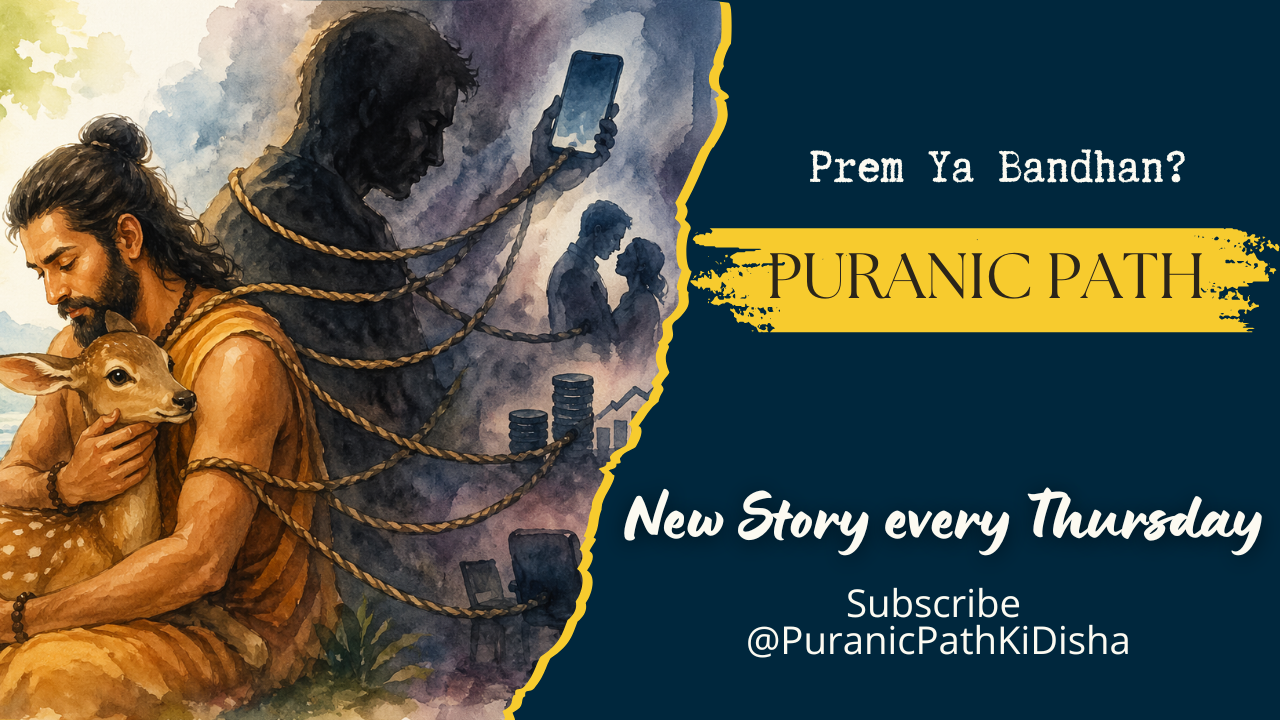
What began as an act of kindness slowly grew into something deeper. Bharat began caring for the fawn like his own—arranging its food and water, protecting it from wild animals, and surrounding it with affection. His heart, once absorbed in the Divine, now found itself increasingly occupied with the well-being of this small being.
And gradually, almost unnoticed…his disciplined practices—his Yamas, Niyamas, daily worship, and spiritual observances—began to fade.
One by one, they slipped away…until eventually, they stopped altogether.
The Subtle Shift
Gradually, a stream of thoughts began to arise within his heart:
“How unfortunate… Time itself has separated this helpless little one from its mother and its kin, only to place it under my care. It sees me as everything—its protector, its family, its entire world. It has no one else to depend on but me, and its trust is so pure, so complete. How can I neglect one who has come seeking refuge? It is my duty to protect, nurture, and love it with all my heart. After all, do not the noble and compassionate always protect the helpless—even at the cost of their own greatest pursuits?”
With such reasoning, what began as compassion slowly deepened into attachment.
His mind, once anchored in the Divine, now found itself gently but firmly tied to the fawn. Whether he sat in silence or partook of his meals, his thoughts circled around it. Whenever he went into the forest to collect Kusha grass, flowers, sacred wood, or roots, he would take the fawn along, fearing it might fall prey to wolves or wild animals in his absence.
Along the way, if the little deer paused to graze upon tender blades of grass, Bharat would watch it with a heart full of tenderness. And if it wandered even slightly, he would lovingly lift it onto his shoulders, as though carrying his own child. At times, he would cradle it in his lap, at times press it gently against his chest—finding in those moments a strange, soothing joy. It was only then that his mind felt at ease.
Looking at it with affection, he would softly pray, “My child… may you be protected and blessed wherever you go.”
And in those gentle whispers of love…his inner silence slowly began to fade.
The Agony of Attachment
Whenever the deer slipped out of his sight, Bharat’s heart would sink into deep unrest—like that of a poor man who has suddenly lost all his wealth. His mind, once steady and composed, now trembled with anxiety. Unable to bear the separation, he would begin to lament:
“Alas… where has it gone? Will that innocent fawn ever return to me again—overlooking my shortcomings, just as a noble soul forgives and trusts? Will I once more see it peacefully grazing upon the soft green grass of this ashram, by the grace of the Lord? I pray that no wolf, no wild dog, no herd of boars… nor even a solitary tiger has harmed it.”
As the day drew to a close and the sun slowly descended, his worry only deepened.
“The Sun God, who shines for the welfare of all beings, is about to set… and still, my dear one has not returned.”
Memories would flood his mind—moments that once brought him joy, now only intensified his longing.
“At times, when I would sit pretending to be in deep meditation, it would come near me, timid yet playful, gently touching my body with the soft tips of its horns—like droplets of water. And if ever it disturbed the sacred items of worship and I scolded it, it would instantly grow quiet, restraining itself with such innocence… just like the obedient child of a sage.”
Recalling the tragic fate of its mother, Bharat’s heart grew even heavier.
He would look up at the night sky and wonder,
“That poor fawn… whose mother perished in fear… now wandering alone—does the Moon, the gentle lord of the stars and protector of the distressed, watch over it with compassion?”
And in these thoughts, woven with love, fear, and longing…his mind drifted further away from stillness—entangled in a bond he no longer recognized as attachment.
This is the truth the story whispers gently:
Attachment does not scream. It quietly replaces the Divine with something else.
The Fall of a Yogi
“O King,” continues Shukdev Ji Maharaj, “in this way, Bharat’s mind became increasingly restless—caught in subtle, unfulfilled longings that quietly pulled him away from his center. By the force of his unfolding destiny, his prarabdh karma, he gradually drifted from the disciplined path of ritual action and Yogic practice.
Reflect for a moment—how astonishing this is. The very man who had once renounced his own sons, born of his own heart, seeing even them as potential obstacles on the path to liberation… how did he now become so deeply attached to a creature of another species?
Such is the power of unseen obstacles.
Slowly, almost imperceptibly, his vigilance faded. What he had once transcended returned in a subtler form. In his constant care, concern, and affection for the fawn, his awareness turned outward. And in that outward pull…he lost sight of the one truth he had once realized within.
He forgot his own Self—the Atman.”
The Final Moment
At that very moment, Time—Kaal, silent yet unstoppable—approached him, just as a serpent quietly enters the hole of a mouse, unseen yet inevitable. There was no escape from its grasp.
As the final moments of his life unfolded, the fawn remained by his side, grieving with a tenderness like that of a devoted son. And Bharat… his mind, instead of resting in the Divine, remained completely absorbed in that one attachment.
His thoughts did not turn inward. They did not rise toward liberation. They stayed bound—to the deer.
And as the eternal law governs, whatever occupies one’s consciousness at the moment of death becomes the path ahead.
Thus, leaving behind his human body, King Bharat—despite all his past spiritual achievements—was reborn… in the form of a deer.
Awareness in the Midst of Consequence
Yet, because the foundation of his earlier spiritual practice was so deep and nearly complete, the flame of awareness within him was not extinguished. Even in the body of a deer, the memory of his previous life remained intact. By the subtle power of his past devotion to the Lord, he could clearly perceive the cause of his present condition.
A wave of remorse rose within him.
He reflected with painful clarity:
“What a misfortune has befallen me! I have slipped from the path walked by the great and disciplined souls. I had once, with courage and conviction, renounced all worldly attachments and taken refuge in the solitude of the sacred forest. There, through constant listening (Shravan), deep contemplation (Manan), and heartfelt chanting (Kirtan) of the glories of Lord Vasudeva, I had firmly anchored my mind in Him.
And yet… how careless I became. How unaware. For the sake of a small, helpless fawn, my mind wandered away from its ultimate goal.”
In that realization, there was no anger… no denial—only a deep, humbling awareness of how subtly the mind can drift, even after coming so far.
This is one of the most powerful truths of this story: Even advanced seekers can fall… if awareness slips.
The Return to the Path
With this awakening of deep detachment—Vairagya—he made a silent resolve within. Without drawing attention, he distanced himself even from the mother-deer and turned away from that bond. Guided by an inner pull, he returned from the region near Mount Kalanjar to the same sacred land he once knew—the holy Shaligram Tirth, the divine abode of the Lord, graced by the ashrams of sages Pulaha and Pulastya, a place cherished by seekers of peace.
There, he chose a life of complete solitude.
Every moment, he remained alert—almost cautious—of any form of attachment arising again within him. Sustaining himself only on dry leaves, he lived with minimal needs, not seeking anything from the world, but simply allowing the force of his past karma to exhaust itself.
He was no longer living to achieve…he was living to be free.
And then, one day, standing in the sacred waters of the Gandaki River, with half his body immersed in its gentle flow, he quietly let go of that deer body—just as a seeker sheds the final layer of illusion.
Avoided all emotional entanglements. And waited…Not for life to begin—but for karma to end.
Finally, standing in the waters of the Gandaki River…he left that body too.
Closing Thoughts
In a world where we are constantly pulled in a hundred directions—notifications, expectations, relationships, ambitions—we often think our problem is lack of time, lack of clarity, or lack of control.
But the story of King Bharat reveals something far deeper.
The real problem is not what we hold…it is how tightly we hold it.
Just like Bharat, we don’t fall because we are weak. We fall because we stop being aware.
Today, our “deer” may look different:
- A relationship we can’t stop thinking about
- A career that defines our self-worth
- A phone that constantly demands attention
- A fear of losing control
And just like him…
we don’t even realize when care becomes attachment…when love becomes dependency…when responsibility becomes restlessness.
This is why stories like these are not just ancient tales—They are maps of the human mind. They answer questions we didn’t even know how to ask. They show us that the solution is not running away from the world…but learning to live in it without losing ourselves.
King Bharat’s journey reminds us: We can renounce everything… and still get attached. But we can also live in the world… and remain free.
The choice is not outside. It is within our awareness.
So the next time our mind feels restless…the next time we feel overly attached… the next time peace feels distant… lets
Pause.
Observe.
Return to ourself.
Because the freedom we are searching for…was never outside, to begin with.
Liberation is not about what we leave outside…It is about what we let go inside.