There are some stories in our ancient tradition that don’t just tell us something—they shake us, awake us.
This is one such story.
A story of love and ego.
Of longing and rejection.
Of the fire that destroys a body but sets a soul free.
A story that feels ancient—and yet, painfully modern.
The Silence Between Shiva and Daksha
Years had passed—years filled with a cold, unspoken tension between father-in-law and son-in-law.
Daksha Prajapati, once a great creator, had now become a man intoxicated with power. Brahma had made him the chief of all Prajapatis… and instead of humility, it birthed pride.
And pride, when watered, grows into blindness.
Daksha began ignoring the greatest being of the universe—Lord Shiva, who was nothing less than the very foundation of the cosmic balance.
Insulting him by not giving them the share in the Yagna (sacrifice), he first commenced the Vajapeya Yagna and then started the mighty Bṛhaspati Sava Yagna. All devas, rishis, and celestial beings were invited with honor.
Everyone.
Except Shiva.
Sati Hears the Sky Whisper
One morning, while standing in Kailash, Sati heard a soft murmuring from the passing devas flying above:
“Daksha’s Yajña…
The celebrations…
The grand gathering…”
She looked up and saw divine wives—Gandharvis, Yakshis, celestial ladies—adorning themselves, wearing shimmering jewels, sitting gracefully in sky-chariots as they sped toward the celebration.
For a moment, Sati’s heart trembled.
This was her home.
Her father.
Her sisters.
Her family.
A wave of longing swept over her.
She turned to Shiva, her eyes filled with innocent excitement—like a daughter hoping to go home after ages.
“Swami… may we go?”
“Mahadev,” she said softly,
“Everyone is going to my father’s Yajña… my sisters, their husbands… the entire family will be there.
It’s been so long.
I want to meet my mother… my aunts… my sisters.
Even strangers are going…
So why shouldn’t a daughter go to her father’s home?”
Her voice cracked with yearning. Sati said with deep longing,
“O Lord, You are the very cause of creation. This entire universe—woven from the three Gunas of Sattva, Rajas, and Tamas—shines only because of Your Maya. And yet, I, bound by a feminine heart, remain unaware of Your true, boundless essence. It has been so long… and today, an intense yearning arises within me to see the place where I was born.
Across the worlds, even women who have no connection to my father, Daksha, are joyfully travelling there, adorned beautifully and accompanied by their husbands. In such a moment,
shouldn’t the heart of his own daughter tremble with eagerness when she hears of a grand festival in her father’s home?
After all, one may go to the home of a father, mother, guru, or even husband, even without an invitation—the bond itself is permission enough.
Therefore, O Divine One, be compassionate toward me.
You are the ocean of mercy. Though You are the Supreme Knower of all that exists, You have lovingly granted me a place in half of Your own being.
With this trust, I bow to You… please listen to my humble plea and bless me with this wish.”
Her words were tender. Childlike. Full of longing.
But Shiva… Shiva remembered something else.
A wound.
A wound caused by Daksha’s poison-laced arrogance.
Rishi Maitreya continued:
Hearing Sati’s gentle request, Lord Shankar—beloved refuge of His devotees—remembered the harsh, piercing words spoken long ago by Daksha Prajapati in the assembly of the sages. A knowing smile touched His lips as He prepared to speak.
Shiva Speaks the Truth That Hurts
He looked at her, kindness in his eyes, but firmness in his voice.
“Devi…
You are right—a daughter can visit her father without invitation.
But only when the father carries love in his heart…
Not malice.
Not ego.
Not hatred.”
Shiva’s voice became heavy and gently spoke:
When pride blinds a person and destroys their ability to discriminate, they lose the capacity to recognize the greatness of noble souls.
Such people look upon their own visitors with anger, jealousy, and a twisted sense of superiority—‘These are our relatives,’ they think, and yet they greet them with contempt. One should never go to the home of such hostile, narrow-minded people.
My beloved, the wounds caused by the arrows of an enemy are not as unbearable as the wounds inflicted by the cruel words of one’s own kin.
An arrow may pierce the body and still one may find sleep—but the arrows of harsh speech strike directly at the heart, keeping the mind restless day and night.
O beautiful one, I know well that among Daksha Prajapati’s daughters, you are the dearest to him.
Yet because you are mine, he will not honor you. His mind is clouded by jealousy toward me.
You may wonder why I did not rise to greet him in the assembly of the Prajapatis.
Listen carefully—
gestures like standing up, bowing, or offering respect, which scholars and worldly people practice so effortlessly, are meaningful only when offered to the Supreme Being—Bhagwan Vasudeva, who resides as the Antaryami in every heart.
All respect ultimately belongs to Him alone. Therefore, the only obeisance I offer is to Vasudeva.
Yet despite my doing no wrong at the Yajna, Daksha hurled bitter insults at me.
Even though he is the father who gave you your body, because he harbors enmity toward me, you should not even think of going to him or to those who follow him.
If you ignore my words and still go, the outcome will not be good.
When a noble, self-respecting soul is publicly insulted by their own people… that humiliation becomes the cause of their very destruction.”
But emotions… emotions often don’t obey wisdom.
Sati’s Heart Breaks
Rishi Maitreya continued:
“Vidura Ji, after speaking these words, Bhagwan Shankar fell silent.
In His omniscience, He could clearly see that whether He permitted Sati to go to Daksha’s house or forbade her, either choice carried the painful possibility that Sati might give up her very life.
Sati herself was torn by inner conflict.
At moments, she would step outside, driven by yearning to see her relatives; the next moment, she would retreat in fear that Lord Shankar might be displeased.
Caught between longing and hesitation, she could not settle her mind and stood speechless.
Her heart overflowed with affection for her family. Tears welled up, spilling down her cheeks.
Overcome by turmoil, her body trembled violently, and she turned toward Bhagwan Shankar with a fierce, burning gaze—as though her sorrow and anger could set even Him ablaze.
In that moment, grief clouded her wisdom.
In a mind darkened by pain, even the presence of a saintly husband—who out of pure love had given her half of his own being—faded from sight.
Breathing heavily, she turned away and began walking towards her father’s home.
Seeing Sati leave in such haste and distress, Mahadev’s attendants—normally silent and composed—immediately followed her.
At their head strode the mighty bull Nandi, with countless ganas, attendants, and Yakshas accompanying them on all sides.
Thus, Sati, along with her vast retinue, arrived at Daksha’s grand sacrificial arena.
There, seated in their respective places, were the great Rishis, and the assembled Deities.”**
The storm had begun.
The Yajña of Ego
When Sati arrived at the Yajna, her father Daksha deliberately ignored her.
Seeing his disdain, the entire assembly—fearing the authority of Daksha, the ruler of the sacrifice—remained silent.
Except for Sati’s mother and sisters, no one rose, no one greeted her, no one offered even the basic courtesies due to a guest.
Her mother and sisters, however, were overjoyed.
Their voices trembled with affection as they rushed to embrace Sati, smothering her with love.
But Sati, wounded by her father’s insult, could not accept their kind words, nor could she receive the respectful offerings and beautiful seats presented by her mother and aunts.
Her heart was too bruised for comfort, too anguished to respond.
Sati’s Wrath
The moment the universal Mother, Devi Sati, realized the extent of the disrespect shown to her, her fury began to rise like a blazing fire.
She saw that no sacred share of the Yajna had been offered to Bhagwan Shankar,
and worse still, her father Daksha was openly reviling Him—the Lord who is the refuge of all beings.
At that sight, a divine rage surged within her.
It felt as if her fury alone could burn the three worlds to ashes.
Sati Stands Up
Daksha, blinded by pride born from his strict adherence to ritualistic Karma Marga, had become unbearably arrogant.
When the Bhootas and attendants who had come with Sati saw the hatred he harbored toward Shiva, they immediately prepared to destroy him.
But Devi Sati, glowing with her own divine radiance, restrained them with a surge of her Tej.
Then, her voice quivering with fury yet echoing with divine authority, she addressed her father loudly so that the entire assembly could hear.
Devi Sati’s Rebuke
“Father, there is no one in the three worlds greater than Bhagwan Shankar.
He is the beloved Soul of all living beings.
He has neither attachment nor aversion; thus, He bears no enmity toward any creature.
He is the Cause of all causes, the form of everything that exists.
Who other than you would dare oppose such a One?
People like you find faults even in the virtues of the noble.
But no saintly person behaves like this.
The greatest souls are those who overlook a hundred faults but magnify even a single virtue in others.
Yet you—you have chosen to slander a Mahapurusha beyond all praise!
It is no surprise when wicked people—who falsely identify their perishable body as the Self—speak ill of the great out of jealousy.
Such slander never harms the great souls, for they pay no mind to such pettiness.
But know this: the dust of their feet does not tolerate such offenses. It alone destroys the slanderer’s power and pride.
Only the corrupt rely on oaths and declarations.
The two-syllable name ‘Shi–va,’ when uttered even once, even casually, destroys all sins instantly.
Who can violate His command?
It is that supremely auspicious, pure, all-powerful Bhagwan Shankar whom you despise.
Truly, you have embraced inauspiciousness!
Great sages—whose minds are like honeybees thirsting for the nectar of Brahmananda—constantly worship His lotus feet.
His feet, which grant both worldly enjoyment and final liberation even to those filled with desires.
He is the true Friend of the Universe—Bhagwan Shiva—
and yet you choose to be His enemy!”
“This body born from you is a burden to me.”
Sati continued, her voice blazing with righteous fury:
“If someone maligns a revered master—one who upholds righteousness—then the listener has only two duties:
If they lack the strength to punish the slanderer, they must cover their ears and leave at once, refusing to hear such sin.
But if they possess the power, they should seize and silence the wicked, inauspicious tongue that dares to speak blasphemy.
To give up one’s life in preventing this sin is, in truth, the highest Dharma.
You have slandered Bhagwan Neelakantha—the blue-throated Protector of the cosmos.
Therefore, I can no longer bear to keep this body that has come from you.
Just as one becomes purified by expelling what is impure, I too shall purify myself by casting off this body born from you.”
Her voice softened—not with weakness, but with the solemnity of deep wisdom:
“The great sages, absorbed in the bliss of their own true Self, do not act under the compulsion of Vedic injunctions or prohibitions.
Just as the ways of gods differ from the ways of men, the state of the knower of Truth and that of the ignorant are worlds apart.
Therefore, one should remain steadfast in their own Dharma, without condemning the path followed by others.
Both kinds of actions described in the scriptures—the path of Pravritti (worldly engagement) and the path of Nivritti (renunciation)—are valid and sacred.
The Vedas prescribe them for two different types of seekers: those who are attached and those who are detached.
Since these paths run opposite to one another, no single person can walk both at the same time.
But Bhagwan Shankar—Supreme Brahman, Paramatma Himself—
He is beyond both. He has no need to perform either Pravritti or Nivritti.”
Sati’s Final Vow and Self-Immolation
Sati continued, her voice trembling with divine resolve:
“Our true glory is self-manifest—it can be understood only by those great souls who are established in Self-realization.
You possess no such glory, nor do those ritualistic priests who depend on sacrificial offerings rather than true wisdom.
You have offended Bhagwan Shankar Himself.
Why, then, should I continue to bear this wretched body that has arisen from you?
I feel ashamed of my lineage because of you.
Shame upon the birth that springs from a man who insults the great!
On the day when Bhagwan Shiva, in jest, refers to me as ‘Daksha-kumari,’ even His gentle humor will pierce me with unbearable shame.
Before that day arrives, I shall cast off this body that carries your name.”
Having spoken these fierce words before all present in the Yajna hall, Devi Sati fell silent.
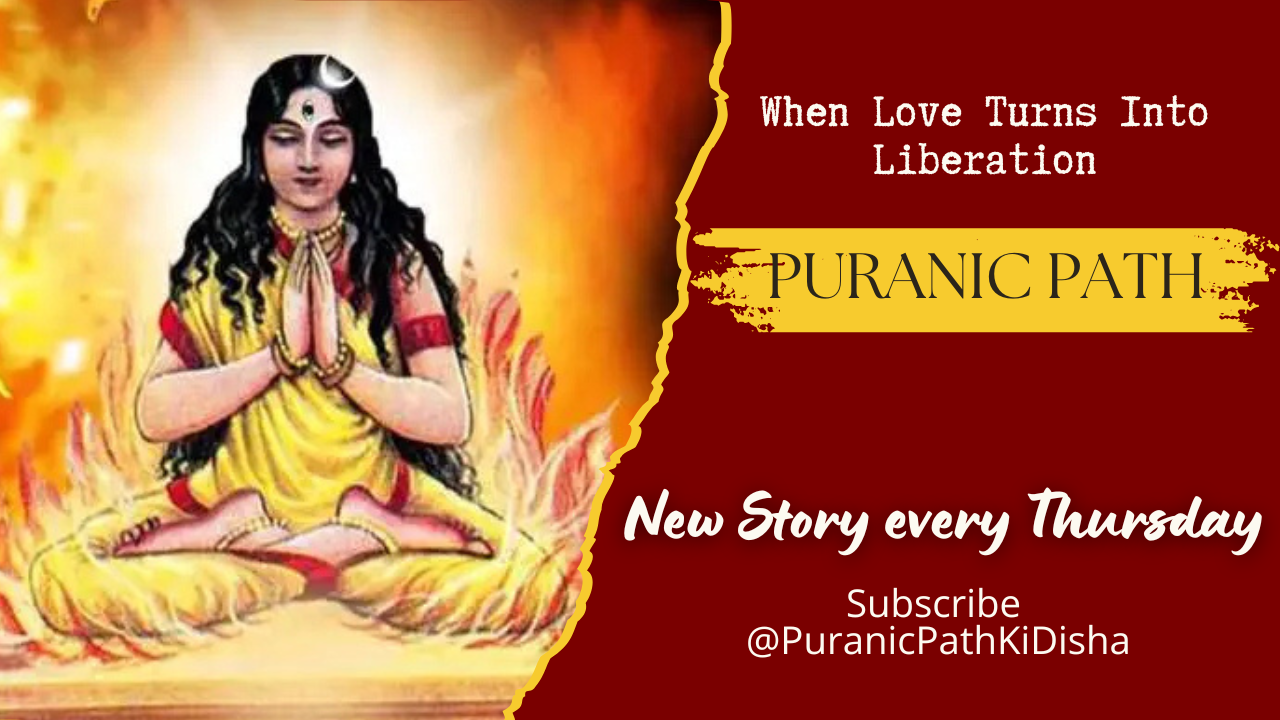
Then, with the solemnity of a divine being preparing for her final act, she sat upon the ground facing the north.
She performed āchaman, covered her body with a yellow cloth, closed her eyes, and entered fully into the discipline of Yoga.
Her posture became steady and unmoving.
Through deep prāṇāyāma, she united the Prana and Apana Vayus and centered them in the Navel Chakra.
Gradually she raised the Udana Vayu upward from the navel and firmly established it in her heart.
From the heart, with unwavering concentration, she guided her breath and consciousness upward—through the throat, toward the space between her eyebrows.
Thus resolved to abandon her body—
a body adored even by sages,
a body Bhagwan Shankar had placed lovingly by His side countless times—
the Divine Mother Sati infused the energies of air and fire throughout every limb.
Her final thought was the sweetest:
the fragrant pollen of the lotus feet of her beloved Lord—Bhagwan Shankar, the Guru of the Universe.
In that one-pointed absorption, all other identities dissolved.
Even the subtle notion “I am Daksha’s daughter” vanished completely.
And in that state of absolute purity, her divine body burst into flames—the sacred fire born of her own Yoga.
Chaos Unleashed
In that very moment, when the assembled Deities and Agni Dev witnessed the awe-striking sight of Sati immolating her own body through the fire of Yoga, a wave of shock and grief swept through the heavens and the earth.
A terrifying uproar echoed in all directions.
Cries arose from every corner:
“Alas! Because of Daksha’s cruelty, Sati—the beloved of Mahadev, Lord of all gods—has abandoned her life!
He is her father, yet how heartless he has become!
His daughter was pure, deserving of honor and respect, yet he insulted her to such an extent that she embraced death!
Truly, he is an enemy of Brahmanas and a destroyer of Dharma!
Even when she stood ready to lay down her life due to his own offense, this hater of Shiva did not make the slightest effort to stop her!
What a terrible disgrace will fall on his lineage!”
As the heavens cried out and the Yagna-hall trembled, Shiva’s attendants, witnessing the divine yet tragic sacrifice of Sati, were seized with uncontrollable rage.
Weapons glimmering in their hands, they charged forward, ready to strike Daksha down.
Seeing their furious advance, Bhagwan Bhrigu quickly began chanting potent mantras.
With the intention to protect the Yagna and crush its disruptors, he cast a sacred oblation into the sacrificial fire.
The Birth of the Ribhus
In response, from the blazing sacrificial pit emerged thousands of radiant beings, known as the Ribhus—powerful deities who had attained the moon-world (Chandra-loka) through intense penance.
Their bodies shone with the brilliance of Brahman itself.
Armed with flaming logs, the Ribhus rushed forward and clashed fiercely with Shiva’s attendants.
The sudden and overwhelming force of their attack caused the Guhakas and the Pramatha ganas to scatter in all directions.
Closing Thought: The Fire That Still Burns Today
Sati’s story isn’t just ancient mythology.
It’s the story of today’s world…
of families torn apart by ego…
of love strangled by pride…
of voices silenced in the name of image, status, and reputation.
Sati teaches us:
When ego enters relationships, love dies.
When humility enters relationships, God arrives.
Sometimes the fire that destroys us…
is the same fire that purifies us.
Her sacrifice reminds us:
True dignity is not in enduring humiliation—
but in standing up for the divinity within yourself.
And ultimately—
Love that is rooted in surrender becomes indestructible.
Even death cannot end it.