In the quiet of the hermitage, the sacred silence was pierced only by the murmured voice of Kapil Bhagwan as He continued His divine discourse to His mother, Devahuti. Her eyes, wide with wonder and humility, reflected the weight of truths she could barely hold – truths that stirred the deepest layers of existence.
Kapil Muni said, “Mother, when a soul, bound by karma, is to be born in a human form, it enters the womb of a woman by divine inspiration. There, it merges with the ovum, becoming a formless mass. In five nights, it transforms into a bubble-like form, and in ten nights, into a semi-solid lump. From there, it slowly hardens into flesh. In birds and other creatures, it may take the form of an egg. But in humans, after a month, the head appears; in the second, limbs develop; and in the third, gender and sensory organs manifest.”
The stages of human formation were not merely biological – there were spiritual unfoldings. In the fourth month, the soul’s subtle faculties, the seven dhatus including mind and consciousness, arise. In the fifth, hunger and thirst awaken. By the sixth, the delicate being starts to stir, cloaked in membranes, its body helplessly coiled like a bird in a cage, floating in the dark waters of the womb.
But then, something sacred happens.
“Mother,” Kapil Bhagwan said, his voice soft with compassion, “In this prison of flesh, this little soul, fragile and folded, is graced with the spark of memory. It recalls the karmas of countless past lives. It feels suffocated, restless. With its head pressed down and limbs numb, it cries not with voice, but with the agony of remembrance.”
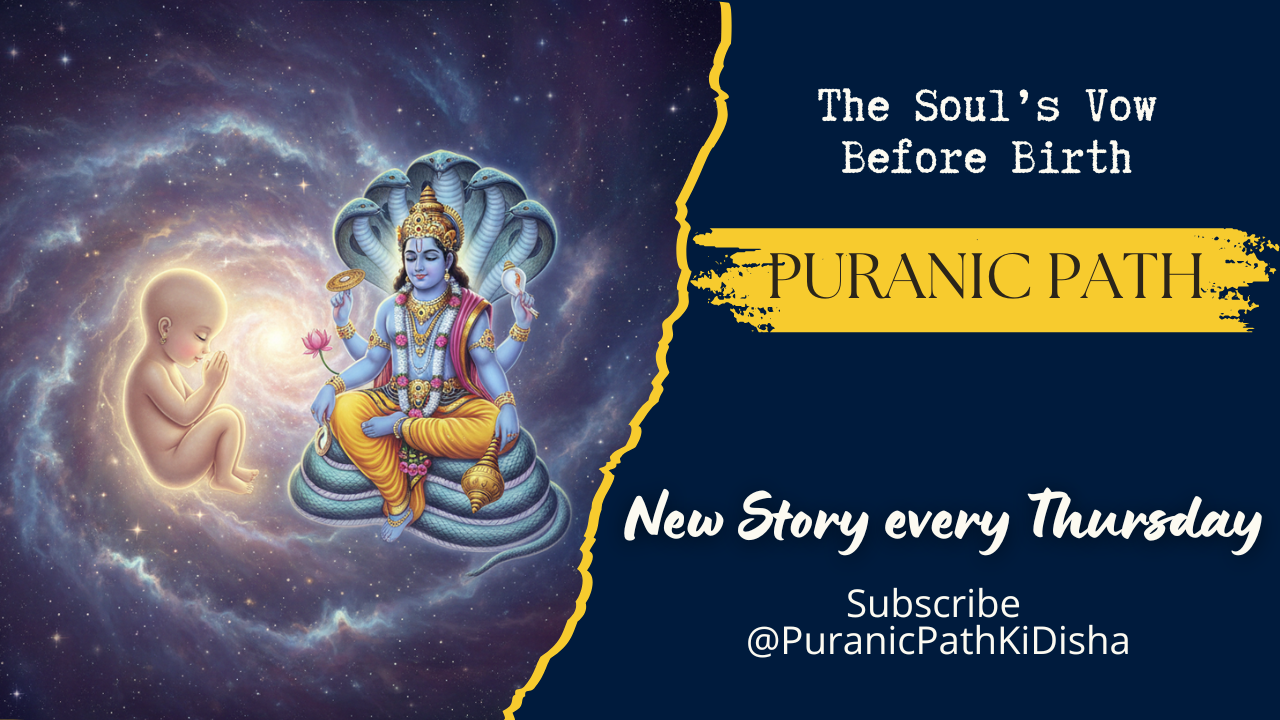
In the seventh month, Gyan Shakti — the power of knowledge — awakens within the unborn being. It becomes aware of its condition and, in that womb of darkness, light dawns. In supreme helplessness, the soul turns to God. With folded hands and trembling devotion, it prays:
This sacred prayer, untainted by ego or expectation, is the highest hymn of surrender. The unborn soul vows to install the lotus feet of the Lord in its heart, to cross the ocean of worldly bondage using the boat of wisdom.
With folded hands and a heart full of humility, the soul eulogizes the Supreme Lord who placed it within the protective confines of the mother’s womb. In its deep realization, it confesses, “O Lord, I am lowly and ignorant, yet the path You have revealed to me is perfectly suited to my fallen state. You, who manifest in countless forms to rescue this transient world, especially uplift those who surrender unto You.
Though I have taken refuge in this womb and become encased in the illusion of body, senses, and mind, I am truly Yours — a spark of Your eternal consciousness, now dulled by karma and delusion. I worship You, O omniscient Lord, the sovereign of Prakriti and Purusha, for only through Your grace can the soul rediscover its divine essence. Without You, there is no escape from the entrapment of karma and the endless wanderings through birth and death. Even this fleeting wisdom I now possess is but a ray of Your mercy. As I count the days of confinement, praying for liberation from this dark womb, I beg You — may I not forget this truth when I emerge into the world. For once outside, Your Maya will veil me again, and I may fall back into ego and illusion.
Hence, I make a vow: I will fix Your lotus feet in the sanctuary of my heart, and with the strength of devotion, I will cross this ocean of worldly existence — never to fall again into the snares of delusion, but to seek only You, my eternal refuge.”
But then — birth begins.
Kapil Bhagwan’s voice grew solemn:
“At the appointed time, that helpless soul is pushed downward. Its head, pressed by the force of labor, emerges painfully into the world. As it cries, the air strikes its lungs, and with that breath, all its sacred memory is erased. The soul, who had just prayed for liberation, is now surrounded by strangers who cannot understand its weeping.” The light it glimpsed is lost.
Enduring the sufferings of birth and childhood, the soul matures into youth — a phase charged with vitality and restlessness. If, during this period, it fails to attain some semblance of worldly pleasure (Kshetra Bhog), its heart, clouded by ignorance, begins to smoulder with dissatisfaction. Anger and pride surge forth, fuelled by unfulfilled desires, and the soul begins to clash with others similarly enslaved by longing. In this turmoil, it becomes proud of its own fleeting intellect and the very body that will one day decay and become the source of immense suffering in old age. Bound by the threads of organs, desires, and karma, it remains ever-attached to this impermanent form, labouring endlessly in pursuit of temporary joys. This attachment binds it to repeated cycles of birth and death (Sansar Chakra), never allowing it true rest. Even if it once chooses the righteous path, a single association with those immersed in sensory indulgence can corrupt it. By imitating the worldly-minded, it falls again into the same human form, losing all its virtues—truth, compassion, discipline, intellect, wealth, modesty, forgiveness, and self-control—like a lamp extinguished by the storm of bad company.
O Devi, the soul (Purusha), caught in the bondage of limiting adjuncts—mind, senses, and karma—wanders from one life to another, reaping the fruits of past actions and sowing new seeds for future births. The subtle body (Linga Sharir), inseparable from the soul until liberation, carries the impressions of all deeds, while the gross body (Sthula Sharir) becomes the field for experiencing joy and sorrow. Death is nothing but the dissociation of these two; and birth, their reunion. When the body, once a tool of perception, loses its power to engage with the world, it is called death. Yet, to falsely identify with this body as ‘I’ is to be reborn into illusion. One must rise above helplessness and delusion by understanding the true, unchanging self—the Atman. With calm detachment and inner contemplation, one should view this body not as the self, but as a temporary trust (nikshep dharohar), living in this dreamlike world with the armour of yoga (discipline) and vairagya (renunciation).
Kapil Devji explains to Devahuti: “O Mother, a householder who performs his duties with a selfish heart (sa-kam bhav), enjoying wealth and desires, and then continues the same indulgent cycle again and again, becomes bound by his own cravings. Such a person, deluded by the mirage of enjoyment, turns away from the Supreme, and instead of seeking liberation, he entangles himself further in ritualistic worship directed only toward minor deities and ancestors. Thus, he remains stuck in the revolving door of existence, unaware that only devotion to the all-pervading Bhagavan can break the chains of rebirth and lead him to true freedom.”
The Paths Ahead: Pitfall or Ascent
Kapil Bhagwan then described two kinds of householders:
- Those attached to desires, who perform duties with expectations. They worship deities and ancestors, gaining celestial pleasures in Chandralok. But when their merit exhausts, they fall back to earth — to the same entanglement they sought to escape.
- The wise ones (viveki purush), who perform duties without desire, solely to please God. Their hearts become pure, egoless, and selfless. They walk the Surya Marg — the radiant path of the sun — toward eternal union with Shri Hari, the Supreme Lord.
Kapil Dev Ji further reveals that the Lord is the eternal controller of both cause and effect—the origin, sustainer, and dissolver of all creation. Even at the end of creation, when the mighty Brahma himself, aware of the invincible power of Kaal (Time), desires to dissolve the entire universe—merging Earth, Water, Fire, Air, Space, Mind, Senses, Ego, and all their objects—he too is absorbed into Trigunatmaka Prakriti (the threefold material nature) and finally merges into the Nirguna (attributeless), Supreme Self. At that profound time, the detached yogis (virakt yogi gan), having conquered breath and mind, also relinquish their bodies and enter into Brahma Ji, and from there merge into Parabrahma—the Supreme, blissful, eternal Person (Parmanand Swaroop Puran Purush). Yet, this merger happens only when even the subtlest trace of ego (ahankar) is dissolved.
Therefore, O Mother, Kapil Dev Ji advises with great tenderness—take unshakable refuge in the lotus feet of Shri Hari. For His temple resides in the hearts of all beings, and you have already heard of His glories from Me. Even great souls like Brahma, Marichi, the Sanatkumaras, and perfected yogis attain Him through nishkama karma—action without attachment. But when cosmic dissolution approaches, even they, affected by the residual sense of doership and duality, are stirred in their gunas by the will of Kal-roop Ishwar (Time in the form of God) and reappear once more in the cycle of creation.
Those who perform ritualistic duties (karma-kand) bound to worldly ends—wealth, desire, and dharma—remain engaged in Vedic rites from birth to death, worshiping ancestors and deities. Their intellect, dominated by rajas (passion), becomes clouded. Trapped in a web of desires, with uncontrolled senses, and attached to household life, they avoid even discussing the divine glories of the Supreme Lord. Such souls, after performing every prescribed samskara, travel through the Dhoom Marg (smoky path)—the southern path of ancestors—and reach Pitrloka, the realm of forefathers ruled by deities like Aryaman. Yet this too is transient. When their merits are depleted, they are cast out by the celestial beings and helplessly fall back into the world, reborn among their own descendants.
Hence, Kapil Dev Ji concludes with urgency and compassion: O Mother, abandon all lesser aims. Worship that Supreme Lord whose lotus feet are worthy of endless adoration. Fix your mind, speech, and body on Him through unwavering devotion. Only by clinging to His divine qualities with sincere love can one cross this ocean of sorrow and attain eternal liberation.
Closing Reflections: A Forgotten Prayer and a Timeless Truth
This divine conversation unveils a stunning paradox — the soul prays with supreme wisdom in the womb, only to forget everything at birth. Isn’t this our story too? Haven’t we all once prayed, from a place of helpless surrender, only to be distracted by the flickers of Maya?
But Kapil Bhagwan offers hope: We are not meant to remain asleep.
Through association with saints, selfless action, detached living, and above all, devotion to Shri Hari, we can remember what we once knew — that we are eternal souls, not perishable bodies.
In a world obsessed with the external, this is a radical awakening. Even now, amid distractions, desires, and delusions, we can turn inward. We can live in the world, but not be of it.
We must ask ourselves —
Will we let the soul’s cry in the womb be forgotten forever? Or will we remember that sacred prayer and live by its truth?
Let us remember now. Let us return to that vow made in the darkness—to seek only God, our eternal refuge. Let us not wait for another lifetime.