From the story series part 4: Kapil Bhagwan’s Teachings to Devahuti – A Journey to Liberation
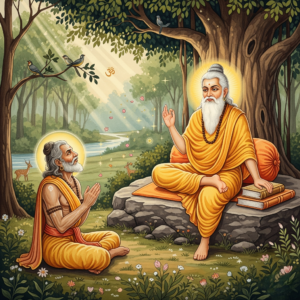
Sitting with folded hands, eyes filled with a rare glow of both humility and eagerness, Devahuti gently asked her divine son, “O Lord, You have blessed me with clarity about Prakriti, Purusha, and the great elements of creation. But now, my heart yearns for the deeper path—the path of Bhakti. Please show me the road of devotion that pierces through the veils of illusion and leads directly to You.”
“Also, please describe the various destinies of living beings—such as birth, death, and other states—hearing which leads to detachment from worldly pleasures. Also, reveal the true nature of powerful Kaal (Time), which inspires fear and righteous action, and which even controls Brahma himself. You have appeared like the sun of Yoga to awaken those lost in ignorance, who falsely identify with the body and remain trapped in the darkness of Samsara, weary from the endless cycle of karma and rebirth”.
Kapil Bhagwan smiled. “Mother, Bhakti Yoga manifests differently for each soul, reflecting the mirror of their inner nature.”
Then, like the Ganga flowing from heaven to earth, Kapil Bhagwan’s words descended, describing the fourfold expression of devotion:
- Tamasic Bhakti – When one worships Me while driven by pride, anger, jealousy, or violence, such devotion is covered in darkness. The devotee clings to ego, unable to see Me clearly.
- Rajasic Bhakti – When one seeks Me with desires for power, pleasures, and worldly gains, this devotion is turbulent like fire. It recognizes Me but from a distance.
- Sattvic Bhakti – When one approaches Me with dutiful reverence, offering actions selflessly, but still sees Me as separate, this is serene devotion—but not yet free from duality.
- Nirguna Bhakti – The highest of all. Like an uninterrupted stream, tireless flow of the Ganga, this is devotion free from desire, duality, and ego. The heart melts, not for reward or liberation, but for love alone.
“These Nirguna Bhaktas,” said Kapil Bhagwan with deep reverence, “even if I offer them liberation, merge into My form, or eternal abode—they refuse. They want nothing but My loving service. That, Mother, is the supreme purpose of human life.”
Devahuti sat speechless, her heart stirred like a still lake kissed by a sudden breeze.
Bhagwan Kapil continued, revealing the sacred practices of Bhakti: “Perform your duties with faith and nonviolence. Worship Me in images, but also in every living being. Touch Me in the poor. See Me in the trees. Hear Me in the scriptures. Speak of Me, sing of Me. Walk with the noble, abandon pride, be simple, and your heart will become pure like the morning sky.”
Then His voice deepened. “I am the Supreme Self, present equally in all living beings. Therefore, those who ignore My presence within others and worship only My external form through idols perform hollow rituals. True devotion is not found in offerings alone, but in seeing Me—the Atma—in all. One who discriminates, harbors hatred, or fails to honor others as embodiments of the Divine cannot attain peace. Even elaborate worship means nothing if one disrespects living beings.
Real spiritual growth begins when a person sees no difference between the individual soul and the Supreme Soul, and worships Me through compassion, charity, respect, and equal vision. Among all beings, the greatest are those who renounce ego and selflessly dedicate all actions, their very self, to Me—seeing Me in all, serving Me in all. Such a person is truly superior. This, dear Mother, is the essence of Bhakti Yoga and Ashtanga Yoga”.
The Mystery of Kaal – Time as the Supreme Teacher
But Devahuti still had questions that burned like sacred fire. “O Lord, what is this mysterious force that terrifies even the gods? What makes the wind blow, the sun shine, the hearts race with fear of loss? What governs this vast creation?”
Kapil Bhagwan’s gaze turned to the eternal. “That is Kaal, Mother. Invisible, unstoppable, eternal. It is the hidden hand behind every birth, every decay, every goodbye. Out of fear of Kaal, fire burns, rivers flow, stars shine, and even Brahma performs his duties. It is both the creator and the destroyer.”
Kaal is not a being—it is the Supreme’s will in motion. It causes Mahat-tattva to expand, elements to rise, and even Time’s own agents like Yamaraja to tremble. It gives birth, sustains, and finally brings death—not out of cruelty, but to awaken the deluded soul from its sleep.
The Soul’s Journey Through Illusion and Death
Then, like peeling layers of a dream, Kapil Bhagwan revealed the sad plight of the soul caught in the web of illusion.
“The Jiva,” He said, “wanders endlessly, thinking temporary joys are eternal. It clings to the body, wealth, children, and name. Even when suffering strikes, it mistakes brief relief as happiness created by Maya. It fights, cheats, hoards, and breaks—never pausing to ask: ‘Who am I?’”
When death comes, it doesn’t come gently. “The body weakens, digestion fails, relatives cry, and speech vanishes. Then, fearsome Yamadutas appear—fiery-eyed, bound with ropes. The soul trembles and is taken—alone—on a painful path of 99,000 yojanas, suffering torment after torment in Yamaloka.”
And yet, from that pit of darkness, light can emerge. “After being purified by pain,” Kapil Bhagwan concluded, “the soul takes human birth once again. A chance. A sacred window to rise above karma and cling to the feet of the Divine.”
Reflections: Eternal Truths for a Modern Heart
We run from boredom, mask pain with distraction, and chase pleasures that fade faster than morning mist. Kapil Bhagwan’s timeless conversation with Devahuti is not just a distant spiritual dialogue—it is a mirror held up to our modern lives. In an age where devotion is often confined to rituals, temples, or occasional prayer, Kapil Bhagwan reminds us that true Bhakti—true love for the Divine—begins in the heart that sees God in every living being. Not just in idols, but in the eyes of the poor, the struggles of others, and the silent beauty of nature.
Today, many chase power, pleasure, or peace, only to find themselves restless, anxious, or lost in endless comparisons. We strive, accumulate, and still feel empty. This is the same Samsara—the cycle of illusion and forgetfulness—that Kapil Bhagwan spoke of. And just like then, the way out is not through more acquisition, but through awareness, detachment, and devotion.
In a world fragmented by division—religious, political, and personal—Kapil Bhagwan’s words call us to rise above ego and see the One Self in all. To serve not with condescension, but with reverence. To turn our daily duties into sacred offerings as time waits for none. Whether we’re a beggar or a billionaire, Kaal walks beside us. But the wise do not fear it but befriend it, using every moment as a step toward divine love.
We may not meet Yamadutas with fiery eyes, but we all feel the tug of time—aging, loss, change, the fear of missing out. Kapil Bhagwan urges us to wake up—to use this human life not for endless consumption, but for conscious transformation. Even today, the chance to evolve, to love deeply without expectation, and to live with meaning is within our reach.
Let us ask ourselves—am I worshipping only through rituals, or am I also bowing to the Divine in the hungry, the lonely, the stranger, and the forgotten?
Let us remember—time is not our enemy, but our greatest teacher. It strips away illusion and invites us to the eternal.
Let us live—not just with devotion on our lips, but with compassion in our hands and oneness in our eyes.
That, Kapil Bhagwan says, is the essence of Bhakti. And that is still the truest way home—even today.
Kapil Bhagwan’s words echo a timeless promise: If you love Me with all your heart—not for reward, not for escape, but just because you know Me as your very Self—I will carry you beyond the reach of death, sorrow, and rebirth.