Have you ever felt invisible despite giving your best?
Have you ever been wounded by words spoken casually—by family, authority, or those whose approval you sought the most?
And in that pain, have you ever thought, “I’ll prove my worth… no matter what it costs”?
The ancient story of Dhruva begins exactly there—not in temples or forests, but in a broken moment of rejection inside a royal palace. A five-year-old child, humiliated not by enemies but by his own family, sets out on a journey that transforms anger into awakening and ambition into surrender.
When Vidura asks Rishi Maitreya to narrate Dhruva’s life, what unfolds is not merely a Purāṇic legend—it is a psychological and spiritual map for modern life.
In an age of comparison, validation-seeking, ego wounds, burnout, and emotional chaos, Dhruva’s journey answers questions we silently carry:
- What should I do with my anger?
- How do I turn pain into purpose?
- Is success enough to heal inner wounds?
- What happens when we ask God for the wrong things?
- And what does true fulfillment actually look like?
This story does not glorify escape from the world—it teaches how to live, rule, love, fail, repent, and finally transcend, without losing compassion or clarity. Dhruva’s life shows us that even when God grants our wishes, inner healing begins only when ego dissolves into awareness.
If you are navigating rejection, ambition, grief, anger, success, or the fear of impermanence—this story is not ancient.
It is deeply, uncomfortably, beautifully current.
When Vidura, burning with the thirst for divine wisdom, humbly requested Maitreya to narrate the sacred story of Dhruva, the sage began unfolding a tale that is not merely history—but a mirror to every wounded heart seeking meaning, dignity, and God.
The Roots of the Wound: A Kingdom Divided by Favor
From Svayambhuva Manu and Queen Shatarupa were born two sons—Priyavrata and Uttanapada. Of these, King Uttanapada ruled the earth with two queens: Suniti, gentle and neglected, and Suruchi, proud and favored.
Suniti’s son was Dhruva. Suruchi’s son was Uttama.
One day, in the royal court, King Uttanapada lovingly seated Uttama on his lap. Innocent Dhruva, yearning not for power but for his father’s warmth, climbed forward to sit beside him. But the King—silenced by attachment and fear—turned away.
That moment shattered a child’s world.
Suruchi, intoxicated with pride, struck Dhruva not with hands—but with words sharper than weapons:
“You are unfit to sit on this throne. You were not born from my womb. If you desire royal honor, worship Vishnu and be reborn through me.”
Those words lodged in Dhruva’s heart like burning arrows.
A Mother’s Pain, A Mother’s Wisdom
Trembling with rage and humiliation, Dhruva ran to Suniti. His breath was heavy, his lips quivered, his eyes burned with unshed tears.
Suniti gathered her son into her arms to calm him but when she heard of Suruchi’s harsh words from the palace staff, she was overcome with grief. Her patience broke, and she began to weep, tears flowing from her lotus-like eyes. Sighing deeply, she told Dhruv: Yet from her tears emerged truth, not poison.
“My child… do not curse those who hurt you. Their cruelty is the fruit of their own karma. What Suruchi said is painful—but not false. If you desire something beyond insult and injustice, then seek refuge at the lotus feet of Narayana. No one else can erase this sorrow.”
“By taking refuge at the lotus feet of Shri Hari—who assumes the pure quality of Sattva to sustain and nourish the entire creation—your great-grandfather, Lord Brahma, attained that exalted position which is worshipped even by sages who have completely mastered their minds and senses. In the same way, your grandfather, Swayambhu Manu, with unwavering devotion, worshipped that very Supreme Lord through sacred sacrifices, selfless charity, and righteous conduct. Only by such single-minded surrender did he attain both worldly fulfillment and ultimate liberation—states that remain unattainable for most beings bound by desire and ego.”
“My son, take refuge in that very Lord who eternally protects His devotees. Those who seek freedom from birth and death wander only toward His lotus feet. Purify your heart through your own swadharma, fix Lord Purushottam firmly within your mind, and worship Him alone, abandoning all other thoughts. I see no one else who can remove your sorrow—for even Goddess Lakshmi herself forever seeks Lord Hari, the supreme refuge of all.”
This was the turning point.
A wounded ego became a seeking soul.
Narada’s Test: Wisdom Meets Determination
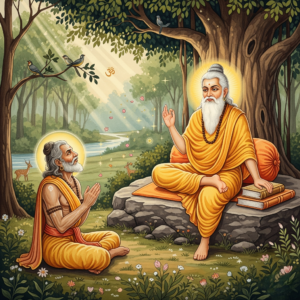
Sage Maitreya said: Having understood the path shown by his mother, Dhruv steadied his resolve and left his father’s city. When Sage Narada learned of this, he came to the child. Narada tried to soften the fire: gently placing his hand upon Dhruv’s head and marveling at the fierce honor of a Kshatriya heart, so deeply wounded by harsh words even at such a tender age.
Narada then counseled Dhruv, saying that he was still a child, meant for play rather than concern over honor and insult. He explained that joy and sorrow arise from past karma, born of attachment, and that the ways of the Lord are unfathomable. Advising contentment with one’s destined circumstances, Narada urged Dhruv to abandon his difficult resolve and return home, reminding him that even great yogis struggle for lifetimes to attain the Lord, and that peace comes through acceptance and detachment.
The Key to Peace and the Fire of Resolve
Narada concluded with a timeless teaching:
“One who rejoices in the virtues of those greater than oneself, shows compassion toward those who have less, and maintains friendship with equals can never be conquered by sorrow.”
Dhruva then spoke with folded hands, his voice steady yet burning with resolve:
“O revered sage, the path of equanimity you describe is lofty and pure, meant for those whose minds naturally rise above joy and grief. But I am still bound by ignorance and possess the fierce spirit of a Kshatriya. My stepmother’s harsh words have pierced my heart like arrows, and therefore your counsel of calm cannot yet take root within me.
O son of Brahma, you wander the three worlds for the welfare of all, radiant like the sun and veena in hand. I seek a position so supreme that neither my father nor my ancestors have ever attained it. Kindly show me the path by which such a goal may be achieved.”
Narada smiled.
Pleased by Dhruva’s unwavering determination, Sage Narada blessed him and said:
“Child, the path shown by your mother Suniti is indeed the path of your highest good. Lord Vasudeva alone is the means to your fulfillment. Fix your heart upon Him and worship Him with single-minded devotion, for those who seek Dharma, Artha, Kama, or Moksha can attain them only by serving the lotus feet of Shri Hari.”
The Path of Fire: Dhruva’s Terrifying Penance
After receiving Sage Narada’s sacred instructions, Prince Dhruv reverentially circumambulated him and bowed low at his feet. With unwavering resolve, he then set forth towards the holy forest of Madhuban, sanctified by the very footprints of the Lord.
Soon after Dhruv departed for the forest of penance, Sage Narada arrived at the palace of King Uttanapada. The King welcomed him with great reverence and offered all customary honors. When Narada was seated, he gently observed the King’s sorrowful countenance and asked,
“O King, your face appears pale and burdened with worry. Have you encountered some obstacle in the pursuit of Dharma, Artha, or Kama?”
Overwhelmed with remorse, the King replied,
“O revered sage, I am indeed cruel and stone-hearted. Alas, I have driven my tender five-year-old son away from my home. He was intelligent and delicate like a lotus—surely his face must now be worn with fatigue. I fear he may have collapsed on the road or fallen prey to wild beasts in the forest. Out of love, he merely sought my lap, yet I failed to show him even the slightest affection.”
Narada consoled the grieving King, saying,
“O King, do not mourn. The Supreme Lord Himself is the protector of your son. You do not yet know his extraordinary strength or destiny—his glory is already spreading across the world. That child shall soon return, having accomplished a feat beyond even the reach of great men. Through him, your own fame shall also shine.”
Sage Maitreya continued: Hearing these reassuring words of Devarishi Narada, King Uttanapada gradually withdrew his mind from worldly affairs and remained constantly absorbed in thoughts of his son.
The Fierce Penance of Dhruv
Meanwhile, in the sacred forest of Madhuban, Dhruv commenced his intense worship of Shri Hari.
- First Month: He sustained his body by eating wood-apples and jujube fruits once every three days, dedicating himself entirely to devotion.
- Second Month: He reduced his sustenance to dry grass and leaves, taken only once in six days.
- Third Month: He subsisted solely on water, drinking once every nine days, while remaining absorbed in deep meditation.
- Fourth Month: Conquering hunger and thirst, he lived only on air, drinking it once every twelve days as he continued his tapasya.
- Fifth Month: Finally, Dhruv completely restrained his breath and stood motionless on one leg, firm like a pillar, meditating upon the Supreme Brahman.
Withdrawing his mind from all sensory objects, he fixed his entire consciousness solely upon the form of Lord Hari, allowing no other thought to arise.
When a Child’s Devotion Shook the Cosmos
As Dhruv meditated upon the Supreme Reality—the foundation of all elements and the master of both Prakriti and Purusha—the three worlds began to tremble. Standing upon one foot, the pressure of his great toe caused the Earth to tilt, much like a boat sways when an elephant steps aboard.
When Dhruv restrained his breath and merged his individual life-force with the universal Prana through unbroken meditation upon Shri Hari, the breath of all beings throughout the cosmos was simultaneously stilled. Stricken with suffocation, the celestial beings became distressed and rushed to take shelter in the Supreme Lord.
They prayed,
“O Lord, the life-force of all moving and unmoving beings has ceased at once—such an event has never occurred before. You are the protector of those who seek refuge; kindly relieve us from this unbearable distress.”
The Lord replied with assurance,
“O Devas, do not fear. This disturbance has arisen because Dhruv, the son of King Uttanapada, has completely merged his consciousness into Me, the Soul of the Universe. His unwavering concentration has reached perfection. As he has restrained his breath, so too has the breath of all beings been affected. Return now to your abodes—I shall personally go and release the child from this severe penance.”
Hearing the Lord’s words, the fear of the deities vanished. Bowing to Him in reverence, they returned joyfully to their celestial realms
And Lord Vishnu arose.
God Appears Where Ego Dissolves
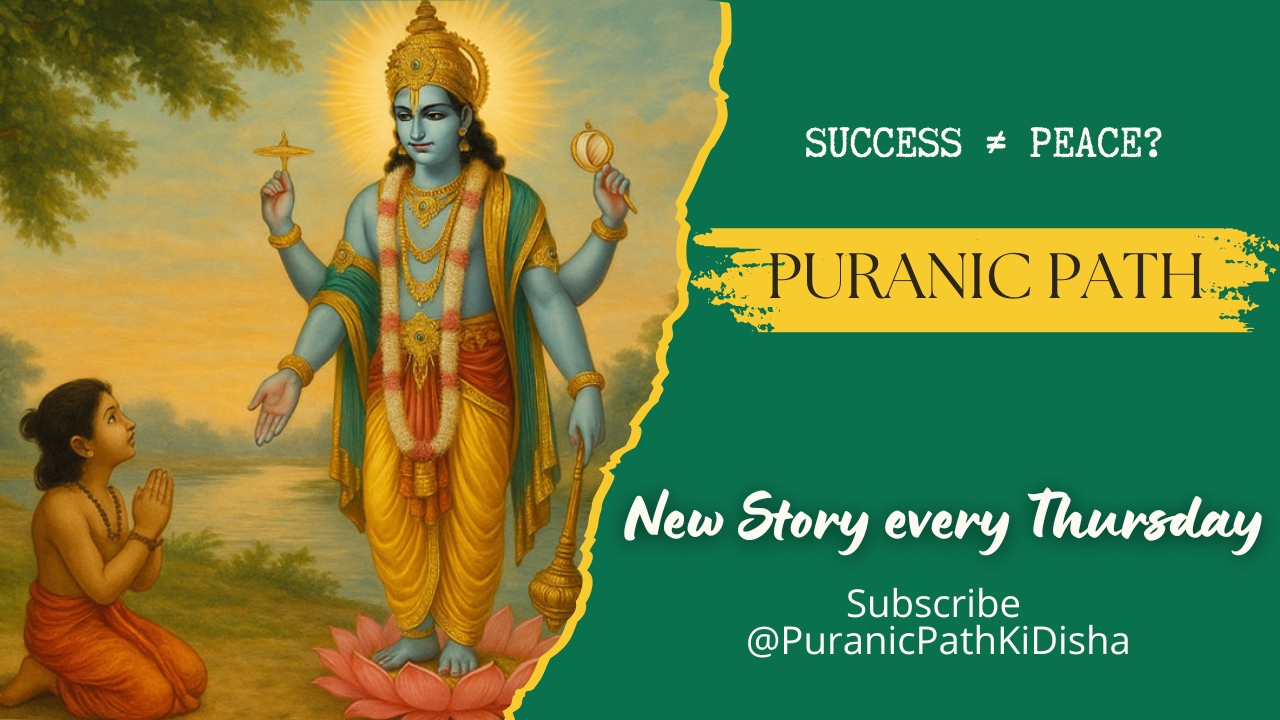
Thereafter, the Supreme Lord, revealing His universal form, mounted Garuda and arrived at Madhuban to behold His devoted child. Dhruva was so deeply immersed in intense Yoga that the divine form he had been contemplating within the lotus of his heart suddenly disappeared. Startled, he opened his eyes—only to behold that very same radiant form of the Lord standing before him in divine splendor.
At the sight of the Lord, Dhruva was overwhelmed with wonder and love. He fell flat upon the earth like a staff, offering his humble obeisance. His eyes drank in the beauty of the Lord, as if longing to embrace Him, to kiss Him, to hold Him forever within his heart. Though his soul overflowed with devotion, he stood with folded hands, unable to find words to praise Him.
Understanding the silent yearning of His devotee’s heart, the all-knowing Lord Hari, in His boundless compassion, gently touched Dhruva’s cheek with His divine conch—the bearer of Vedic wisdom. At that sacred touch, divine speech awakened within Dhruva, and he attained clear realization of the Soul and the Supreme Brahman. With steady devotion and reverence, he began to glorify the world-renowned Lord.
Dhruva prayed:
“O Lord, You dwell within my heart and awaken my dormant voice by Your power alone. You enliven my senses, my limbs, and my very life-breath. I bow to You, the eternal Indweller of all beings.”
Sage Maitreya said to Vidura: When Dhruva, firm in resolve and purified in heart, thus offered his prayers, Lord Hari—ever affectionate toward His devotees—addressed him with words of praise.
The Boon Bestowed by the Lord
The Lord said:
“O noble Prince, I know the intention of your heart. Though what you seek is exceedingly rare, I grant it to you. May you be blessed. I bestow upon you Dhruva-loka, the eternal and self-effulgent Pole Star—an imperishable realm never attained before. Around it revolve all planets and stars, and it remains unmoved even when other worlds dissolve at the end of a cosmic age. The great sages and celestial luminaries eternally circumambulate this supreme station.
In due time, you shall rule the Earth righteously for thirty-six thousand years, your strength and senses remaining ever unimpaired. You shall worship Me through sacred sacrifices—My beloved form—and enjoy noble worldly pleasures. In the end, remembering Me alone, you shall reach My supreme abode, revered above all worlds. Having reached it, one never returns to the cycle of birth and death.”
Having thus revealed Dhruva’s destined path, Lord Vishnu, seated upon Garuda, vanished from before his eyes.
But
Dhruva felt sorrow.
The Greatest Regret: Asking Too Little from God
Having attained his desired boon through service at the lotus feet of the Lord, Dhruva returned to his city. Yet, despite his extraordinary success, his heart was not at peace.
Vidura then asked Sage Maitreya, “O revered sage, the supreme abode of Shri Hari is exceedingly rare and attained only through unwavering devotion to His lotus feet. Dhruva possessed the wisdom to discern the eternal from the transient. Why, then, after attaining such an exalted state within a single lifetime, did he still consider himself unfortunate?”
Maitreya replied, “Dhruva’s heart had been deeply wounded by the sharp words of his stepmother, and even at the moment of receiving the Lord’s boon, those impressions lingered within him. Thus, instead of seeking liberation from the very Giver of liberation, Shri Hari, he asked for a worldly reward. When the divine vision of the Lord finally cleansed his mind of all impurities, Dhruva was overwhelmed with profound remorse.”
Dhruva reflected within himself:
“The very refuge of the Lord’s lotus feet—so difficult to attain that great celibates like Sanaka and perfected beings strive for it over countless lifetimes—I attained in merely six months. Yet, because my heart was divided, I drifted away from Him once more.
How great is my folly! I stood before the One who severs the bonds of worldly existence, yet I begged for transient power. Perhaps the celestial beings, unable to bear my rising spiritual state, clouded my understanding, and thus I failed to heed the wise counsel of Narada.
In truth, there is no ‘other’ besides the one Self. Yet, like a man frightened by an imagined tiger in a dream, I was deceived by the Lord’s Maya. I viewed my own brother as an enemy and burned in the fire of resentment. I pleased the Soul of the Universe through severe penance—an achievement rare even for the greatest yogis—yet what I asked for was as futile as medicine given to one whose life has already ended.
Alas, how unfortunate I am! From the Lord who liberates beings from birth and death, I sought more of the perishable world. I am like a beggar who, after winning the favor of an Emperor, asks only for a handful of broken grains. Instead of seeking eternal bliss, I chose a lofty position that merely feeds the vanity of pride.”
The Return and Reunion of Dhruva
When King Uttanapada heard that his son Dhruva was returning, he was struck with disbelief, as if someone had returned from the realm of Death itself. Thinking himself unworthy of such fortune, he soon recalled the reassuring words of Devarishi Narada, and faith replaced despair.
Dhruva bowed at his father’s feet, received his blessings, and then prostrated before both his mothers. Suruchi, lifting him with trembling hands, embraced him and tearfully blessed him with long life. Dhruva and his brother Uttama met with deep affection, their eyes flowing with tears, while Suniti embraced her beloved son, forgetting the world in boundless joy.
As Dhruva grew and the people’s devotion toward him became evident, King Uttanapada, remembering Narada’s prophecy and witnessing its fulfillment, renounced worldly life and retired to the forest.
Sage Maitreya concluded by telling Vidura that Dhruva later married Bhrami, the daughter of Prajapati Shishumara, with whom he had two sons, Kalpa and Vatsara. He also married Ila, the daughter of Vayu, who bore him a son named Utkala and a virtuous daughter.
The Conflict with the Yakshas
Dhruva’s brother Uttama, still unmarried, was once killed by a powerful Yaksha while hunting in the Himalayas. Soon after, his mother Suruchi also passed away. When Dhruva heard of this tragedy, grief and rage consumed him. Mounting his chariot, he set out toward the northern Himalayan valleys, reaching Alkapuri, the city of the Yakshas—inhabited by Bhootas, Pretas, and Pishachas who followed Lord Rudra.
Upon arrival, the mighty Dhruva blew his conch, causing the sky and all directions to tremble. The Yaksha warriors rushed out armed with weapons and attacked him.
Dhruva, a peerless archer, struck each Yaksha with three arrows at once, stunning them with his skill. Though his enemies, they could not help but marvel at his valor. In retaliation, the Yakshas—numbering one hundred and thirty thousand—fired six arrows each and showered Dhruva, his chariot, and charioteer with spears, shaktis, and countless weapons, completely hiding him from sight like a mountain lost in heavy rain. Seeing this, the Siddhas watching from the heavens cried out in despair, believing the “sun among men” had fallen, while the Yakshas roared in triumph.
Suddenly, Dhruva emerged like the sun breaking through fog. Twanging his bow, he unleashed a fierce storm of arrows that shattered the Yakshas’ weapons and pierced their armor like Indra’s thunderbolts. The surviving Yakshas fled the battlefield in terror, their bodies mangled like defeated elephants.
Seeing no armed enemy before him, Dhruva remained cautious and did not enter Alkapuri, aware of the Yakshas’ mastery over illusion. Soon, terrifying omens appeared—roaring sounds like the ocean, rising dust, spreading darkness, flashing lightning, clouds raining blood, severed heads falling from the sky, mountains appearing midair, and a rain of stones, maces, swords, and clubs. Serpents hissed with fiery eyes, and a dreadful ocean rose like the end of time, surging toward him with massive waves.
Hearing that the Yakshas had unleashed a terrible illusion, several sages appeared to bless Dhruva, saying, “O son of Uttanapada, may the Lord who wields the Sharanga bow destroy your enemies. Merely hearing or chanting His name frees one from the grasp of death.”
Sage Maitreya told Vidura that, inspired by their words, Maharaja Dhruva purified himself through Achamana and fixed the Narayanastra, born of Lord Narayana, upon his bow. The moment the divine weapon was invoked, all the Yakshas’ illusions vanished instantly, just as ignorance and suffering are destroyed by true knowledge.
From that celestial weapon emerged golden, razor-sharp arrows with swan-like feathers, whistling fiercely as they tore through enemy ranks. Enraged, the Yakshas charged at Dhruva from all sides like serpents rising against Garuda. Calm and resolute, Dhruva severed their arms, thighs, shoulders, and bodies with his arrows, sending them to higher realms attained by those who pierce beyond the sun.
The Intervention of Swayambhu Manu and the Arrival of Kubera
Seeing his grandson Dhruva, mounted on his splendid chariot, slaying countless Yakshas in fury, Swayambhu Manu was moved with deep compassion. Approaching him, Manu admonished Dhruva with firm yet loving words.
He said that unrestrained anger is the gateway to hell and that, driven by grief, Dhruva had crossed the boundaries of righteousness by killing many for the crime of one. Such violence, Manu warned, is condemned by noble souls and does not befit their lineage. Though Dhruva’s love for his brother was natural, treating the body as the soul and destroying living beings like animals is not the path of devotees.
Manu reminded him that, though worship of the Lord is exceedingly difficult, Dhruva had attained the supreme state even in childhood by worshipping Vishnu, earning the reverence of great devotees. As a guide for the righteous, such conduct was unworthy of him. The Lord, Manu explained, is pleased only by tolerance toward superiors, compassion toward the weak, friendship with equals, and equanimity toward all beings. When the Lord is pleased, one transcends the modes of nature and attains the bliss of Brahman, for God alone is the cause of birth and death.
Manu further reminded Dhruva how, wounded at the age of five by harsh words, he had renounced comfort, worshipped Rishikesh, and attained a position above the three worlds. That Supreme Soul, who dwells lovingly in Dhruva’s pure heart, should now be realized inwardly. By conquering anger through reflection, Dhruva would sever the knot of ignorance formed by “I” and “mine.” Anger, Manu declared, is the greatest enemy of spiritual welfare. He then warned that by killing the Yakshas, Dhruva had offended Kubera, the friend of Shiva, and urged him to quickly appease Kubera with humility before further consequences arose.
Having given this counsel, Manu accepted Dhruva’s obeisance and departed with the sages. Soon after, learning that Dhruva’s anger had subsided, Lord Kubera arrived, praised by Yakshas, Charanas, and Kinnaras. Seeing him, Dhruva stood respectfully with folded hands.
Kubera expressed his pleasure, praising Dhruva for abandoning fierce enmity on his grandfather’s command. He explained that neither the Yakshas had truly killed Uttama, nor had Dhruva killed the Yakshas—the real cause of birth and death is Time (Kaala) alone. The sense of “I” and “mine,” born of ignorance, makes one mistake the body for the Self, leading to bondage and suffering. Though Hari governs creation through Maya, He remains untouched by it, and His lotus feet alone are worthy of worship.
Recognizing Dhruva as one who always remains near the Lord’s feet, Kubera honored him and invited him to ask for any boon without hesitation.
Dhruva’s Prayer and His Reign
Dhruva asked Lord Kubera for only one boon: unbroken and eternal remembrance (smṛti) of Shri Hari, for through such remembrance one easily crosses the ocean of material existence. Pleased by this highest aspiration, Kubera granted him constant divine remembrance and then disappeared.
Dhruva returned to his capital and ruled while worshipping the Lord—the very personification of sacrifice—through grand yajñas and generous charity. Filled with devotion, he began to perceive the all-pervading Shri Hari dwelling within every living being. He was virtuous, devoted to Brahmins, compassionate toward the poor, and a steadfast guardian of Dharma. His subjects loved him as a father. By enjoying royal splendor without attachment, he exhausted his merits, and by performing sacrifices without desire for results, he dissolved his sins. Thus, he ruled the earth righteously for thirty-six thousand years.
Having skillfully fulfilled the aims of Dharma, Artha, and Kama, the self-controlled and noble Dhruva entrusted the kingdom to his son Utkala. Realizing the visible world to be a dream born of ignorance—an illusion like a city in the clouds—he understood that his body, relations, wealth, power, and even the earth itself were held in the grip of Time. With this awakening, he departed for Badrikāśrama.
There, he purified his senses in sacred waters, attained inner stillness, and practiced prāṇāyāma. Withdrawing his senses inward, he fixed his mind upon the Lord’s Universal Form. In deep meditation, the distinction between the meditator and the meditated dissolved, and he entered vikalpa samādhi. Waves of bliss flowed through him—tears of joy streamed, his heart overflowed, and his hair stood on end. As the ego of the body faded, even the sense of being “Dhruva” disappeared.
The Celestial Chariot and Dhruva’s Ascent
At that moment, Dhruva beheld a magnificent celestial chariot descending from the sky, illuminating all ten directions like the full moon. Standing within it were two exalted attendants of the Lord—four-armed, youthful, dark-complexioned, lotus-eyed—adorned with radiant garments, crowns, ornaments, and maces.
Recognizing them as servants of Shri Hari, Dhruva rose at once, forgetting all formalities. With folded hands, he prostrated, chanting the names of Lord Madhusudana. Smiling gently, the attendants—Sunanda and Nanda—addressed him, blessing him and declaring that by his penance at the age of five he had pleased Lord Vishnu Himself. Sent to escort him, they proclaimed his right to dwell in Vishnu-loka, a realm unattainable even to the Saptarishis, around which the sun, moon, planets, and stars eternally revolve. The chariot, they said, had been specially sent for him—the crown jewel among the pious.
Hearing these nectar-like words, Dhruva bathed, performed Sandhya Vandana, adorned himself with auspicious ornaments, and took leave of the sages of Badrikashram after receiving their blessings. He worshipped and circumambulated the celestial chariot. As he stepped forward, he saw Death personified before him and, without hesitation, placed his foot upon Death’s head and entered the chariot. Instantly, drums resounded, Gandharvas sang, and flowers rained from the heavens.
At the moment of departure, a tender thought arose—how could he ascend without his mother Suniti? Reading his heart, Sunanda and Nanda pointed to another chariot soaring ahead, revealing that Queen Suniti was already proceeding to the divine realm.
As Dhruva ascended beyond the spheres of the sun and planets, deities in their own chariots showered flowers and praises upon him. Thus, he reached the eternal abode of Lord Vishnu, situated beyond the entire planetary system. There, the son of Uttanapada attained an unshakable state and now shines above the three worlds like a radiant crown jewel—having found everlasting refuge at the Lord’s feet.
Closing Thought — Dhruva’s Answer to Today’s World
In today’s world, many of us are successful yet restless, accomplished yet inwardly dissatisfied. We chase positions, recognition, security, and validation—believing that once we reach a certain height, peace will finally arrive.
Dhruva reached that height.
And then realized it wasn’t enough.
His story gently but powerfully reveals a truth modern life often hides: achievement can silence the world, but only awareness can quiet the mind. Dhruva teaches us that anger unresolved turns into destruction, that ambition without introspection becomes bondage, and that even divine blessings feel hollow when rooted in wounded ego.
“When ego asks God for success, it still feels empty; when surrender asks for remembrance, life itself becomes fulfilled.”
Yet the story does not condemn ambition—it purifies it. Dhruva falls, reflects, rules wisely, forgives deeply, renounces consciously, and finally transcends fear itself—by stepping on Death and ascending beyond time. This is not escapism; this is evolution.
In a world struggling with anxiety, rage, comparison, and identity crises, Dhruva reminds us:
- Pain can awaken, not break us
- Anger can become discipline
- Success must mature into wisdom
- And remembrance is greater than reward
Stories like Dhruva’s endure because they do not offer temporary motivation—they offer inner reorientation. They do not distract us from life’s problems; they reframe them, giving us clarity, courage, and compassion.
✨ When you stop asking life to prove your worth and start aligning with truth, even the chaos begins to guide you.
✨ That is why Dhruva still shines—inside the sky, and inside us.