A Timeless Journey from Duty to Detachment, from Power to Surrender
In today’s fast-paced life, we are constantly juggling roles—career, family, responsibilities, ambitions. One moment we are chasing success, the next we are seeking peace. We scroll through endless content on mindfulness, productivity, and purpose… yet somewhere deep inside, a question quietly lingers:
“Is it really possible to live a successful worldly life… and still remain spiritually free?”
What if you could have both?
What if you didn’t have to choose between success and inner peace, family and self-realization, ambition and spirituality?
This is not just a modern dilemma.
Thousands of years ago, a king faced the exact same conflict.
A man who stood at the peak of power… yet longed for silence.
A ruler of the entire world… yet afraid of losing his soul.
A seeker who questioned whether responsibility would become bondage.
This is the story of King Priyavrata—a story that doesn’t just belong to ancient scriptures, but mirrors the life we are living today.
- When we feel lost between career growth and inner peace
- When responsibilities start pulling us away from ourself
- When success feels incomplete despite having everything
👉 This story will not just give you answers…
👉 It will make you question the way you are living.
Because the real question is not:
“Can we leave the world to find truth?”
But rather…
“Can we stay in the world… and still not lose ourselves?”
And the answer lies hidden in this timeless journey of duty, devotion, and ultimate surrender.
“True success is not in escaping the world, but in living within it without losing your soul.”
The sacred narration continues…
After offering his heartfelt gratitude, Vidur Ji, with folded hands and a heart filled with reverence, took leave of the wise sage Maitreya. His journey now turned toward Hastinapur—to reconnect with his kin, but more importantly, to carry forward the wisdom he had received.
From here onward, the divine dialogue unfolds between King Parikshit and Shri Shukdev Ji Maharaj.
And in that sacred space of inquiry and realization, a profound question arises…
The Question That Mirrors Our Own Life
King Parikshit, with deep curiosity, asked:
“How is it possible that King Priyavrata—who lived amidst wife, children, and royal responsibilities—still attained spiritual perfection? How did he remain devoted to Lord Shri Krishna despite being surrounded by worldly life?”
This is not just his question.
This is our question.
How do we live in the world… and yet not get lost in it?
The Secret of Inner Anchoring
Shri Shukdev Ji gently replied, “O King, what you have spoken is indeed true. Maharaj Priyavrata’s heart was deeply absorbed in the divine nectar flowing from the supremely sweet lotus feet of Shri Hari, whose sacred glories purify all who hear them. Great souls never turn away from the path of ultimate welfare—a path nourished by constantly listening to the divine pastimes of Lord Vasudev. Through sincere service and devotion, Prince Priyavrata had effortlessly realized the highest spiritual truth, the Paramartha Tattva.”
The Conflict: Renunciation vs Responsibility
Just as Prince Priyavrata was about to take a sacred vow to dedicate his entire life to deep meditation upon the Absolute Brahman, his father, Swayambhuva Manu, intervened. Recognizing in him all the noble qualities described in the scriptures for a righteous protector of the world, Manu instructed him to accept the responsibility of ruling the kingdom.
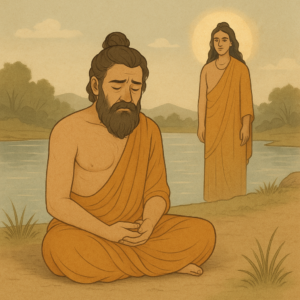
But Priyavrata’s consciousness was already fully surrendered. Through uninterrupted samadhi, he had offered all his senses, actions, and very being at the lotus feet of Lord Vasudev. Though he deeply respected his father’s command and knew it could not be disregarded, his heart hesitated. Within himself, he reflected:
“If I accept royal power, will I not become entangled in the illusions of wife, children, and worldly duties? Will the burdens of kingdom and family not cloud my true self and cause me to forget the ultimate spiritual truth I have realized?”
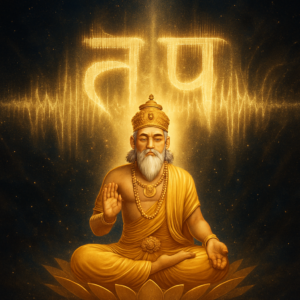
Priyavrata stood at a crossroads.
On one side—his longing for deep meditation and spiritual absorption.
On the other—his father, Swayambhuva Manu’s command to rule the kingdom.
How many times have we felt the same?
- Career vs Peace
- Family vs Self-growth
- Success vs Inner Silence
When Divine Wisdom Intervenes
Swayambhuva Manu—the first among mankind—and Lord Brahma are ever engaged in contemplating the expansion and order of this vast material creation. Lord Brahma, being the knower of all hearts, perceived the deep spirit of detachment arising within Priyavrata. Moved by this, he descended from his celestial abode, accompanied by the personified forms of the Four Vedas and great sages like Marichi.
As Lord Brahma arrived upon his divine swan carrier, both Swayambhuva Manu and Priyavrata immediately rose in reverence, recognizing, “Our revered father, Lord Brahma, has come.” With folded hands and hearts filled with devotion, they offered their respects. Then, the primordial creator, Lord Brahma, casting a compassionate and grace-filled glance upon Priyavrata, began to speak…
No one—not even the greatest beings—can escape the will of the Divine. We are all instruments in His cosmic plan.
He explained:
- Life is not about rejecting duties
- It is about performing them with awareness
- Even a householder can be spiritually liberated
A Powerful Truth for Modern Life
Further Lord Brahma spoke with profound compassion and authority:
“One must never cultivate a fault-finding vision toward Shri Hari. Understand this clearly—neither I, nor Lord Mahadev, nor your father Swayambhuva Manu, nor even your revered guru, Maharshi Narad, can act independently of His divine will. We all move in surrender to His command. His will cannot be overcome by intellect, austerity, yoga, personal effort, or even the support of others. Every living being must accept the body granted by the Supreme and, through it, experience action, birth, death, joy, and sorrow.
Just as an animal tied by a rope carries the burden placed upon it, we too are bound by the subtle cords of the Supreme—through the Vedic laws, the three gunas of nature, and the consequences of our actions. In alignment with His will, we continue to perform our duties, and through those very duties, we worship Him. Whatever situation, form, or life we are placed into is not accidental—it is a divine arrangement shaped by our nature and past karma. And so, just as a blind person must follow one who can see, we must learn to walk in trust of His guidance.
Even a liberated soul continues to live within the body, experiencing the unfolding of past karmas (prarabdha), just as one may recall a dream even after waking. Yet, such a soul remains untouched—free from ego and unaffected by worldly impressions that bind one to rebirth. But one who remains enslaved by the senses continues to live in fear—fear of loss, fear of death, fear of becoming. For unless the mind and senses are mastered, the six inner enemies never loosen their grip.
Tell me then, what harm can worldly life truly cause to one who has conquered himself and delights in the Self? In fact, for one who seeks to overcome these inner enemies, the householder’s life itself can become a training ground. Just as a king, protected within a fortified castle, can defeat even the mightiest foes, a wise person can, while living amidst responsibilities, discipline the senses and gain mastery over them. And once these inner forces weaken, he may then move forward freely, guided by wisdom.
You, O Priyavrata, have already taken refuge in the lotus-like feet of the Lord, the source of all creation. You have conquered these enemies within. Therefore, accept your duties, experience the world as ordained by Him, and in time, naturally rise above it—remaining ever established in your true spiritual nature.”
The King Who Became the Sun
Shri Shukdev Ji Maharaj narrates that when the revered teacher of the three worlds, Lord Brahma, had spoken in this way, then Priyavrata, filled with humility and deep respect, gently bowed his head and accepted the command, saying, “As you wish.”
Swayambhuva Manu, overjoyed by his son’s obedience and grace, performed the proper worship of Lord Brahma with great devotion. Soon after, Lord Brahma departed for his celestial abode. With his heartfelt purpose fulfilled by Brahma Ji’s divine intervention, Manu entrusted the responsibility of protecting and ruling the entire earth to Priyavrata. Having completed his duty, he himself withdrew from worldly life, recognizing it as a deep and deceptive lake filled with the intoxicating waters of sense pleasures.
Thus, by the will of the Supreme Lord, Maharaja Priyavrata accepted the throne. In due course, he married Barhishmati, the daughter of Prajapati Vishvakarma, and from this union were born ten exceptionally powerful and virtuous sons, along with a daughter named Urjasvati. Among his sons, three—Kavi, Mahavir, and Savan—were spiritually inclined from childhood. Rooted in self-realization, they chose the path of renunciation and became lifelong celibates, dedicating themselves entirely to the pursuit of truth. From another wife, Priyavrata had a son named Uttama, Tamas and Raivat who later became the ruler of a Manvantara bearing their name.
In this way, even as some of his sons walked the path of renunciation, King Priyavrata himself ruled the earth for an astonishing span of time. His power and valor were such that the mere sound of his bowstring would strike fear into the hearts of those who opposed dharma, causing them to disappear as if swallowed by the unknown.
Gradually, surrounded by royal comforts and the loving companionship of his wife Barhishmati—whose gentle smiles, graceful glances, and charming nature could captivate any heart—Priyavrata appeared, from the outside, to become absorbed in worldly pleasures, like one who has lost discrimination. Yet inwardly, he remained unattached, untouched at the core of his being.
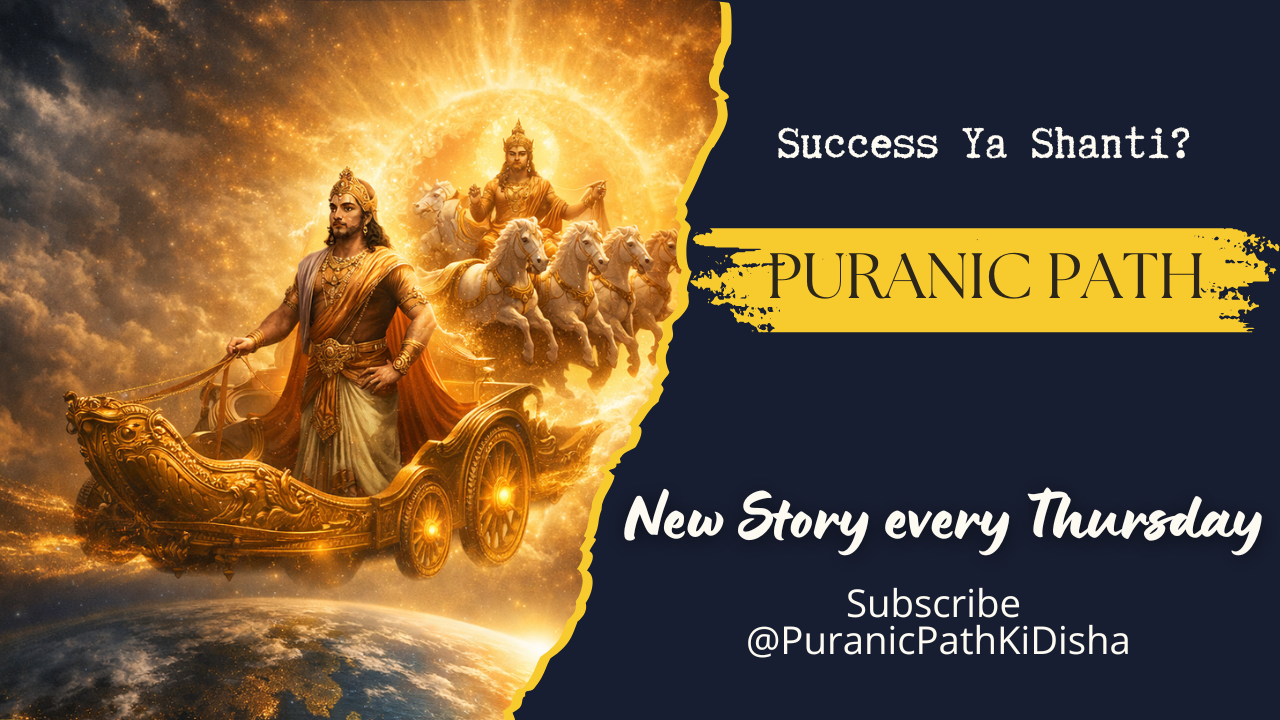
Once, observing that as the Sun-god circled Mount Sumeru, only half the earth was illuminated while the other half remained in darkness, Priyavrata felt this imbalance deeply. A powerful resolve arose within him: “Why should darkness exist at all? I shall turn night into day.”
Mounted upon a radiant chariot as swift as the Sun itself, he followed its path like a second sun, circling the earth seven times. By the immense spiritual power born of his devotion, the marks of his chariot wheels transformed into the Seven Seas, thereby dividing the earth into the Seven Dweeps.
The seven Dweeps — Jambu, Plaksha, Shalmali, Kusha, Krauncha, Shaka, and Pushkar—were arranged in a magnificent cosmic order, each one expanding to twice the size of the one before it.
At the very center lay Jambu Dweep, encircled by an ocean of saltwater. Beyond it spread Plaksha Dweep, embraced by an ocean of sweet sugarcane juice. Further outward was Shalmali Dweep, surrounded by an ocean of divine wine (madira), followed by Kusha Dweep, encircled by a vast ocean of clarified butter (ghee). Beyond that lay Krauncha Dweep, bordered by an ocean of pure milk, and then Shaka Dweep, surrounded by an ocean of curd (buttermilk). Finally, at the outermost expanse stood Pushkar Dweep, enveloped by an ocean of sweet, pure water—completing this extraordinary and symbolic cosmic arrangement.
He then entrusted each of these regions to his worthy sons, establishing order and harmony across the world. His daughter Urjasvati was married to Shukracharya, and from their lineage was born the renowned Devayani.
And yet, despite possessing such extraordinary power, glory, and achievements, a moment of deep introspection arose within him.
A silent pain awakened in his heart.
He thought:
“Alas! Even after taking shelter at the feet of the great sage Narad, how have I again fallen into the web of worldly illusion? These restless senses have dragged me into the dark well of ignorance. Enough… this is not my true path.”
By the grace of Lord Shri Hari, his inner wisdom—Vivek—awakened once again.
In that moment of clarity, Priyavrata made a decisive choice.
He divided the entire earth among his sons, relinquished his kingdom, abandoned even the royal pleasures and the companionship he once cherished—as effortlessly as one discards something lifeless—and turned inward once more.
With a heart filled with renunciation and a mind absorbed in the divine pastimes of the Lord, he returned to the sacred path shown by Narada Ji.
Such was the greatness of Maharaja Priyavrata—
That even the highest pleasures of heaven, the depths of the netherworld, and the glories of earthly life—all gained through karma and yoga—appeared insignificant to him, no better than hell, when compared to the bliss of devotion to the Supreme.
Spiritual Lessons for Modern Life
1. You Don’t Need to Escape Life to Find Truth
Spirituality is not about running away—it’s about rising within.
2. Duty Can Be Divine
When done with surrender, even worldly responsibilities become a path to liberation.
3. Awareness is Everything
You can have everything… and still remain unattached.
4. True Success is Inner Freedom
Not power. Not wealth. Not recognition.
But freedom from within.
5. It’s Never Too Late to Return
Even if you feel lost…
One moment of awareness can bring you back.
Closing Reflection: Your Inner Priyavrata
Despite his greatness, Priyavrata lived amidst royal luxuries.
Beautiful palaces.
A loving wife.
Pleasures of life.
Outwardly, it seemed like he was immersed in worldly enjoyment.
But inwardly? He remained untouched. Yet… even for a realized soul, awareness must be maintained.
Gradually, a subtle realization dawned upon him:
“Have I slipped back into illusion?”
One day, with intense introspection, he cried out within:
“Enough! These senses have dragged me into the blind well of worldly pleasures. Shame on me!”
This was not guilt. This was awakening.
The grace of Shri Hari stirred his inner wisdom (Vivek).
Without hesitation…
He walked away.
- From his kingdom
- From his wealth
- Even from his beloved queen
As easily as one discards something lifeless.
Why?
Because once you taste the Divine…Everything else loses its grip.
He chose meditation over monarchy. Silence over sovereignty. Truth over temporary pleasures.
This story is not about a king. It is about us.
👉 We may be a professional, a parent, a student
👉 We may be surrounded by responsibilities
But the question is:
Where is your inner anchoring?
Every human life goes through three phases:
- Aspiration (seeking truth)
- Involvement (getting lost in life)
- Awakening (returning to truth)
Priyavrata lived all three. And so will we.
The question is…
👉 Will we remain lost in the illusion?
👉 Or will we awaken, surrender, and return?