Have you ever wondered why, despite doing everything right, life still seems to fall apart?
Why families break even after years of “good intentions”?
Why rituals, positions, achievements, and moral superiority sometimes fail to bring peace—while a single moment of humility transforms everything?
In today’s world, we often see ego disguised as authority, pride masked as righteousness, and rituals performed without empathy—in boardrooms, homes, institutions, and even spiritual spaces. We cancel people, shame them publicly, defend our “rightness,” and forget the human heart standing in front of us.
Thousands of years ago, this very human problem unfolded on a cosmic scale.
The story of Daksha Yajna is not merely about gods, fire, and destruction—it is about what happens when ego refuses to bow, when love is insulted in the name of rules, and when power forgets compassion. It is about how anger explodes when dignity is crushed, yet how grace still finds a way to rebuild what ego burns.
This story answers the questions we silently ask today:
- Why does anger erupt when patience runs out?
- Why do relationships collapse even when intentions seem “right”?
- And most importantly—how does surrender heal what ego destroys?
As you read ahead, you may not just witness the destruction of a sacrifice…
You may recognize the patterns of your own life—
and discover the ancient solution hidden within divine compassion.
When Ego Burned… and Grace Rebuilt the Cosmos
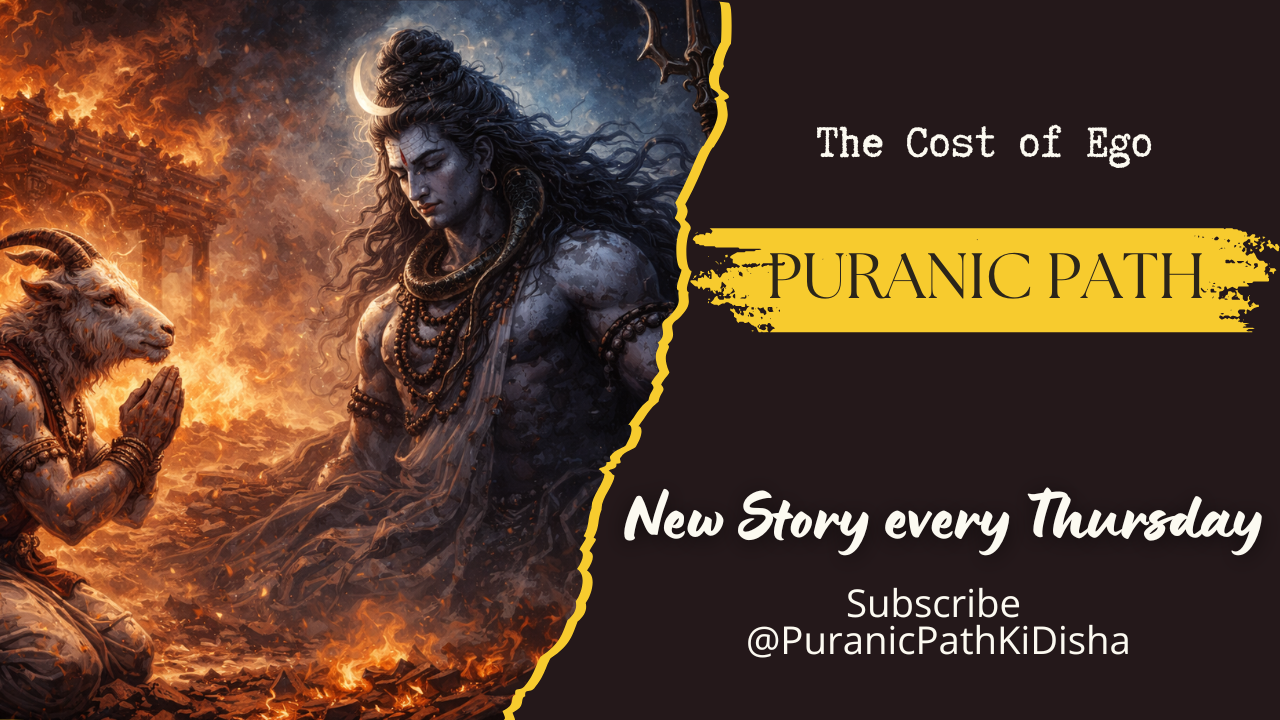
Sage Maitreya continued, “O Vidur ji, when Lord Shiva learned that Devi Sati, unable to bear the insult hurled at her beloved by her own father Daksha, had abandoned her body—and that the sages born from the sacrificial fire had driven away His attendants—something ancient and terrible stirred within Him.
This was not just the anger. This was the cosmic grief of Love insulted… of Dharma violated… of Truth mocked in the name of ritual.
Mahadev, the stillest among yogis, became the fiercest among forces.
His lips trembled. His teeth bit down in restrained fury. His eyes blazed—not with hatred, but with the fire of justice long suppressed. And then, in a single movement that shook existence itself, He tore a blazing lock of His matted hair—radiant like lightning, blazing like fire—and flung it upon the earth with a thunderous, echoing laugh.
From that divine act arose Veerabhadra.
A being so vast his body touched the heavens. A thousand arms carried the weight of cosmic retribution. His complexion was dark like a rain-filled cloud heavy with destiny. Three eyes blazed like suns of destruction. His matted hair burned red like molten fire. Around his neck hung a garland of skulls—symbols not of cruelty, but of the impermanence of ego. In his hands were weapons meant not merely to destroy bodies—but to shatter arrogance.
Veerabhadra folded his hands and bowed.
“Prabhu, what is my command?”
Mahadev, Lord of Ghosts and Yogis, spoke—not in hatred, but in truth:
“You are My very expansion. Go. Lead My attendants. Destroy Daksha’s sacrifice—so the world may remember that Dharma without humility is hollow.”
The March of Reckoning
With a roar that split the directions, Veerabhadra charged toward Daksha’s sacrificial arena, wielding a trident capable of piercing even Death. Behind him followed the fierce attendants of Rudra—beings beyond human fear, beyond social order, beyond illusion. As they ran, the anklets at Veerabhadra’s feet rang jhan-jhan, as if Time itself was approaching.
In Daksha’s Yajna hall, a strange dread settled.
A cloud of dust rose from the north.
The priests whispered anxiously:
“There is no storm… no bandits… the king still rules… the cows have not returned… then why does this dust rise? Is Pralaya upon us?”
Daksha’s wife Prasuti, trembling, spoke what no one else dared:
“This is the fruit of Daksha’s sin. Who insults his own innocent daughter before the world? Who mocks Shiva and expects peace?” She remembered the cosmic form of Mahadev during dissolution—when His laughter shatters directions, when stars scatter like dust, when even the guardians of the worlds tremble. “Who,” she asked in despair, “has ever prospered by provoking Shankar?”
The assembly seated in Prajapati Daksh’s sacrificial arena looked at one another in stunned silence, their faces drained of color and their eyes trembling with fear. Confused whispers rose from every side as anxious minds searched for meaning—when suddenly, as if the very fabric of existence had been disturbed, countless dreadful omens erupted across both earth and sky. The winds howled unnaturally, the atmosphere grew heavy and suffocating, and signs of impending calamity appeared in all directions, sending a wave of terror through every heart present in the Yajna hall.
The Collapse of Hollow Ritual
Suddenly—
Omens exploded across sky and earth.
Veerabhadra and Rudra’s attendants stormed the sacrificial arena.
Some of them violently shattered the towering pillars and wooden beams that upheld the sacrificial hall, causing the very structure of the Yajna to tremble. Others rushed toward the western side and demolished the Patnishala, the quarters meant for the wives, while another group stormed the northern side, tearing down the Sabha Mandap, where learned assemblies once echoed with ritual chants, and the Agni Grahshala, the sacred hall of fire itself. A few attendants ransacked the host’s private quarters and the kitchen, reducing them to ruins. Sacrificial vessels were smashed to pieces, sacred fires were mercilessly extinguished, and the ritual materials were scattered and destroyed, as the consecrated boundaries and sacred threads of the altar were torn apart. Amid this overwhelming chaos, some of the attendants seized the gods who were desperately attempting to flee, leaving no corner of the sacrificial arena untouched by devastation. This was not chaos—it was truth exposing pretence.
Maniman swiftly bound Sage Bhrigu, Veerabhadra seized Prajapati Daksh himself, Chandesh captured Pusha, and Nandeshwar overpowered and restrained the deity Bhag. Witnessing the terrifying onslaught of Lord Shankar’s attendants—armed, roaring, and hurling stones from all directions—the priests, members of the assembly, and even the gods were seized with panic and fled wherever their feet could carry them, abandoning all order and dignity.
At that moment, Bhrigu Rishi, still clutching the sacrificial ladle (sruva) in his hand, was confronted by Veerabhadra. Remembering how Bhrigu had mockingly laughed and ridiculed Lord Mahadev in the assembly of the Prajapatis, Veerabhadra, burning with righteous fury, tore out Bhrigu’s beard and mustache, stripping him of the pride with which he had scorned the Lord.
Likewise, Veerabhadra hurled the deity Bhag violently to the ground and gouged out his eyes, for when Daksh had been showering insults upon Lord Mahadev, Bhag had silently encouraged him with a suggestive and approving glance. In the same spirit of divine retribution, Veerabhadra struck Pusha, knocking out his teeth—just as Lord Balarama had once knocked out the teeth of the King of Kalinga during Aniruddha’s marriage—because Pusha had laughed openly, baring his teeth, while Daksh abused Mahadev.
Then Veerabhadra mounted Daksh’s chest and attempted to sever his head with a sharp sword. Yet, despite repeated and forceful blows, he found himself unable to cut through Daksh’s neck, for no weapon could pierce his skin. Struck with astonishment, Veerabhadra paused, reflecting deeply upon this mystery. Suddenly recalling how sacrificial animals were slaughtered in the Yajna itself, he resolved to treat Daksh—the host of the sacrifice—in the very same manner. Following that ritual method, he severed Daksh’s head from his body.
At this sight, the ghosts (bhūtas), spirits (pretas), and ghouls (piśāchas) erupted in thunderous praise, crying out “Bravo! Bravo!” while cries of terror, anguish, and despair rose from Daksh’s supporters on all sides. Still blazing with fury, Veerabhadra hurled Daksh’s severed head into the Dakshinagni, the southern sacrificial fire. After setting the sacrificial hall ablaze and utterly destroying the Yajna, he withdrew from that devastated arena and returned to Mount Kailash, having fulfilled the command of Lord Mahadev.
Fear, Repentance, and the Journey to Grace
Sage Maitreya continued, “O Vidur ji, in this way, when the attendants of Rudra had completely overpowered the gods, and when the limbs and bodies of the gods, priests, and participants were mangled, shattered, and pierced by the tridents, swords, maces, axes, and hammers wielded by the ghosts and spirits, a deep terror seized them all. Overwhelmed by fear and despair, the gods—along with the priests and members of the sacrifice—fled and made their way to Lord Brahma. Reaching him, they fell flat like rods upon the ground, offered their obeisances, and narrated in detail the entire sequence of events that had unfolded at Daksha’s sacrifice.
Lord Brahma and the all-knowing Lord Narayan were already aware of this impending calamity; it was for this very reason that neither of them had attended Daksha’s Yajna. Now, after patiently hearing the account from the mouths of the terrified gods, Brahma ji addressed them gravely and said:
‘O gods, even when a supremely powerful and glorious personality commits a fault, it never brings any good to those mortals who respond by offending him in return. Moreover, you yourselves have committed a grave transgression by denying Lord Shankar His rightful share of the sacrifice. Still, Lord Shankar is Ashutosh—easily pleased. Therefore, with pure hearts, go and fall at His feet, appease Him, and beg His forgiveness.
His heart had already been pierced by the arrow-like insults hurled by Daksha, and upon that wound was added the unbearable pain of separation from His beloved Sati. If you truly wish for this sacrifice to be revived and properly completed, then go at once and seek His pardon for your offenses. Otherwise, if He remains enraged, it will be impossible for all these worlds—along with their guardians, the Lokpalas—to survive.
Lord Rudra is supremely independent. Neither any sage, seer, nor god, nor even the presiding deity of sacrifice, Indra, nor I myself, can fully comprehend the truth of His essence or the extent of His power. That being so, who else could possibly speak of it? And in such a situation, who besides Him could ever be capable of pacifying Him?’
Having spoken thus, Brahma ji gathered the gods, the Prajapatis, and the ancestors (Pitrus) and departed from his own realm, setting out for Mount Kailash, the chief of mountains and the supreme abode of Lord Shankar.
On their journey, they arrived outside a city named Alaka. Flowing beside that city were the sacred rivers Nanda and Alaknanda, which had become exceedingly holy due to their contact with the dust of the lotus feet of Lord Shri Hari (Vishnu). Leaving behind Alkapuri, the resplendent capital of Kuber, the king of the Yakshas, the assembly of gods proceeded further.
In that divine region, they saw a Banyan tree extended across seventy-five yojanas, a realm into which the miseries of the material world could not enter, where there was no trace of violence, sorrow, or suffering. There, beneath a tree, the gods beheld Lord Shankar seated. He appeared like Time (Kaal) personified, yet He was entirely free from anger. The body of Bhootnath, the Lord of Ghosts, radiated profound peace and stillness. He was being reverently served by perfected sages (Siddhas) such as Sanandan and others, as well as by Kuber, the lord of the Yakshas and Rakshasas.
Lord Mahadev, the Master of the Universe and the eternal well-wisher of all beings, shone like the rising sun—bestowing compassion and laboring solely for the welfare of the world. It is only for the good of all creation that He engages in spiritual disciplines such as worship, concentration of the mind, and deep Samadhi. His body glowed with the soft radiance of a sunset-hued cloud. He wore His matted locks (jata) and the deerskin cherished by ascetics, while the crescent moon adorned His forehead. Seated upon a throne and surrounded by many saintly listeners, He was expounding upon the eternal truth of Brahman, responding to the questions posed by Narad Ji.
His left foot rested upon His right thigh, and His left hand lay gently upon His left knee. With a string of Rudraksha beads adorning His wrist, He sat in Tark Mudra, the gesture of divine reasoning and instruction. Established firmly on the path of Yoga, He experienced the bliss of Brahmananda, His mind perfectly one-pointed and absorbed.
Seeing Him thus, all the sages along with the guardians of the worlds (Lokpalas) folded their hands and prostrated before Lord Shankar, the foremost among all meditators. Although the lords of gods and demons eternally worship the lotus feet of Mahadev, when Lord Brahma arrived at His abode, Lord Shiva immediately rose from His seat. Just as the worshipful Lord Vishnu, in His Vamana incarnation, once offered salutations to Kashyap Ji, in the same manner Lord Shiva bowed His head before Brahma. Following His example, the great seers and the perfected beings (Siddhas) seated around Lord Shankar also rose and offered their respectful obeisances to Brahma ji.
The Prayer That Melted the Cosmos
After everyone had duly completed their salutations, Brahma ji, with a gentle smile, addressed the moon-crested Lord Shiva, who was still standing in a posture of deep reverence. Brahma ji then spoke in a voice filled with devotion and profound understanding:
“O Lord, I know and realize that You alone are the Master of the entire universe, for You are that unchanging Supreme Brahman, who exists beyond both the womb of creation—the creative power known as Prakriti—and its seed, the conscious principle called Purush.
O Lord, by Your own divine will, You engage in the creation, preservation, and dissolution of this world as a sacred play, manifesting through Your aspects of Shiva and Shakti. For the protection of the Vedas, which bestow both Dharma (righteousness) and Artha (prosperity), You appointed Daksha and established the sacred system of sacrifice (Yajna). The regulations of the Varna and Ashram systems are ordained by You alone, and devoted Brahmins follow them with great faith. You reward the performers of virtuous acts with heavenly realms or even Liberation (Moksha), and You consign those who commit sinful deeds to fearful hellish conditions.
Yet, O Lord, how is it that for some individuals the results of these actions appear to manifest in an opposite manner? Those noble souls who surrender themselves fully at Your lotus feet, who perceive Your presence within all living beings, and who behold every creature as residing within the Self—such elevated persons, unlike animals, are never overcome by anger or hatred.
There are others, however, who are bound by a sense of duality and become attached merely to external, ritualistic actions. Their intentions are impure; their hearts burn with envy at the advancement of others, and they wound the hearts of fellow beings with ignorant, harsh, and piercing words. For a great and compassionate soul such as You, it is not befitting to destroy even such people, for those unfortunate beings are already afflicted and driven by Fate (Vidhata) itself.
O Lord, even if at some time or place a person develops a sense of duality due to being deluded by the powerful Maya of the lotus-navelled Lord Vishnu, saintly persons, by virtue of their compassion, extend only mercy towards them. Whatever occurs, they do not attempt to obstruct events through violence or force.
O Lord, You are omniscient. The defect-laden Maya of the Supreme Personality of Godhead cannot touch or bewilder Your intellect in any way. Therefore, even when those whose minds are confused by this Maya and who are attached to the path of karma commit offenses, You should still bestow Your mercy upon them, for You alone are the root and source of all beings.
You are the very one who completes and sanctifies all sacrifices, and You possess the full and unquestionable right to receive a share of every Yajna. Yet the foolish participants in Daksha’s sacrifice denied You Your rightful portion. For this reason alone, the sacrifice was destroyed by You. Now, O Lord, please be gracious and restore it. Kindly arrange that Daksha may regain his life, that Bhag Devta may recover his eyesight, that Bhrigu ji’s beard and mustache may grow back, and that Pusha’s teeth may return as they were before. May the limbs of the gods and priests, which were wounded by the shower of weapons and stones hurled by Rudra’s followers, be healed by Your divine grace. Whatever remains after the completion of the sacrifice may be accepted entirely as Your share, and may this destroyed Yajna be completed today with Your rightful portion.”
When Brahma ji offered this prayer, Bhagwan Shankar smiled with satisfaction and spoke gently:
“Listen, Brahma ji. I neither dwell upon nor remember the offenses committed by ignorant persons like Daksha, who are deluded by the Maya of the Supreme Lord. I administered only a slight punishment to caution them and set them upon the right path. Since Prajapati Daksha’s head has been burned, let the head of a goat be attached to his body. Let Bhag Devta behold his share of the sacrifice through the eyes of Mitra. Let Pusha, who once ate flour, now partake of his sacrificial share using the teeth of the host (yajman). The limbs of all the other gods shall become healthy once again, for they have now designated the remnants of the sacrifice as My rightful share.
Among the priests, those whose arms were broken shall function with the arms of the Ashwini Kumars, and those whose hands were destroyed shall work with the hands of Pusha. As for Bhrigu Rishi, let him grow a beard and mustache like that of a goat.”
Sage Maitreya continued, “O Vidur ji, upon hearing these compassionate words of Lord Shankar, everyone present was filled with immense joy and began to cry out repeatedly, ‘Blessed is He! Blessed is He!’ Thereafter, all the gods and sages humbly requested Mahadev to accompany them to Daksha’s sacrificial arena, and the Lord proceeded there along with them and Lord Brahma.”
Ego Dissolves… Devotion Awakens
In complete accordance with the instructions given by Lord Shankar, the gods and sages carefully joined the head of the sacrificial animal—the goat—to Daksha’s lifeless torso. The very moment the head was properly affixed and Lord Rudra cast His compassionate glance upon him, Daksha regained consciousness instantly. Rising as though awakening from deep sleep, he opened his eyes and beheld Lord Shiva standing before him.
By the mere sight of the Lord, Daksha’s heart—once darkened and polluted by malice and envy towards Shankar—was instantly purified, becoming as clear and serene as a lake in the autumn season. He longed to offer prayers at Mahadev’s lotus feet, but as the memory of his beloved daughter Sati, who had abandoned her body, surged within him, his eyes overflowed with tears born of affection, remorse, and unbearable longing. His throat choked, his voice failed him, and not a single word could escape his lips. At last, the highly intelligent Prajapati, steadying his emotions with great effort, restrained his tears and, with a heart cleansed by repentance and devotion, began to pray to Lord Shiva.
Daksha said, “O Lord, I committed a grievous offense against You, yet by correcting me through punishment, You have in fact bestowed upon me the greatest favor. You do not even neglect those Brahmins who are Brahmins in name alone—how, then, could You ever abandon those like us who are engaged in sacrificial duties? I failed to understand Your true and transcendental nature, and thus I pierced You with the cruel arrows of my words in the open assembly. Still, You did not hold my offense against me. Because of my transgression against a worshipful and exalted soul such as Yourself, I was destined to fall into the darkest regions of hell, yet You uplifted me by Your merciful glance alone. Even now, I possess no virtue worthy of pleasing You; therefore, please be satisfied with me solely by Your own boundless and generous glory.”
Shri Maitreya ji continued, “O Vidur ji, thus forgiven for his offense by Ashutosh, the easily pleased Lord Shankar, Daksha—acting under the guidance of Brahma ji—once again began the sacrificial rites with the assistance of the teachers and priests. In order to properly complete the sacrifice and to purify it from the defects caused by the presence and contact of Rudra’s attendants—ghosts and spirits—the Brahmins prepared an oblation of Purodash, the sacred sacrificial cake meant for Lord Vishnu, and offered it in three vessels.
O Vidur, as Daksha, standing beside the Adhvaryu priest who held the sacrificial ladle, meditated upon Lord Hari with a completely pure and focused mind, the Supreme Lord Himself manifested there. He arrived borne upon Garuda, carried by the sacred vibrations of the Brihat and Rathantara hymns. As Garuda drew near, the Lord’s divine brilliance spread across all ten directions, eclipsing the radiance of all the gods with the effulgence of His own limbs. In His presence, the luster of everyone else faded entirely.
The Lord appeared with a dark, enchanting complexion (Shyam varna). His waist was adorned with a radiant golden belt, and He wore exquisite yellow silk garments (Pitambar). Upon His head rested a crown dazzling like the sun itself. His lotus-like face was framed by dark, shimmering curls resembling swarms of black bees, and His beauty was further enhanced by His glowing earrings (kundals). He possessed eight powerful arms, all ornamented with golden jewelry, eternally poised for the protection of His devotees.
In those eight arms He held the conch (Shankh), lotus (Padma), discus (Chakra), arrow, bow, mace (Gada), sword (Khadag), and shield (Dhal). Thus adorned with divine weapons, He resembled a fully blossomed oleander (Kaner) tree. Upon His chest shone the sacred Shrivatsa mark, and He was beautified by a magnificent Vanmala, the garland of forest flowers. With His gentle smile and playful, compassionate glances, He filled the entire universe with bliss.
On either side, attendants waved white fans and chavars as pure as royal swans, while above His head shone a white umbrella, radiant and immaculate like the moon. Witnessing this divine vision, Indra, Brahma along with all the other lords of the gods, the Gandharvas, and the great Sages, immediately rose from their seats and fell prostrate before Him. Overwhelmed by His splendor, their own brilliance vanished, their tongues faltered, and struck with awe, they stood silently before the Lord with folded hands.
Although even the intellects of Brahma and the other gods cannot grasp the full extent of the Lord’s glory, Shri Hari, who had manifested this divine form solely out of compassion for His devotees, graciously listened as they offered prayers according to their respective capacities. While the assembly thus glorified the Lord, Daksha, the highly intelligent protector of sacrifices, once again resumed the Yajna that had been destroyed by Veerabhadra, the attendant of Rudra.
Although Shri Hari is the supreme enjoyer of all sacrificial offerings, He was especially pleased by the Purodash offered to Him on this occasion. Addressing Daksha, the Lord spoke:
“I am the supreme cause of the entire universe, and I alone exist as Brahma and Mahadev as well. I am the Soul of all beings, the Supreme Controller, the eternal Witness, self-luminous, and free from all material designations.
By accepting My own inscrutable Maya, I create, maintain, and dissolve the universe. According to these cosmic functions, I alone assume the names Brahma, Vishnu, and Shankar. In Me—the non-dual, pure, and Supreme Brahman—the ignorant perceive Brahma, Rudra, and all living beings as separate entities.
Just as a person never considers their own head, hands, or limbs as being separate from themselves, in the same way, My devotee never sees any living being as different from Me. O Brahmin, We—Brahma, Vishnu, and Mahesh—are one in essence, and We alone constitute all living beings. One who perceives no difference between Us attains eternal peace.”
Having thus instructed him, Daksha, the chief of the Prajapatis, worshipped the Lord through the Tri-kapal sacrifice and duly honored all the other gods through both the principal and subsidiary rites of the Yajna. Thereafter, the Lord bestowed upon Daksha—who had already achieved all perfections through his own efforts—the blessing: “May your mind always remain firmly established in Dharma.”
Having received this divine benediction, all the gods departed joyfully for their respective heavenly abodes.
Eternal Return of Love
O Vidur ji, I have heard that Daksha’s daughter Sati, after relinquishing her body in that extraordinary and tragic manner, was born once again from the womb of Maina, the consort of the King of the Himalayas. Just as the supreme creative energy, Shakti, withdraws and dissolves into the Lord at the time of universal dissolution (Pralay), and then, at the dawn of a new creation, again seeks His shelter to manifest the cosmos, in the very same way that divine energy took birth again. In that incarnation, she appeared as the supremely devoted Shri Ambika, Parvati, and true to her eternal nature and unwavering love, she chose none other than her beloved Lord Shankar as her husband, uniting once more with the Lord who is her eternal refuge and counterpart.
Closing Thought — Today’s Relevance
The story of Daksha Yajna does not belong to the past—it unfolds every single day in our lives.
Every time we prioritize being right over being kind, Daksha rises within us.
Every time we perform duties without empathy, rituals without awareness, or authority without humility, the Yajna collapses again.
And every time anger erupts because love was humiliated, Veerabhadra is born within the soul.
Yet this story does not end in destruction—it ends in healing.
Mahadev does not destroy to punish; He destroys to correct.
He does not forgive because offenses were small—but because compassion is vast.
Even after ego beheaded itself, grace restores life.
In today’s world of burnout, broken relationships, identity conflicts, and emotional exhaustion, this story offers a profound solution:
👉 Drop the ego, not the responsibility.
👉 Surrender the pride, not the purpose.
👉 Choose humility over hollow righteousness.
When we bow—even slightly—life responds with healing.
When we accept our mistakes, relationships breathe again.
When surrender replaces stubbornness, peace becomes possible.
This is why such Puranic stories still guide us—they don’t escape reality; they decode it.
They don’t demand belief; they offer clarity.
And perhaps, like Daksha, when we finally look up after our inner collapse,
we too may find Shiva standing there—not in anger, but in grace,
ready to rebuild what ego once burned.
That is the eternal answer this story gives to our modern chaos “When ego refuses to bend, life breaks it; when surrender arises, grace rebuilds everything.”