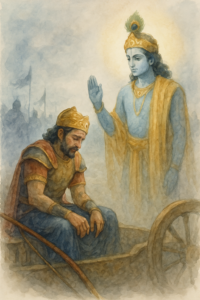
“Just as fire, born of wood, consumes its very source and rises upward in radiance, so too, the purified soul burns the illusions of bondage and ascends toward eternal freedom.”– Bhagavan Kapil to Devahuti
A Question from the Depths of Bondage
With eyes softened by surrender, Devahuti posed a question that echoes through every soul seeking liberation:
“O Lord, if Purusha (the soul) and Prakriti (nature) are eternal and inseparable, like fragrance in earth or taste in water, how can the soul ever be truly free?”
“Even when knowledge removes the fear of bondage, doesn’t this fear return as long as Prakriti’s qualities remain active?”
This was not a philosophical curiosity—it was a heartfelt cry from one who had tasted the bitterness of worldly entrapment and longed to know if true, irreversible freedom was possible.
Kapil Muni’s Response: The Fire that Consumes Its Source
Kapil Muni, the Lord incarnate, answered not with mere theory, but with a roadmap to transformation:
“Just as fire, emerging from the Arani wood, burns even the very wood from which it was born, similarly the soul—through purification and realization—destroys the very ignorance that gave rise to its bondage.”
He described the gradual yet definite path by which the Purusha detaches from Prakriti:
- Selfless action according to Dharma purifies the inner instrument (antahkaran).
- Devotion strengthened by hearing the glories of the Lord turns the heart inward.
- Realization of Truth (Tatva-sākshātkār) brings unwavering clarity.
- Vairagya (detachment) loosens worldly grip.
- Steady meditation and single-pointed concentration (ekāgratā) dissolve identification with the fleeting.
Through this fire of yogic discipline and spiritual perception, the illusion of bondage burns away. The soul, once entangled, now shines in its own radiant essence—untouched, unbound, and unmoved.
The Sage Beyond Dream and Wakefulness
Kapil Bhagwan compares this liberated sage, the Ātmārāma Muni, to one who wakes from a dream:
“As a dream vanishes upon waking, so too does worldly fear vanish in one established in Me. Prakriti can no longer harm the one who has realized My truth.”
The devoted and patient Yogi, by My boundless grace, attains true knowledge and is liberated through Self-realization. Upon the dissolution of the subtle body, having taken complete refuge in Me, he effortlessly reaches his own supremely blissful and eternal nature — a state from which there is no return.
O Mother, if the Yogi remains unattached to the Siddhis born of Maya — which arise only through Yoga — then he attains My imperishable supreme abode, untouched by death and beyond all decay.
The Life of a Seeker: Traits that Purify and Elevate
The Lord then enumerates the characteristics and disciplines of those who walk the path toward liberation. This is the spiritual lifestyle that purifies the mind and makes it a fertile ground for divine realization:
- Follow one’s prescribed Dharma, abandoning forbidden conduct.
- Contentment with one’s destiny and acceptance of Prarabdha Karma.
- Serve the feet of the realized ones, and avoid actions that feed desire.
- Love for disciplines that free one from samsara.
- Eat simple, pure food; reside in seclusion without fear.
- Nonviolence in thought, word, and deed; truthfulness, non-stealing, and non-possessiveness.
- Embrace celibacy, austerity, purity, study of scripture, and worship of the Divine and continuously listening to Bhagwan Leelas.
- Control speech, master posture, and begin the practice of Pranayama.
Kapil Bhagwan outlines the inner progression: first the asana, then pranayama, followed by withdrawal of senses (pratyāhāra), concentration (dhāraṇā), and finally meditation (dhyāna).
Each step removes internal impurities:
- Vāta and Pitta through breath regulation,
- Sin through dhāraṇā,
- Attachments through pratyāhāra,
- And rāga-dveṣa (likes and dislikes) through meditation.
Just as gold, when purified by fire, sheds its impurities, so too does the mind of the Yogi—who has subdued the vital air—become pure and radiant in a short time.
Meditation on the Divine Form of Lord Narayana
Through disciplined practices such as vows, charity, and other forms of austerity, one must gradually master the vital life forces (Pranas). With steady intellect, the restless and unruly mind should be gently directed toward the Supreme Being and engaged in deep meditation upon Him.
With poetic beauty, Kapil Bhagwan guides the seeker into divine meditation:
“Fix your mind on the Lord’s lotus-like face, blooming with joy. His eyes, reddish as lotus petals, radiate compassion. His dark blue body, like a raincloud, glows with a golden silk garment and the Kaustubha gem. Around His neck hangs a fragrant garland alive with buzzing bees. Let this image consume your thoughts.”
Whether standing, walking, reclining, or dwelling in the heart—meditate on Narayana. Eventually, narrow your attention to one limb, especially the lotus feet, glowing with auspicious signs, from which flows the holy Ganga. In this focused absorption, the mind forgets all else and melts in loving devotion.
As the heart overflows with divine emotion, tears flow and worldly concerns vanish.
The Final State: Beyond the Ego, Beyond the Mind
Through intense practice and divine grace, the mind becomes free from the illusion of “I” and “mine.” The Jiva rises above body, mind, senses, and even the idea of being a meditator. The Supreme Truth alone remains.
In this Brahma-rūpa, the soul sees sorrow and joy not as personal, but as illusions born of ego. A realized soul, firmly established in the bliss of the Self, no longer identifies with the movements or actions of the body, which continues only due to the momentum of past karma (Prarabdha). For such a Siddha Purusha, the body and worldly relationships appear as unreal as a dream, and all notions of ‘I’ and ‘mine’ fall away. By deep reflection, just as one distinguishes oneself from external possessions, the wise discern the Witnessing Self as distinct from the body, senses, and mind. Even the Jiva is ultimately different from Brahman, and Brahman from the Supreme Purushottama, who governs all.
Seeing all beings as Atma, just as fire appears differently in different vessels, the liberated one recognizes oneness amidst diversity. By conquering Maya through devotion and truth, the soul becomes established in its original, blissful nature—beyond bondage, beyond return.
Closing Reflections
In today’s chaotic world, Kapil Muni’s ancient teachings shine with startling relevance.
We are surrounded by distractions, attachments, and the illusion of control. But the path to freedom has not changed. It still lies in purification, devotion, detachment, meditation, and above all, grace.
We may not yet be sages in caves or masters of pranayama, but we can start where we are:
- Do your duty without clinging.
- Eat simply. Speak truthfully. Seek quiet moments.
- Meditate on the Divine, however you understand Him.
- Most of all, know that the bondage you feel is not final.
Like fire that burns its own source, the divine fire within you can consume even the deepest illusion.
And in that final stillness, you will remember: You were always free.