In the vast ocean of spiritual wisdom, there are moments when the soul stirs with a truth so profound that it cuts through the fog of illusion. In the second part of the spiritually charged dialogue between Kapil Bhagwan and Devahuti, we witness such a revelation — a cosmic unfolding of creation, layered with philosophical depth and practical insights for all of humanity. This is not just a tale of the origin of the universe but a powerful reminder of our true nature and the path to awakening through surrender.
The Question That Unlocks the Cosmos
With a heart yearning for liberation, Devahuti turns to her divine son, Kapil Bhagwan — the very incarnation of Supreme Wisdom. Her voice trembles with humility but is steady in its longing:
“O Purushottama, tell me about that Prakriti and Purusha — the primal nature and the cosmic soul — whose gross and subtle forms are both the cause and effect of this universe. How do they create, and how are they sustained?”
Her question is not intellectual curiosity. It is the cry of a soul desiring freedom — the thirst of a seeker who knows that knowledge alone can cut the chain of bondage.
Kapil Bhagwan, smiling with compassion, begins to pour nectar into her heart.
The Eternal Principles: Prakriti, Purusha, and the 25 Elements
“The root principle,” he begins, “is called Pradhana. It is unmanifest, composed of the three Gunas — Sattva (purity), Rajas (activity), and Tamas (inertia). Though formless and neutral, it gives rise to all specific forms and attributes. This is Prakriti.”
From this primal nature, 24 fundamental elements arise:
- The internal instruments: Buddhi (Intellect), Ahankara (Ego), and Manas (Mind)
- The five Mahabhutas: Earth, Water, Fire, Air, Ether
- The five subtle elements (Tanmatras): Smell, Taste, Form, Touch, Sound
- The ten senses: five of action (Karmendriyas) and five of perception (Gyananendriyas)
The learned consider this collection of these twenty-four principles to be the effect of Prakriti. The intellect is characterized by resolve (Sankalpa), determination (Nischaya), deliberation (Chinta), and ego (Abhiman). In this way, the knowers of principles have enumerated these twenty-four principles of Saguna Brahman.
To these, Kapil adds the twenty-fifth: Time (Kala). Some sages consider Time to be a direct manifestation of the Supreme Purusha, the Supersoul (Parmatma) — the will of the Divine that sets the wheel of creation in motion and also winds it back into dissolution (Maya), which is the source of all beings who have attained the unseen destiny, from that, the effulgent Mahat-Tattva was produced.
The Descent of Consciousness: From the Supreme to the Subtle
Kapil bahgwan explains: The Mahat-Tattva, the primordial principle and seed of the universe, is inherently free from distractions and all imperfections. Serene and self-luminous, it manifests the cosmos within itself by dispelling the profound darkness of dissolution (Pralaya) with the brilliance of its own effulgence. This supreme principle, predominated by the Sattva quality, is pure and tranquil, making it the very field in which Bhagavan is realized. Owing to these divine attributes, it is also known as Vasudeva.
In its essential nature, this Mahat-Tattva is characterized by purity, changelessness, and inner stillness. Its transformations, or vrittis, reflect the various expressions of consciousness. Thus, what is commonly referred to as Chitta—the inner field of awareness, in essence, this same Mahat-Tattva when viewed through the lens of its modifications. It is within this sacred and unblemished expanse of consciousness that the light of the Divine is most vividly perceived.
From Mahat arises Ahankara, the sense of “I am.” This Ego, influenced by the three Gunas, divides into:
- Vaikarika (Sattvic) — giving rise to Mind and the Devas
- Taijasa (Rajasic) — producing the senses
- Tamasa (Tamasic) — manifesting the five gross elements through their corresponding subtle elements
The enlightened sages recognize Ahankāra—the cosmic ego—as the direct manifestation of Ananta Deva, also known as Sankarshan, who is symbolically described as possessing a thousand heads. This ego, which assumes the form of the elements, senses, and mind, expresses itself in threefold ways: as the deities representing doership, as the instrumental principles (Kāraṇa Tattva) embodied in the senses through Indra and other Devatas, and as the effect principles (Kārya Tattva) manifested in the five great elements. When this ego associates with the gunas—Sattva, Rajas, and Tamas—it takes on qualities such as peacefulness, form, and motion, reflecting the diversity of creation.
Among the three divisions of Ahankāra—Vaikārika (Sattvic), Taijasa (Rajasic), and Tāmasa—the Vaikārika ego undergoes transformation and gives rise to the mind (Manas), the faculty responsible for thought (Sankalpa) and indecision (Vikalpa), from which all desires originate. This divine mind is known as Aniruddha, the inner controller.
From further transformation arises the principle of Intellect (Buddhi), known as Pradyumna, which is endowed with the power of clear perception. It discerns the nature of objects, facilitates sensory functioning, and grants the capacity for precise knowledge. The intellect also gives rise to various cognitive states such as doubt, misapprehension, certainty, memory, and even deep sleep—all manifestations of its refined awareness.
The senses, both of knowledge (Gyānendriyas) and action (Karmendriyas), are themselves offshoots of Ahankāra, distinguished by their respective domains of cognition and activity. Thus, from this one principle—ego—arise the manifold faculties through which the living being engages with the world, experiences reality, and ultimately, through proper realization, transcends it.
1. From Tamasic Ahankāra:
- Shabda Tanmātra (subtle element of sound) was produced.
- From Shabda Tanmātra:
- Ākāśa (Ether/Space) was produced.
- Shrotrendriya (sense of hearing) was produced.
2. From Ākāśa:
- By movement of Kāla (Time), Sparsha Tanmātra (subtle element of touch) was produced.
- From Sparsha Tanmātra:
- Vāyu (Air) was produced.
- Tvak Indriya (sense of touch / skin) was produced.
3. From Vāyu:
- Motivated by divine life-force, Rūpa Tanmātra (subtle element of form) was produced.
- From Rūpa Tanmātra:
- Tejas (Fire/Light) was produced.
- Netra Indriya (sense of sight / eyes) was produced.
4. From Tejas:
- Rasa Tanmātra (subtle element of taste) was produced.
- From Rasa Tanmātra:
- Jala (Water) was produced.
- Rasana Indriya (sense of taste / tongue) was produced.
5. From Jala:
- Gandha Tanmātra (subtle element of smell) was produced.
- From Gandha Tanmātra:
- Pṛithvī (Earth) was produced.
- Ghrāṇa Indriya (sense of smell / nose) was produced.
Elemental Qualities and Corresponding Senses:
| Gross Element | Unique Quality | Tanmātra | Corresponding Sense (Indriya) |
| Ākāśa (Ether) | Shabda (Sound) | Shabda Tanmātra | Shrotrendriya (Hearing) |
| Vāyu (Air) | Sparsha (Touch) | Sparsha Tanmātra | Tvak Indriya (Touch/Skin) |
| Tejas (Fire) | Rūpa (Form/Sight) | Rūpa Tanmātra | Netra Indriya (Sight/Eyes) |
| Jala (Water) | Rasa (Taste) | Rasa Tanmātra | Rasana Indriya (Taste/Tongue) |
| Pṛithvī (Earth) | Gandha (Smell) | Gandha Tanmātra | Ghrāṇa Indriya (Smell/Nose) |
The Emergence of the Cosmic Being and the Manifestation of the Universe
Among the five great elements (Mahābhūtas), Earth (Pṛithvī) uniquely possesses all five qualities—sound (śabda), touch (sparśa), form (rūpa), taste (rasa), and smell (gandha)—making it the most complete manifestation of material reality.
In the beginning, the seven primary principles—Mahat-tattva (cosmic intelligence), Ahaṅkāra (ego), and the five great elements (pañchabhūtas)—remained distinct and uncombined. At this juncture, Śrī Nārāyaṇa, the Supreme Cause of all creation, entered these elements along with Kāla (time), Adṛiśya (the unseen or destiny), and the guṇas—Sattva, Rajas, and Tamas. Stirred by the presence of the Paramātmā (Supreme Soul), these principles began to interact and merge. From their union emerged an inanimate cosmic egg (aṇḍa).
From this egg arose the Virāṭ Puruṣa, the Cosmic Being—the manifested form of the universe. This egg is known as “Viśeṣa” (the Particular) and contains within it the entire expanse of the fourteen realms, each a manifestation of Śrī Hari. The egg is enveloped layer upon layer—each ten times thicker than the previous—by Water, Fire, Air, Ether, Ego, Mahat-tattva, and finally Prakṛiti (Primordial Nature) as the outermost sheath.
Once manifested, the Virāṭ Puruṣa re-entered the cosmic egg, resting in the Kāraṇa Salila (Causal Waters), and from within began to shape the universe by creating various apertures and centers of function.
- First, the Mouth appeared, from which arose Agni (Fire), the presiding deity of Speech (Vāk).
- Then the nostrils (Ghrāṇa) manifested, producing the olfactory sense (Ghrāṇendriya) and Prāṇa, the vital breath. From this, Vāyu (Air), the deity of smell, was born.
- Next, the eyes (Netra) formed, from which came the sense of sight (Chakṣur Indriya), followed by Sūrya (the Sun), the deity of vision.
- The ears (Śrotra) emerged next, giving rise to the sense of hearing and its deities, the Dik-pālas (guardians of the directions).
- The skin manifested, along with hair and beard, followed by the Aushadhis (medicinal herbs and plants), deities of touch.
- The Guda appeared, producing the Apāna Vāyu (downward-moving air) and its deity, Mṛityu (Death), who instills fear.
- The hands manifested, from which arose strength (Bala) and its presiding deity, Indra, lord of action.
- The feet appeared, from which emerged movement (Gati) and its deity, Lord Viṣṇu, the protector of all paths.
- As the Nāḍīs (channels, veins, and arteries) formed, they filled with Rudhira (blood), animating the Cosmic Form.
- The abdomen (Udara) then appeared, manifesting hunger and thirst (Kṣudhā and Pipāsā), with Samudra (the Ocean) as its presiding deity.
- The heart manifested next, with Candrama (the Moon) as its deity, symbolizing the mind (Manas).
- From the heart arose Buddhi (intellect), whose presiding deity is Brahmā, the creator.
- Then came Ahaṅkāra (ego), and with it Rudra, the deity of dissolution.
- Finally, Chitta (consciousness) emerged, with Kṣetrajña, the individual soul or the knower of the field, as its presiding force.
The Deities Enter the Virāṭ Puruṣa
Even after all the presiding deities had manifested—except the Kṣetrajña (the indwelling soul)—the Virāṭ Puruṣa remained unmoved, unawakened. In their effort to rouse Him, each deity entered their respective seat within the cosmic body:
- Agni, along with Vāk (speech), entered the mouth—yet the Virāṭ did not stir.
- Vāyu, with the senses of knowledge (Jñānendriyas), entered the sensory system—but still, the Virāṭ remained inert.
- Sūrya, along with vision (Chakṣu), entered the eyes—yet the Puruṣa did not rise.
- The Dikpālas (guardians of directions) entered their respective domains—but no movement came.
- The herbs (Auṣadhis) entered the skin, along with the pores and hair (roma)—yet the Virāṭ Puruṣa stayed still.
- Mṛtyu (Death) entered the anus (Guda), accompanied by Apāna, the downward-moving vital air—yet there was no awakening.
- Indra, with strength (Bala), entered the hands—but still, the Virāṭ did not rise.
- Viṣhṇu, accompanied by motion (Gati), entered the feet—yet the Puruṣa remained motionless.
- The rivers entered the veins and arteries (Nāḍīs), carrying with them blood (Rudhira)—yet He remained unawakened.
- The ocean, along with hunger and thirst (Kṣudhā and Pipāsā), entered the abdomen (Udara)—but still, there was no sign of life.
- The Moon (Candrama) entered the mind (Manas) with his soothing presence—but even then, the Virāṭ Puruṣa did not rise.
- Brahmā, along with intellect (Buddhi), entered the heart (Hṛdaya)—yet the Cosmic Being did not awaken.
- Rudra, entering the same heart with ego (Ahaṅkāra), also failed to stir the Puruṣa.
Despite all the divine forces having taken their seats within Him, the Virāṭ Puruṣa remained unawakened, for the essential presence—the Kṣetrajña, the conscious indwelling Self—had not yet entered.
The Supreme Revelation: The Entry of Kshetrajna
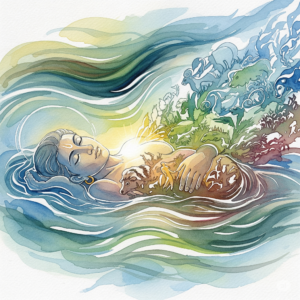
Then comes the Kshetrajna — the indwelling Self, the conscious witness, the knower of the field. The moment He enters the heart along with Chitta (conscious awareness), the Virat Purusha rises and stands!
Just as a sleeping body cannot awaken by mere stimuli of breath, thought, or sense — it needs the spark of consciousness — similarly, all parts of creation remain inert without the Self.
This is the greatest truth:
Consciousness is not a byproduct of matter. It is the cause.
The Misidentification and the Cause of Bondage
Kapil Bhagwan now speaks with grave clarity:
“O Mother, just as the reflection of the sun appears in water but is untouched by the water’s waves or impurities, so too the Self appears in the body but remains untainted.”
Yet, the Jiva, deluded by Ahankara, identifies with the body and its attributes. Thinking “I am the doer,” it accumulates karma — both virtuous and sinful — and is reborn again and again, caught in the wheel of Samsara.
This identification leads to pride, attachment, suffering, and loss of inner peace.
Even in dreams, without real threats, the mind can conjure suffering due to its attachments. Similarly, the soul suffers in the waking world not because of reality, but because of its identification with what it is not.
The Path to Self-Realization through Bhakti
The wise teach that the mind (Chitta), bound to sense objects, must be steadily restrained through Bhakti Yoga, Vairagya (detachment), and focused yogic discipline. One should cultivate unwavering faith, love for the Lord, hear His glories, live without hatred or attachment, remain celibate, and abandon all other duties.
Such a seeker accepts what comes by destiny, eats moderately, lives in solitude, is peaceful, kind, patient, and content. Having realized the truth of Prakriti and Purusha, he no longer identifies with the body or relations, transcends all mental states, and perceives only the Supreme Self (Paramatma).
Just as the sun’s reflection in water points to the real sun in the sky, the ego (Ahankar)—reflected in body, senses, and mind—reveals the presence of the Self, the light of consciousness. Through this reflection, one attains direct realization of the Brahman, the cause of all, beyond all limitations, yet present within all.
In cosmic dissolution (Laya) and deep sleep (Sushupti), the ego dissolves into unmanifest Prakriti, and the Self, though present, is not perceived. Deluded, one feels lost—just as a man feels destroyed when his wealth vanishes.
But the discerning soul (Viveki Purush), reflecting on this, realizes the Atman—the eternal witness, beyond ego, beyond all.
Closing Thought: The Relevance Today
Today, we build identities from careers, relationships, possessions, and opinions. We seek happiness in outer complexity, forgetting the simple presence of the Self within. The more we define ourselves by roles, the more we are caught in the play of ego.
But this story reveals the truth:
Without the Kshetrajna — the inner witness — nothing rises, nothing lives.
Awakening comes not from doing more but from realizing:
“I am not the doer. I am the witness.”
Let the senses perform their duties. Let the intellect guide the way. But let the Self remain free — silent, steady, shining.
This wisdom, taught millennia ago, remains as urgent today as ever. In the chaos of modern life, when the soul feels fragmented and lost, this story whispers:
“Return to the Self. Remember who you are. The Divine in you is waiting to awaken.”