(An Elaborate, Spiritually Rich Retelling of Kapil Bhagwan’s Teachings to Devahuti — Part 1 of 6)
Have you ever paused in the middle of your hectic day—notifications buzzing, deadlines looming, relationships tugging at your energy—and whispered to yourself: “Is this all there is?”
Have you ever felt that despite having everything, something deep inside still longs for clarity, stillness, and meaning?
If so, you’re not alone. In fact, thousands of years ago, a queen and mother—Devahuti—stood at the same spiritual crossroads. Overwhelmed by the exhaustion of worldly pleasures and emotional burnout, she turned to the one source who could guide her home: her own divine son, Kapil Bhagwan.
This isn’t just a story—it’s a mirror to our times.
In an age of instant gratification, anxiety epidemics, and identity confusion, what if the answers to our modern chaos lie hidden in an ancient conversation?
Welcome to the timeless wisdom of Sankhya Shastra—a crystal-clear science of the Self, explained by none other than Kapil Bhagwan, the incarnation of divine knowledge Himself. This is not just philosophy—this is soul-level transformation.
In this coming six stories, we’ll journey through the sacred dialogue between Devahuti and Kapil Bhagwan, in the form of heartfelt questions and soul-awakening answers. Together, they explore:
- How the mind can either imprison us or set us free
- What it means to truly detach in a world full of distractions
- Why devotion is even greater than liberation
- And how to reclaim peace in the middle of everyday chaos
So if you’re tired of chasing happiness and ready to discover unchanging joy, this ancient mother-son dialogue may be exactly what your soul has been waiting for.
The Divine Seat of Realization
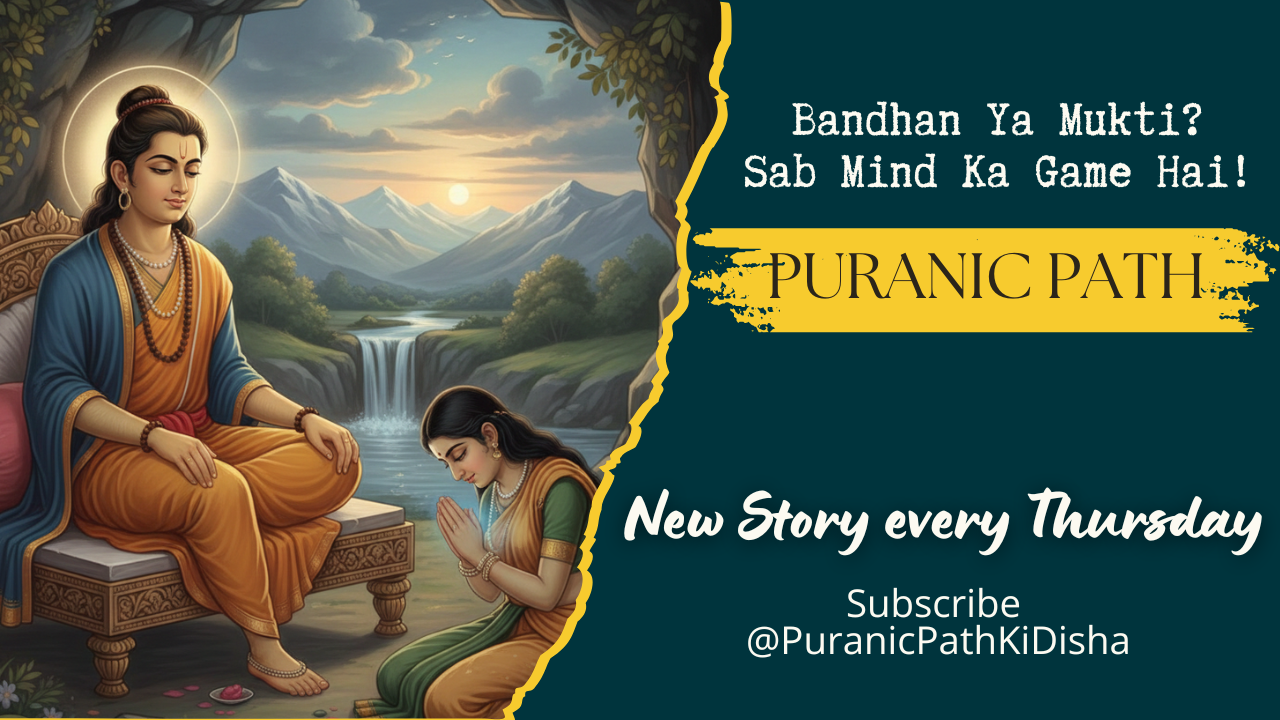
Once, in the sacred stillness of divine serenity, Kapil Bhagwan—the pristine embodiment of eternal principles and detached wisdom—sat in deep, unwavering silence upon His sacred seat. Untouched by the motions of creation, He radiated a peace that echoed the timeless truths of the cosmos.
It was then that Devahuti, mother of Kapil Bhagwan, overwhelmed by lifetimes of sensory indulgence and inner restlessness, approached Him. She recalled the words of Brahma Ji and bowed in surrender before her own son—the Divine Guru incarnate.
With eyes lowered yet spirit yearning for light, she spoke:
“O Lord, I am worn and weary from the relentless desires of these deceitful senses. In chasing their momentary pleasures, I have slipped into a dark abyss of ignorance. Yet today, by Your boundless grace, the cycle of my birth feels near its end. You have come to me like the eyes of Truth, ready to lead me across this stormy ocean of darkness. Even this deep-rooted sense of ‘mine’ that clings to my being—I now see that it too arises from You. I seek to understand Prakriti and Purusha, and for that, I surrender completely to You, who are the eternal refuge of seekers. You, who is the knower of Bhagavat Dharma, to You I bow.”
A Mother’s Longing and the Beginning of Liberation
Maitreya Rishi, narrating this moment to Vidura, said with great reverence:
“The desire in Mother Devahuti’s heart was pure, sacred, and rooted in the thirst for liberation. It was the kind of yearning that awakens devotion not just in oneself, but in the hearts of others who hear it.”
Seeing this sublime surrender, Kapil Bhagwan—whose heart is the final destination of realized souls—smiled gently. His smile was not just affection, but an eternal blessing. He said:
“O Mother, know this firmly: the path of Adhyatma Yoga—spiritual discipline rooted in inner awareness—is the supreme path to the welfare of all living beings. This path leads to freedom from all dualities—of pleasure and pain, of sorrow and joy. I shall explain it to you again, just as I spoke it in ancient times.”
The Mind: Key to Bondage or Liberation
“The mind alone, Mother, is both the cause of bondage and the door to liberation. When it is entangled in worldly cravings, it binds the soul to the chains of karma. But when it is devoted to the Supreme Self, it becomes the ladder to transcendence.
When the mind is purified, when it is no longer touched by the impurities of desire or aversion, it goes beyond both suffering and delight. It finds peace beyond emotion, beyond duality.”
Kapil Bhagwan’s voice was steady like a river flowing toward the ocean of truth.
Seeing the Self, Beyond Prakriti
“The soul—when blessed with knowledge, detachment, and devotion—recognizes the Self as distinct from Prakriti. The Self is subtle, indivisible, self-effulgent, and beyond sorrow or joy. When this is seen, and Prakriti is experienced as powerless, the seeker becomes free.
O Mother, know this: for yogis seeking union with God, there is no path greater than devotion to Shri Hari, the indwelling soul of all.”
Kapil Bhagwan’s words now poured like nectar, healing and uplifting.
Attachment and Detachment: The Turning Point
“Attachment to worldly things binds the soul,” He continued, “but that same attachment, when directed to saints and great beings, becomes the doorway to liberation.
Those who are peaceful, compassionate, non-violent, simple, without hatred, and who love Me alone, renouncing even family ties for My sake—those who listen to My stories, chant My names, and constantly think of Me—such souls are not shaken by the world’s miseries.
Devotion developed through remembering My divine pastimes and detachment from sense pleasures leads one to true mental mastery. This is the essence of Yoga.”
Devhuti’s Humble Question
Listening with tears of gratitude in her eyes, Devahuti spoke again:
“O Lord, what kind of devotion is suitable for someone like me, with limited understanding? How can I, a woman struggling to comprehend such deep truths, attain Nirvana by Your grace? Please explain it simply, so that even a humble seeker may follow.”
Rishi Maitreya turned to Vidura and said, “Seeing the sincerity of His mother—who gave Him birth—Kapil Bhagwan began to unfold the sacred teachings of Sankhya, revealing the principles of reality, and at the same time expanding upon Bhakti and Yoga.”
Devotion Superior to Liberation
Kapil Bhagwan continued:
“O Mother, the natural tendency of the senses, both the working senses (Karmendriyas) engaged in Vedic activities and the cognitive senses (Gyanendriyas) apprehending objects —when fixed solely on Me, Shri Hari, who is the embodiment of Sattva—is in itself supreme devotion. This kind of devotion is even higher than liberation, for it burns away the subtle body—the unseen storehouse of bondage.
Those blessed souls who lovingly serve My feet, act only for My pleasure, and rejoice in the company of other devotees, see My divine forms—gentle, beautiful, compassionate, with lotus-like eyes and a smile that enchants the heart. Great yogis yearn for these forms but may never behold them.”
Kapil Bhagwan paused. His divine presence filled the air.
The Peaceful Abode Beyond Time
“Such pure devotees,” He continued, “never desire even the divine grandeur of Vaikuntha. Yet, upon reaching there, they are gifted with all the enjoyments of that sacred realm. They are beyond the reach of time. My eternal wheel of time cannot touch them.
I am the Supreme Being, the Lord of Prakriti and Purusha. Without taking shelter in Me, no one can escape death or fear. Even the sun, wind, rain, and fire act out of fear of Me. Death itself obeys Me.
True peace comes when the seeker, endowed with knowledge and detachment, surrenders completely at My fearless lotus feet.”
The Root of Ignorance and the Path to Realization
“Now, Mother, I shall reveal the subtle truths of the Tattvas—of Prakriti, the elements, and beyond. By understanding these, a soul becomes free from material qualities.
The Self—the Purusha—is beginningless, beyond attributes, beyond Prakriti. It illuminates everything from within. Yet, for the sake of divine play, the Self embraces Vaishnavi Maya, adorned with the three gunas.
Deluded by Maya’s covering power, the Self forgets its true nature. It begins to identify with the body, with action, and with the ego. Thus, it suffers, though in reality it is free.
The ego—this ‘I’ and ‘mine’—creates the illusion of doership. But in truth, the Self is a witness, beyond joy and sorrow. By turning inward and recognizing this truth, the knot of ego is cut, and the soul is liberated.”
Closing Reflection: A Message for Our Times
In today’s fast-paced world, Devahuti’s journey feels deeply relevant. Surrounded by desires, overwhelmed by the senses, and buried beneath material obligations, modern humans are not unlike her—yearning for peace, but unsure where to find it.
Kapil Bhagwan’s divine Updesh is not just an ancient teaching; it is a living path for anyone seeking true freedom. The mind, once seen as a tyrant, becomes a guide when purified. The same world that entraps us can become a temple when seen through the lens of devotion.
His words remind us: peace is not in possessions, power, or escape—it is in surrender, in seeing the Self, and in anchoring our hearts in God.
“True peace begins not by changing the world—but by seeing the Self that is beyond it.”