What if your deepest desires could shape your destiny—and your surrender could awaken the Divine itself?
Imagine a man who meditated for 10,000 years not for wealth, fame, or power—but for a partner aligned with his dharma. Imagine a woman who left a royal palace to serve in a forest hermitage—not out of helplessness, but out of devotion. Their sacred union didn’t just give rise to a family—it gave birth to divine wisdom itself: the Sankhya philosophy, which still echoes in spiritual circles today as a path to freedom from suffering.
As we hustle through deadlines, manage relationships, and silently seek “something more,” this story reveals a powerful truth: our duties, our desires, and even our detours can become divine—when guided by surrender.
Journey with us through ancient rivers, celestial palaces, and silent forests, as we uncover how a sage, a princess, and the Lord Himself wove a story that still holds the keys to balance, purpose, and inner liberation.
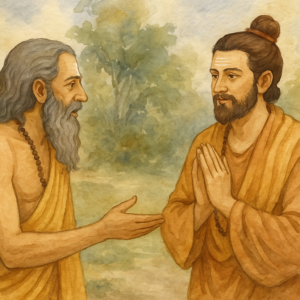
In the serene stillness of time’s earliest dawn, Vidura, with a heart yearning for truth, turned to Rishi Maitreya and asked, “Bhagwan Svayambhu Manu’s lineage is revered across the three worlds. His sons Priyavrata and Uttanapada governed the earth with dharma, and his daughter Devahuti, a woman of great inner strength and spiritual virtue, was married to the yogi Kardama Muni. O wise sage, how many children did that great sage had? What happened in that sacred union?”
In response, Rishi Maitreya smiled gently, as though the memory of the tale itself sanctified his soul. He began to recount the story that wasn’t merely history—but a deep spiritual revelation, echoing across the ages for all seekers of truth.
The Tapasya of Kardama Muni
On the tranquil banks of the divine Saraswati river, Kardama Muni, born from Brahmaji, undertook severe Tapasya for ten thousand years. In solitude and self-restraint, his meditation ripened with the flame of desire—not for material gain—but for a companion, a wife who would walk the path of dharma alongside him, because marriage was the command to him by his father.
His heart, filled with devotion, called out to the Supreme Lord:
“O Lord, You are beyond all action, yet You orchestrate the cosmos. I bow to Your lotus feet. I seek only a wife of pure nature, that we may together fulfill the duties of household life.”
Pleased by the Muni’s unwavering focus and surrender, Bhagwan Vishnu appeared—not in a mere vision, but as Shabda Brahma, the divine sound manifest in form. Hovering above in resplendent glory, the Lord addressed Kardama:
“O sage, the fruits of your Tapasya are already manifested. Manu, the emperor of Earth, has a daughter named Devahuti. She is noble, virtuous, and devoted. She shall be your wife. From her, nine daughters will be born—each destined to be the mother of great sages. Later, I Myself will enter her womb to reveal the Sankhya Shastra, freeing souls from bondage.”
With divine assurance, the Lord vanished, leaving Kardama in blissful gratitude, his heart echoing with purpose.
The Divine Union of Devahuti and Kardama
On the very day foretold by Lord Vishnu, Emperor Svayambhu Manu, accompanied by Queen Shatarupa and Devahuti, arrived at the Bindusara lake. The sage Kardama, radiant from tapasya and touched by divine grace, sat in calm dignity.
The emperor offered his daughter with folded hands:
“O sage, this daughter of mine has chosen you as her husband after hearing of your character and devotion. Please accept her as your equal companion.”
Kardama, humbled by the emperor’s sincerity, agreed—with a vow:
“I shall remain a householder only until children are born. Thereafter, I will return to the path of renunciation as per the Lord’s instruction.”
Devahuti, hearing his soft yet steady voice, felt her heart melt with reverence and love. Thus, the marriage was solemnized, uniting two souls—one born of royal legacy, the other of spiritual flame.
After the ceremony, King Manu and Shatarupa departed tearfully, entrusting their daughter to the sage. Devahuti, now in the hermitage, began a life of heartfelt service. Like Parvati served Shiva, she served Kardama with unwavering faith—through cold nights, fasting days, and silence-filled mornings. Her joy lay in his joy. Her fulfillment was his peace.
The Path of Pativrata: Service That Blossomed Into Grace
Days turned into years. Observing her thin frame and pale face, Kardama’s heart overflowed with compassion. He said:
“O noble one, your devotion has purified even my yogic powers. Through your selfless service, you have earned the fruits of my tapasya. Today, I grant you divine vision.”
With yogic mastery, Kardama created a celestial flying palace—a Vimana more radiant than Indra’s abode, adorned with silks, gems, and fragrances of paradise.
Yet Devahuti, having tasted the nectar of simplicity, remained unmoved. Kardama, seeing her inner state, gently urged:
“O beloved, bathe in this sacred lake. It is not just water—it is the tear of the Lord, fallen out of compassion for His devotee.”
As she bathed in the Bindusara lake, Devahuti found herself transformed. Maidens, born of divine will, adorned her in brilliant garments and jewels. Emerging from the water, she was no longer the frail ascetic—but a radiant empress of spiritual beauty.
Together, they traveled through the realms—Mount Meru’s valleys, Gandharva gardens, and the celestial heights. In this joy, he knew Devahuti’s desires, particularly her wish for children. Remembering Bhagwan’s command, the sage fulfilled his vow by splitting himself into nine forms. From this, nine divine daughters were born, each a spark of creation, destined to become the mothers of sages.
The Awakening of Devahuti
But as promised, the time for Kardama’s renunciation drew near.
Seeing his preparations, Devahuti, now a mother, held back her tears. With a trembling smile, she said:
“You have fulfilled all you promised. Yet, someone must guide our daughters and console my heart. My time with you was beautiful, but I fear I have wasted it, caught in worldly affection, forgetting the deeper purpose. I now understand that even the highest pleasures are illusions if they veil the Divine.”
Her words, soaked in surrender, moved Kardama deeply. He recalled the promise of the Lord and replied:
“Fear not, O pure-hearted one. The Supreme Himself will be born through you—as to impart the wisdom of Sankhya. Serve Him with devotion. Let Him be your path to liberation.”
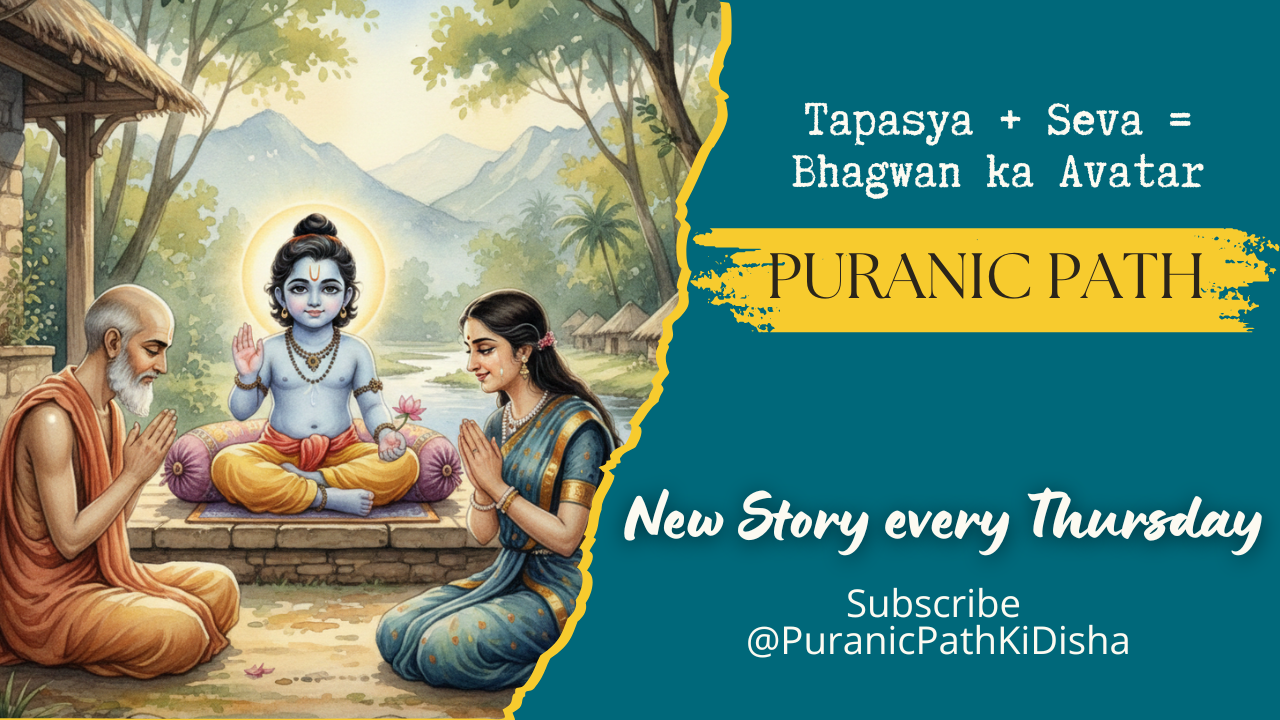
Soon, with signs of divine grace filling the skies, Kapil Muni was born. Gandharvas sang, Apsaras danced, rain fell in blossoms, and joy echoed through creation.
Kapil Muni: The Dawn of Sankhya Wisdom
As the child shone with golden hue and lotus eyes, Brahmaji himself descended to honor the birth. He told Kardama and Devahuti:
“This child is the Supreme Lord Himself. He will sever the bonds of delusion with the sword of Sankhya. Raise Him, worship Him, and your lineage shall be immortal.”
Kardama, seeing the purpose fulfilled, gave his daughters in marriage to the great Rishis as instructed by Brahmaji—Kala to Marichi, Anasuya to Atri, Shraddha to Angira, Havirbhu to Pulastya, Gati to Pulaha, Kriya to Kratu, Khyati to Bhrigu, Arundhati to Vashishtha, and the daughter named Shanti to Rishi Atharva. He accorded great hospitality to the Rishis along with their wives and with Kardama ji’s permission, all of them departed for their respective hermitages.
Kardama’s Surrender and the Lord’s Divine Assurance
In the quiet sanctity of his heart, Kardama Muni beheld a divine miracle—before him stood none other than Shri Hari Himself, the Lord of all gods, incarnated in their humble abode. Overwhelmed, he approached the Lord in solitude, bowed with reverence, and poured out his soul with tearful gratitude.
“O Lord,” he said, “the gods may favor those who suffer in this sorrow-laden world, but only after long ages of tapasya. Yet You—whose radiant form yogis strive to behold across countless lifetimes of deep meditation—have come to us unasked, out of boundless compassion. Engrossed as we are in worldly illusions, still You chose to grace our home. Truly, You uplift the dignity of Your devotees and fulfill Your divine promises with unwavering love.”
With deep devotion, he praised the Lord’s transcendental form, the very source of creation and its dissolution, the knower of all hearts. Then, his voice steady with renunciation, he sought the Lord’s blessing to embrace the path of Sannyasa, to renounce all worldly ties and live immersed in the contemplation of the Supreme.
Moved by his devotion, Bhagwan Kapil assured him: “Indeed, I have incarnated to re-establish the lost path of self-knowledge and fulfill My word. Offer all your actions unto Me, and through Me, conquer death itself. Know Me within your heart, and you shall be free from all sorrow.”
With heart at peace and purpose fulfilled, Kardama Muni circumambulated the Lord and joyfully departed to the forest. There, renouncing all possessions, ego, and duality, he wandered the earth in quietude, seeing the Self in all, his heart absorbed in Shri Vasudeva. With devotion unwavering, he reached the supreme state of liberation.
As the father dissolved into the freedom of the forests, Bhagwan Kapil remained by Mother Devahuti’s side at the sacred Bindusara, ready to illuminate her soul with the knowledge that frees one from all bondage. Such is the grace of the Lord—He comes not only to rule the universe but to walk beside those who love Him, guiding them gently toward eternal peace.
Closing Thought
In a world where desires often lead to discontent, we are Kardama—seeking connection, purpose, and truth. And we are also Devahuti—serving, sacrificing, searching the sacred bridge—from aspiration to surrender, from love to liberation.
Devahuti’s journey teaches us that devotion in daily life—through service, love, and responsibility—can lead to the highest spiritual realization. Her surrender, born not from defeat but from wisdom, reminds us that even amidst worldly duties, one can walk the path of divine fulfillment.
Kardama’s story shows that spirituality is not rejection of life but embracing it with purity and purpose. His tapasya, marriage, fatherhood, and eventual renunciation portray a full circle—a dharmic life lived in harmony with divine will.
Spiritual truths are timeless. They are not confined to ashrams or scriptures. They are lived, moment by moment, in our relationships, responsibilities, and realizations. When we surrender ego and align with the Divine, even the ordinary becomes sacred.
“Discipline may begin the journey, but it is surrender that brings the Divine home.”